

•
mess
Merchants'
MECCA
Jewish retailers like the diversity
and the vibrancy of downtown
Birmingham.
JULIE EDGAR STAFF WRITER
ewish merchants now ac-
count for about 25 percent
of the shops and galleries
in Birmingham.
That's as high a number as Lar-
ry Sherman can recall.
He was the third Jewish retail-
er in town when he opened Sher-
man Shoes on Maple Road 37 years
ago. The glamorous windows of the
defunct Himelhoch's and Kay
Baum, women's clothing shops,
characterized and anchored the
street at the time. Before them, in
the 1920s, Levinson's was the
town's retail giant.
In the late '80s, when rents start-
ed coming down and older mer-
chants closed shop, more
independent entrepreneurs were
able to afford to start a business in
the pedestrian-rich city, Mr. Sher-
man said.
That turnover and the natural
evolution of the marketplace —
merchants go where their cus-
tomers are — led to an influx of
Jewish merchants. Today, 35 Jew-
ish retailers and gallery owners op-
erate along the tree-lined city
streets.
Art Schurgin, a board member
of the Birmingham Principal Shop-
ping District, a coalition of down-
town merchants who advertise
together and co-sponsor city events
like Night on the Town, estimated
there are between 125 and 150
stores in town.
"It's a matter of being able to get
into the marketplace. They knew
there was high income here," said
Mr. Sherman, the president of the
Birmingham Principal Shopping
District.
Lauren Steinhardt set up a
clothing shop about two months
ago after finding a low-rent space
j
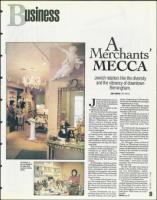
Lori Karbal, in
her Lori Karbal Et
Al, works with
customer Johana
Baylor.
above a bagel shop on Woodward.
At 19, she is probably the youngest
entrepreneur in town.
Her store, Venus Flytrap, caters
to "a more progressive shopper"
who she believes has become more
common in the city.
"I like Birmingham because I
think it's becoming more progres-
sive. I think maybe people thought
Birmingham was stuck up or run
of the mill. People are coming to
shop here expecting more," she
said.
Ms. Steinhardt, the daughter of
chocolatier Gayle Harte, chose to
locate in Shops at the Top, a group-
ing of mainly resale shops, because
the rent is lower and she liked the
mix of minority and women busi-
ness owners up there.
Mr. Schurgin, owner of Horn of
Plenty on Woodward Avenue, a
store that sells specialty household
goods and gift baskets, said he's un-
aware of an increase in Jewish-
owned businesses.
"I haven't been conscious of it.
We here in this community, Jew-
ish merchants — I've been here 20-
some years — have been readily
accepted. We haven't had any con-
flicts," he said.
But Mr. Schurgin has noticed a
surge in the number ofJews mov-
ing into Birmingham, empty-
nesters like himself who crave a
more urban lifestyle. He recently ,cr'
moved from Bloomfield Township
to a downtown condominium.
"My impression is there is an in-
creased amount ofJews living here, co
in Bloomfield Township and in cD
=
Bloomfield Hills. Look, in down-
town Birmingham we now have a <
bagel place. What more can I say?"
he said.
MECCA page 40
39