

To Russia With
ntils ."1'
nne Bonn does not speak Russ-
ian, but she has taken on a per-
sonal and professional mission to
communicate with Russians. Her
language is films.
Since 1989, the former Detroi-
ter, the daughter of Ralph and
Phyllis Bonn of Birmingham, has
selected more than 130 U.S. doc-
umentaries for the St. Petersburg
International Film Festivals, and
this year she took on similar,
though scaled-down, responsi-
bilities for the Third International
Women's Film Festival in Min-
sk.
Ms. Bonn, who earns
her living as an indepen-
dent film editor and pro-
ducer's representative for
European movies, also
has been asked to select
American directors who
can contribute to the
more than 100 short
works commemorating
the 850th birthday of
Moscow in 1997. In be-
tween these commit-
SUZANNE CHESSLER
ments, Ms. Bonn is
SPECIAL TO THE JEWISH NEWS
writing her first full-
length feature film,
Makeup, a story about a
Russian family divided
between New York and Moscow
as relatives experience the inti-
mate effects of vast political
changes.
"In the 1980s, I was very in-
terested in the idea of citizen
diplomacy," said Ms. Bonn, who
now lives in New York with her
husband, Bart Teush, a film pro-
International film
festivals have
taken a former
Detroiter home.
ducer who developed the theater
studies program at Yale Univer-
sity.
"I had a fear of nuclear domi-
nation and accidents after Cher-
nobyl, and I've been committed
to helping our two countries
break down the notion of seeing
one another as enemies.
"There were various events
where Russians and Americans
were talking to each other
through satellite technologies,
and there were a lot of self-mo-
tivated individual citizens initi-
ating exchange projects.
"I happened to meet a few peo-
ple who were involved, and I
went to a Citizens Summit
arranged in Washington by the
Center for Soviet-American Dia-
logue because I heard there were
some very fine film people there."
After the summit, which in-
cluded professionals from sever-
al fields, Ms. Bonn invited
filmmakers to New York and or-
ganized special events for them
— screenings and meetings with
members of the cinema commu-
nity.
Through her activities with
these professionals came an in-
vitation to work with the Russ-
ian film festivals.
In May, three of the movies she
selected for the Minsk festival
won awards — Paul Bowles: The
Complete Outsider, Satya: Prayer
for the Enemy and Mrs. Matisse.
In June, one of the movies se-
lected for St. Petersburg — Pi-
casso Would Have Made a
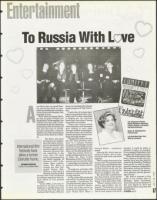
Top: Americans in Russia:
Regina Weinreich, Anne Bonin,
Suzanna Justman, Liza Davitch
and Renee Silverman.
Above: St. Petersburg Film
Festival poster.
Left: Anne Bonin: New York-
Moscow connection.
Glorious Waiter — earned an
award.
Although Ms. Bonn does not
receive a salary, she is reim-
bursed for both work and travel
expenses.
"We're really fortunate to be
living in New York because there
are several annual festivals that
bring in films from all over the
country and the world, and I'm
always keeping an eye out for
films I can suggest," she said.
Ms. Bonn has watched how
the dismantling of the Soviet
Union has changed the film in-
dustry in that part of the world.
"When I started, there were
unions and studios," she ex-
plained. "Filmmakers were not
independent, so a censor would
look at each project and decide
whether it could be made or
whether it had to be changed.
Once accepted, filmmakers were
provided with funding and crews.
"When the studio system broke
down, there no longer was cen-
sorship, but it was very hard for
people to find funding. Problems
were similar to what is experi-
enced by American independent
filmmakers looking for backers.
Recently, however, the govern-
ment agreed to provide percent-
ages of costs."
Ms. Borin's interest in film
dates to her student days at
Michigan State University,
where she earned her bachelor of
fine arts degree in 1974 and
changed her focus away from still
photography.
TO RUSSIA page 91