

4
Get Into The
rocNied•
'
RUTH LITTMANN STAFF WRITER
e're not just talking
about the Flintstones
— although, as a
child, remembering to
pop those colorful pel-
lets of well-disguised vi-
tamin supplements was
tough enough.
For adults on more complicat-
ed regimens of care, forgetting to
take a prescribed medication can
make the difference between life
and death.
Put simply, prescription non-
compliance means straying from
your doctor's orders. In the Unit-
ed States, it's a high-priced prob-
lem, accounting for $25 billion in
needless hospital bills each year,
according to the National Coun-
cil of Patient Information and Ed-
ucation (NCPIE) in Washington,
D.C.
Commonly, patients simply for-
get. Or they take their pills too
late. Or too early. Sometimes, they
swallow too much or too little. It's
easy for oblivious consumers to
down hazardous combinations of
pills and elixirs. When mixed with
certain foods, they're destined to
wreak bodily havoc.
Half of the 1.8 billion pre-
scriptions doctors write each year
are taken improperly, says liter-
ature from NCPIE. Thousands
of needless deaths result. Ac-
cording to the Annals of Internal
Medicine, noncompliance annu-
ally costs the nation $1.5 billion
in foregone wages and some $50
billion in lost productivity.
"It is a major public health
problem and the complications
are far-reaching," says Ray Bull-
man with NCPIE.
Straying from a
doctors Rx costs lives
and billions of dollars
each year. Three local
entrepreneurs have
developed a system
to help patients
stay on track.
k
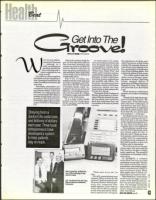
Above: DosePage, by MediTrac,
uses 1990s technology to help
patients comply.
PHOTOS BY BETH B IRSCHING
In recent years, U.S. compa-
nies and medical professionals
have developed ways to combat
noncompliance. Locally, Arbor
and Perry drug stores promote
"Arbor Dose Check Plus" and
"Perry Link" computer systems,
which furnish customers with in-
formation on their medications,
including common applications
and possible side effects. Na-
tionwide, manufacturers have
produced a variety of pill boxes,
measuring utensils and elec-
tronic timers to help patients fol-
low the doe's decree.
Pharmacist Andy Grodman at
Warren Prescriptions in Farm-
ington Hills has noticed that peo-
ple are asking more questions
about their drugs these days, and
he considers it his duty to provide
answers.
Left: The MediTrac trio: Eric Labe,
Richard Davidson and Melanie
Schaengold.
"That's part of our job," he
says.
But still, noncompliance runs
rampant. What accounts for the
epidemic? Medical professionals
list several factors. Patients gen-
erally don't understand their
health regimens. They walk out
of their doctor's office as confused
as they were upon arrival. Some-
times, patients don't recognize
the importance of a drug, espe-
cially if symptoms of their illness
subside. For example, doctors al-
most always warn patients to fin-
ish a prescription of antibiotics,
even if they're feeling better. Few
individuals adhere to this caveat.
"You really need to take the
whole course of therapy, gener-
ally seven to 10 days," says Craig
Cooper, assistant director of
pharmacy at William Beaumont
Hospital in Troy. "The infection
will come back if you don't finish
it up."
Blood pressure medications
present yet another stumbling
block.
"People think high blood pres-
sure is related to tension," Mr.
Cooper says. "If they feel tense,
they take their medication. If
they feel fine, they don't. But re-
ally, hypertension (or high blood
pressure) is a silent disease. Even
if you feel OK, you need to take
your medicine — every day."
Antidepressants throw con-
sumers for a loop because the ef-
fects don't kick in for up to three
weeks. Disillusioned patients of-
ten quit their prescription, then
complain that it was ineffective.
Noncompliance is partly symp-
tomatic of this fast-paced, rush-
hour decade called the '90s. It
slips the mind. People are busy.
Increasingly, adult children are
saddled with the responsibility
of administering medication to
their elderly parents, to their own
children and to themselves.
The burden grows as the pop-
ulation ages. Just wait until the
baby boomers hit their twilight
years, experts say. The myriad of
medications to remember will be
astounding.
In Southfield, a company
called MediTrac aims to make
compliance an easy task. The sys-
tem, which is brand new and un-
precedented, uses wireless pagers
and a computerized modem to
send out airwave alerts. When
their pagers beep or vibrate, pa-
tients know it's medicine time.
With MediTrac, instructions 0->
scroll across the pager's quartz —
screen, which looks like the win- co
c=,
dow of a portable digital alarm Li.,
clock. The message includes the z
date, patient's name, type of med-
ication, dosage, precautions and
other vital details.
•
INTO THE GROOVE page 44
43