
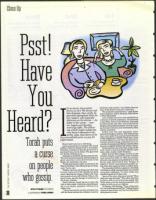

Have
You
Heard.?
Cr)
LLJ
Cr)
w
CC
F-
U.J
CI
1--
30
Torn puts
a curse
on people
who gossip.
RUTH LITTMANN STAFF WRITER
ILLUSTRATIONS BY PAMELA HOBBS
is no secret. Journalists
thrive on dirt. We devour tid-
bits of gossip, then verify, di-
gest and regurgitate them for
our readers, who typically
elaborate on the stories — for
better or for worse — over
lox, bagels and Sunday
morning coffee. The follow-
ing article might violate the
very laws it attempts to de-
scribe. Alas, that seems to be
the unavoidable price we pay for
information.
Rumor had it she was a wild thing.
Lorna (a pseudonym) socialized with Israeli
soldiers when her family lived in Jerusalem.
Somehow, word got out that she got around. It
just wasn't true, Lorna claims. The guys were
her friends. Nothing more.
Attempts to derail the slander came too late.
The cross-continental gossip mill had begun to
grind, and when Lorna arrived back in the
States, her reputation was shot.
"People had already called my friends in the
West to tell them I was taking drugs and preg-
nant," Lorna says.
Neither was true, yet things went from bad
to worse. Lorna, now in her mid-20s, has spent
years repairing her image, riddled with scars
some people say are self-inflicted. Others, who
know Lorna, say the damage is testimony to
the poison of gossip.
Small talk can wreak big havoc when the
topic is other people. Jewish law proscribes gos-
sip or evil speech, generally referred to as
loshen hora.
"Talmud equates the severity of loshen hora
with the three cardinal sins: idolatry, incest (or
adultery) and murder," says Rabbi Shmuel
Irons of the Kollel Institute in Oak Park.
"It's character assassination," adds Rabbi
Aaron Bergman of Beth Abraham Hillel Moses
in West Bloomfield.
Laws of loshen hora have been distilled from
centuries of Jewish experience. Enumerated
in the Bible, Talmud and Midrash, discussed
by Maimonides and other renowned Jewish
thinkers, the guidelines pertain not only to gos-
sip, but also to hearsay and conversations about
anyone, anywhere.
Loshen hora has had mammoth conse-
quences throughout history. The Talmud says
Jews were exiled from ancient Israel because
of their blasphemous babble. Torah puts a curse
on idle talebearers, even when the tale is true.
Overall, Jewish liturgy commands us to re-
member the punishment Miriam received when
she ever-so-slightly belittled her brother, Moses.
God's response was more than a slap on the
wrist. There, in the Sinai desert, Miriam came
down with a week's worth of leprosy.
Rabbi Yisroel Meir Kagan, known as the
Chofetz Chayim, studied the laws of loshen
hora during the 1800s. In 1975, his century-
old work was adapted and published in a well-
known book titled Guard Your Tongue. It
details 31 Torah commandments people vio-
late when they speak or listen to loshen hora.
The clearest prohibition appears in the Book
of Leviticus, which commands that "you should
not go like a talebearer." In other words, man
shouldn't speak ill of other men.
Some of the other references include "Thou
shalt not curse the deaf" This edict, also from
Leviticus, tells us not to denounce people with
God's name, even the hearing-impaired, who
might not pick up on our ridicule.
In Exodus, God dictates: "From a false mat-
ter, you shall keep yourself far." Talking behind
someone's back is bad, very bad, but lying about
that person is worse.