
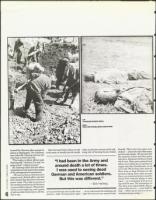

Left:
Townspeople buried the victims.
Above:
Many of Bob Hartwig's photos captured death.
LU
UJ
CC
LLI
C:1
LU
48
Next morning I had a chance to ride miles, we became conscious of the sick-
located Mr. Hartwig after seeing his
to
this scene, to actually view the results ening odor of burning human bodies
photos in Washington. The California
man called Mr. Hartwig and now, the
men hope to meet this year
'That night, (a fellow officer) said,
`Hartwig talk.' I told him 'I'm sick. I'm
going to bed.' I talked anyway."
Mr. Hartwig talked and the officer
transcribed several typewritten pages
of the photographer's experiences.
...We came across an American first
sergeant and a British officer who had
been released that day from a German
prison camp. They told us of some of
Bob Hartwig
the atrocities practiced by the Germans
on some of their prisoners. We took their
stories, as one might say, with a grain
of salt and didn't fully believe all they of mass barbarism and to take some ... As we rode toward the buildings, the
pictures...After driving about eight sight that met our eyes seemed unbe-
had to say...
"I had been in the Army and
around death a lot of times.
I was used to seeing dead
German and American soldiers.
But this was different."
lievable. There were rows upon rows
of dead — dead who had died many
and horrible deaths. We learned that
the majority of them had been given
injections. Injections of what we could
not be sure. Some were poisoned and
others were killed by an injection of
oxygen into their bloodstream, so we
were told. We do know that some of
them were at least 30 hours in the
process of dying. Even when we were
there, an occasional groan could be
heard from someone dying in that
mass — or a movement of an arm or
leg could be seen. The expressions on
their faces were indescribable. The po-
sitions they were in — some half sit-
ting — others up on one arm or in a
twisted grotesque shape. I I