
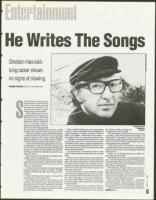

PHOTO BY MAR GERY GRAY H ARNICK
He Writes The Songs
Sheldon Harnick's
long career shows
no signs of slowing.
SUZANNE CHESSLER SPECIAL TO THE JEWISH NEWS
heldon Harnick began his en-
tertainment career with the
violin, achieved his greatest
success with Fiddler on the
Roof and continues to length-
en his string of attractions.
After starting out as an in-
strumentalist in Chicago, Mr.
Harnick moved to New York
to pursue opportunities as a
Broadway lyricist. He kept his
chin up through almost a
decade of uncertain work un-
til he wrote the winning words
for the songs in Fiorello, his first hit, which
brought him a Pulitzer Prize and a Tony Award.
Last year, Fiddler came to the Fisher Theatre
to begin its 30th anniversary tour on the stage
where it debuted. This year, another Sheldon
Harnick classic, She Loves Me, comes to Mead-
ow Brook Theatre after its Broadway revival.
A musical version of the play Parfumerie, lat-
er adapted into the film The Shop Around the
Corner, She Loves Me tells the story of Georg and
Amalia, co-workers who squabble with each oth-
er by day and become anonymous, amorous pen
pals after hours.
The musical, which features melodies by Jer-
ry Bock, runs through May 14.
"Jerry Bock and I were invited to work on She
Loves Me by the producer," Mr. Harnick recalled.
"Both of us knew and loved the movie, and we
said 'yes' immediately.
Among the enduring songs that have emerged
from the musical are "She Loves Me," "Tonight
at Eight," "Will He Like Me?" and "Grand Know-
ing You."
Other Bock-Harnick hit shows include The
Rothschilds and The Apple Tree.
"Jerry Bock and I had a very specific way of
working," Mr. Harnick said. "We would become
acquainted with the source material, in this case
both the Hungarian play and the movie. Then
we would go off to our respective studios to think
about the show and jot down ideas.
"Jerry would sit at the piano and compose pieces
of music, which he thought were appropriate for
certain characters or certain situations. When he
had 10, 12, 15 ideas — there was no set number —
he would put them on a tape and send them to me.
"I'd listen to the tape, and by that time, I had
certain ideas as to how I wanted to get started.
Invariably, there were a couple of numbers on
the tape which coincided with numbers I want-
ed to write so that I could start the process with
music already present.
"At certain times, I needed to be free to write
a lyric without being constrained by the musical
form.
"There was one point in our career together
when I got curious about which came first more
often, the music or the lyrics. I made a list of all
the songs we had written, and I really was sur-
prised to find that ultimately about 50 percent
of the lyrics came first and about 50 percent of
the music came first."
Mr. Harnick's first song in a Broadway show
was "The Boston Beguine" for New Faces of 1952.
He had moved to New York about two years ear-
lier, after majoring in violin at the Northwest-
ern University School of Music, receiving a
bachelor's degree and working with dance bands
in the Midwest.
With his background as a parody writer in
school and during military service, he went on
to contribute songs to musical revues. He met
Sheldon Harnick:
Bridging the
Mr. Bock in 1956, and the two
decades.
introduced Fiorello in 1959.
"The first book musical I did turned out to be
a big flop, and I was terribly discouraged," he
reminisced. "I thought I had my chance and
missed it, but then I got another chance, which
was to do Fiorello. When it succeeded, it gave me
a tremendous sense of relief.
"I felt that since I had written a hit show I
would be hired to do more work. Also, I had been
living hand-to-mouth, and it made my livelihood
more secure."
Fiddler on the Roof premiered in 1964, one
year after She Loves Me.
"We didn't think of it as a particularly Jewish
show," Mr. Harnick commented. "We thought of
it as something that was aiming for the univer-
sal values we had found in the Sholem Aleichem
story arevye's Daughters.'
"Nevertheless, we knew that in many ways it
was a Jewish show. We knew that it was a se-
rious show, and we knew that it was a long show.
With all those things, we-were worried that it
might not be accepted, and we were very nervous
about the show's Detroit premiere."
There were two other concerns — a citywide
newspaper strike, which meant no written re-
views or publicity, and subscription rates limit-
ed to the first 3 1/2 weeks of the five-week run.
"We knew that we could go broke if we didn't
HARNICK page 94
a
85