
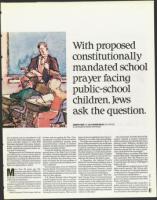

With proposed
constitutionally
mandated school
prayer facing
public-school
hildren, Jews
ask the question.
JENNIFER FINER AND JILL DAVIDSON SKLAR STAFF WRITERS
ILLUSTRATIONS BY MICHAEL MCPARLANE
law students such an amendment "will
not stop the crisis of teen pregnancy, youth
crime, domestic violence or raise SAT
(Scholastic Aptitude Test) scores. Instead,
things may begin to unravel and, perhaps
fatally, weaken the American justice sys-
tem and Constitution."
Religious and civil libertarian groups
are leading the current charge against
school prayer. Two weeks ago, several or-
ganizations, including the American Jew-
ish Committee, released instructional
pamphlets outlining when prayer and re-
ligion are appropriate in school.
ore than 30 years ago, Mr.
Imerman and other children at-
tending public schools continued
the morning prayers until the
Supreme Court banned such rituals in
public-school classrooms.
A series of subsequent Supreme Court
decisions consistently ruled against school
prayer, nullifying many state laws allow-
ing for mandatory prayer or a moment
of silence.
Other Supreme Court cases ruled ac-
tivities such as posting the Ten Com-
mandments in a public school and school-
sanctioned graduation prayers were
unconstitutional. A debate on whether
students can lead a prayer at graduation
remains somewhat unclear.
A moment of silence was seen as a way
around some of the High Court rulings.
Yet, today, it remains somewhat of an open
question because the High Court struck
down an Alabama law providing a mo-
ment of silence for the sole purpose of
prayer. A neutral moment of silence, how-
ever, is allowed.
Governing bodies, from the Oakland
County Board of Commissioners to the
U.S. Congress, have either tried to pass
school-prayer legislation or have put such
items on their agenda.
U.S. House Speaker Newt Gingrich
vowed Congress would vote on a prayer
amendment by July 4. He and the Re-
publicans have since backed away from
that pledge. Senate Majority Leader Bob
Dole said recently that Congress probably
would not have time to address the issue
during the current session. Still, several
One month later, the State Board of Ed-
pieces of prayer legislation have been in-
ucation
adopted a mission statement
troduced in a number of governing bodies.
Two bills were introduced in the U.S. which touched on the school-prayer issue,
House of Representatives: one would start stating in part: "Religion, morality and
the process of amending the Constitution knowledge are necessary to good govern-
to permit "individual or group prayer in ment and the happiness of mankind, so
public schools or other public institutions"; therefore schools and the means of edu-
the other proposes a constitutional amend- cation shall forever be encouraged."
Kathleen Straus, a member of the State
ment to permit voluntary prayer. Congress
tried unsuccessfully to amend the Con- Board of Education, voted against the mis-
sion statement. But, Ms. Straus is not
stitution six times in the last 31 years.
In December, the Oakland County overly concerned about school prayer. She
Board of Commissioners failed to pass a is worried about the future of Michigan's
voluntary-prayer resolution. If the mea- public schools.
"I think prayer in school is lower on the
sure had passed, it would not have had di-
rect impact on students. However, it would state board's agenda," Ms. Straus said.
have sent a pro-prayer message to law- "What concerns me is that the board is
working hard to change public education
makers in Lansing and Washington.
The failed proposal stated: "The Oak- so it's driven by market forces..."
Several pieces of school-prayer legis-
land County Board of Commissioners
strongly believes that reinstitution of vol- lation have been introduced in the state
untary prayer in the public school is one House and Senate.
A handful of Senate bills would allow
step in the restoration of religious choice
guaranteed by the Constitution and will public schools to post or read out loud a
assist in moving this nation toward those list of documents, excluding none because
religious rights and beliefs upon which the of religious content. Documents include
the preamble to the Michigan Constitu-
nation was founded."