

2 ■
SPRING 1995 ISSUE
■
SINAI HOSPITAL
HeattMews
Sinai's Radiation Oncologists
Beam With Pride
A
A conveniently-packaged program of breast care eliminates some anxiety
for patients.
Special Program
for Breast Care
SPEC IAL ADVERTIS E MENT
W
hen a gynecologist or primary care physician
suspects breast cancer, a referral must be made.
The woman needs specific tests performed by
diagnostic experts. If the results are positive, she will need
to be seen by a variety of specialists. This process can com-
pound the tremendous stress she already feels.
"If you look at the way women's breast health is being
managed at the moment in most places, the process is so
fragmented," says David B. Schwartz, M.D., Chairman of
Sinai's Department of Obstetrics and Gynecology. "First
she sees a physician for an evaluation, then she's sent to
another doctor for diagnosis. If management is necessary,
she'll be sent to other doctors at other sites. Then, somehow,
all of these specialists need to collaborate and coordinate.
It is cumbersome and time consuming," according to
Dr. Schwartz. 'The delays distress the patient. At the very
least, this approach is inconvenient; at the worst, it may
compromise the quality of care."
Eduardo Phillips, M.D., Chairman of Sinai's Department
of Surgery, has seen it so many times over the course of his
career as a surgeon. A woman is told her diagnosis is can-
cer. This is followed by a consultation on how to proceed and
explanations of the options. All to no avail. The diagnosis
is disturbing and the process is overwhelming.
Consequently, the wrong choices may be made, laments
Dr. Phillips. And those choices can be permanent. "A woman
may incorrectly conclude, 'HI remove my entire breast, I'm
doing a better job of getting rid of my cancer.' Actually, in
many cases, the survival statistics are the same for mas-
tectomy as for the breast-sparing lumpectomy in which only
the cancerous region is removed."
Over a number of years, Sinai Women's and Infants'
Services Advisory Committee, Dr. Schwartz and Dr. Phillips
have worked on the concept of a seamless system to provide
a continuity of comprehensive care for women with breast
disease. This system would begin with screening, include
diagnostic services, and conclude following treatment of the
patient. Dr. Phillips has designed a team approach to treat
breast cancer and implemented a program to create a more
convenient, patient-friendly and efficient approach to breast
care.
This program involves a team of specialists, including a
breast or general surgeon, a medical oncologist to address
chemotherapy, a radiotherapist, a plastic surgeon, a can-
continues on page 4
person confronted with a can-
cer diagnosis instinctively
seeks the best, most current,
and most efficient treatment.
When radiation therapy is pre-
scribed to decrease a tumor's size or to de-
stroy any cancerous cells that may remain
after surgery, Sinai Hospital's Radiation
Oncology Department, chaired by Nathan
Kaufman, M.D., is where this path leads.
Sinai's modern, fully-dedicated Abraham
and Anna Srere Radiation Oncology Cen-
ter, generously donated by Mrs. Abraham
Srere and Mr. and Mrs. Malcolm Lowen-
stein, offers the finest cancer treatment
available. The physicians and staff are
highly qualified, and come from the top
training programs in their fields. The state-
of-the-art technology includes a simula-
tor, linear accelerator, cobalt teletherapy
machine, CT scanner, and three-dimen-
sional treatment planning computers —
all linked via a network of computers to pro-
vide optimal patient treatment.
Traditional radiation therapy uses a beam
of radiation directed to the tumor site.
However, it may pose a hazard to the sur-
rounding healthy tissues. It is most desir-
able for radiation treatment to precisely
target and deliver fatal doses of radiation
...
..
to abnormal cells only while limiting the
dose to the normal tissue.
A form of radiation therapy which tar-
gets the areas exposed to radiation very
accurately is known as remote after-load-
ing high-dose-rate brachytherapy. High-
dose radioactive implants are used directly
at the tumor site.
Specialized devices, often straw-like
tubes, serve as the delivery apparatus to
get the radiation to the tumor site with min-
imal exposure to healthy tissue. The device
may be implanted in the patient during
surgery or as a simple clinical procedure.
The precise location to optimally target the
tumor is determined prior to implantation.
The procedure is guided in its accuracy and
three-dimensional line-of-fire by sophisti-
cated computers.
A source of radiation is placed via tubes
connected to the implant device(s) during
the treatments. Calculated amounts of ra-
diation are sent to the various points in the
device(s), thus allowing precise levels of ra-
diation to be delivered to specific areas of
the tumor site.
Precise, effective treatment can be deliv-
ered on an outpatient basis with sessions
as short as ten minutes in duration. Side
continues on page 6
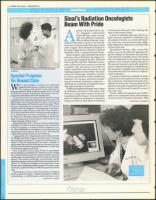
-• •
ar
Precise locations e
determined using
state-of-the-art
computer technology.
:34
•,;?::
..&:ptAeta
(
S
3
. 4:< kyi