

Different Than All Other Nights
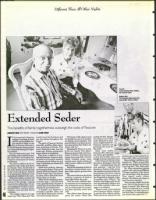
Top left:
Ted and Gladys Allen: Setting
the Passover table.
Bottom right:
The Passover dishes were first
used by Mrs. Allen's mother.
Extended secl.er
The benefrts of family togetherness outweigh the costs of Passover.
JENNIFER FINER STAFF WRITER PHOTOS BY GLENN TRIEST
I
f Guinness had a Passover
category in its book of world
records, one Southfield cou-
ple would be high on the
list of serious contenders
for most Passover food prepared
and consumed during the eight-
day holiday.
For one week every year, Ted
and Gladys Allen's home becomes
the equivalent of a kosher-for-
Passover restaurant for family
and friends.
The dinner table is set for 41
people for each seder, and that's
just family. Then, for the rest of
the week, family and friends stop
by for lunch and dinner. Sixteen
to 20 guests per Passover meal
(excluding breakfast) is the norm.
Before the seders, couches and
other living-room furniture are
moved to the garage, making
room for the tables that will ac-
commodate grandchildren, great-
grandchildren, cousins, nieces,
nephews and assorted family
members.
"My mother used to do it the
same way," Mrs. Allen said. "She
would move the furniture and
run the tables throughout the
house."
The start of Passover dictates
when Mr. and Mrs. Allen return
from wintering in Florida. This
year's departure date was two
weeks ago. Holiday preparation
began almost immediately.
Each year, in addition to mov-
ing the furniture, Passover dish-
es need to be brought upstairs
and year-round dishes are put
away. Cupboards are cleaned and
tables are set.
Aside from cooking, cleaning
and changing dishes, visits to the
grocery store are frequent. Three
or four "major trips" are typical-
ly made, where items like meat
and poultry are bought.
When all the shopping is done,
24 dozen eggs, a case of kosher
wine, approximately 18 boxes of
matzah and 20 pounds offish are
among the purchased items.
"I wouldn't say Passover is
stressful," said Mrs. Allen, who
hosts Rosh Hashanah and the
rest of the holiday dinners.
"Everyone really chips in and
I'm thankful we can do it and that
our family can be together. Our
grandchildren and great-grand-
son come in from New York to cel-
ebrate with us."
Shopping for Passover is cost-
ly for any family. The Allen's
Passover grocery bills total hun-
dreds of dollars. The Passover
roasts alone costs $100. One bill,
which included grape juice,
matzah meal, potato starch and
other meats, added up to $153
and change.
Not all the shopping is done by
the Aliens. Various family mem-
bers make regular grocery-store
trips.
The same holds true for all the
cooking, a majority of which is
done right before the seder.
Over the years, different fam-
ily members have developed ar-
eas of expertise in the kitchen
and are responsible for prepar-
ing their specialty items each
year.
Mrs. Allen's sister, Honey, pre-
pares the roasts. Sister Bea
makes the fish. Daugh-
ters Elayne and Terry
make desserts (a mini-
mum of eight kosher-for-
Passover desserts are
generally the norm for
the seder).
Each year before
Passover, Mrs. Allen and
her sisters get together
to plan the holiday menu even
though it always stays the same.
Other Passover family tradi-
tions have developed. All of the
"kids" — including those who are
now married — ask the Four
Questions. Portions of the service
are repeated to accommodate the
generations who know various
melodies. And, when a section of
the Haggadah is skipped, a fam-
ily member yells, "Hold it." The
tradition that began with the Al-
lens' granddaughter Melissa who,
as a child, wouldn't allow pas-
sages to be skipped.
There is even a story behind
their Passover dishes, original-
ly used by Mrs. Allen's mother.
With service for almost 50, the
set has been in the family for as
long as Mrs. Allen can remember.
Some holiday traditions never
carried over. "When we were kids,
getting new clothes for Passover
was a big deal," Mrs. Allen said.
Mr. Allen remembers playing
a game with walnuts and filberts.
Younger members of the family
are not familiar with the game.
That doesn't really matter
though. The Aliens are happy to
have everyone together.
"Some people might think the
noise, from all the people in the
house, is tumult," Mrs. Allen said.
"We're accustomed to it. I would
be unhappy if we didn't have it. I
love that noise. I'm thankful every-
one wants to be a part of it." ❑