

Eveything
v\i/OU
v VVanted
Nnow About .
n the Detroit nursing home
where she works, Ann
Marie Demchak knows of
only two Jewish residents.
"But there's nothing to say
we don't have more," she re-
marks.
The fact is becoming enor-
mously clear to geriatric spe-
cialists in the Jewish
community: Not all institu-
tionalized Jewish elderly
live in Jewish nursing
homes.
In fact, an unidentified
number of elderly Jews anony-
mously live out their final years
in facilities far removed from the
organized Jewish community.
Last week, two local groups
hosted an educational event tar-
geting professionals in non-Jew-
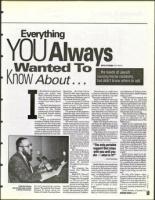
Rabbi Avie Shapiro
demonstrates ways to create
a Jewish environment.
ish and nonsectarian nursing
homes. "Everything You Always
Wanted To Know About the
Needs ofJewish Nursing Home
To
Residents ... But Didn't Know
Where To Ask" was a three-hour
forum that took place March 30
at Fleischman Residence, part of
the Jewish Home for Aged.
It was sponsored by LeVine
Institute on Aging (an educa-
tional branch of the Jewish
Home for Aged) and Hospice of
Southeastern Michigan.
The purpose of the program,
organizers said, was to help nurs-
ing home professionals better un-
derstand ways to care for their
Jewish residents.
"We can't reach out to every
single nursing home in the corn-
munity that has Jewish resi-
dents, but we can at least give
workers there enough informa-
tion to know whom to call if they
need (Jewish) resources," said
Judah Isaacs, senior
planning associate for
the Jewish Federation,
which has been working
with the Jewish Home
for Aged and LeVine In-
stitute.
Ms. Demchak, a so-
cial worker at Fairlane
Nursing Center, joined
more than 70 other
nursing-home profes-
sionals representing
about 50 facilities
throughout the tri-coun-
ty area.
The program fea-
tured five different
speakers.
Rabbi E.B. ("Bunny")
Freedman of Jewish
Hospice Services spoke
on "Who is a Jew?" He
explained to the largely
gentile crowd that Jews
identify themselves in different
ways: religiously, culturally, na-
tionally. He described the differ-
ent denominations of Judaism.
RUTH
LITTMANN ST AFF WRITER
... the needs of Jewish
nursing-home residents,
but didn't know where to ask.
"Sometimes you might have
to find out what kind of rabbi to
call for your resident," he said.
"Don't get confused by it."
Don't be baffled by some oth-
er little-known facts, the rabbi
added. Jews come in different col-
ors and from all types of socio-
economic backgrounds. They
share, he said, a sensitivity to
anti-Semitism and "there's an-
other thing. Jews like to kvetch.
They always want to see things
get better. They tend to be very
demanding patients."
Rabbi Avie Shapiro of the Jew-
ish Home for Aged spoke on Jew-
ish traditions. He encouraged his
audience to plant trees for their
Jewish residents.
"Planting a tree (in Israel) is
something that's universally ac-
cepted within the Jewish com-
munity as a nice way to recognize
an individual," he said.
"The only portable
support that stays
with you until you
die — what is it?"
— Carol Rosenberg
Rabbi Shapiro also pointed out
a list of synagogues and temples
included in the audience's infor-
mation packets. He also outlined
some of the major Jewish holi-
days, including Sukkot.
"If you don't have enough Jew-
ish residents to build your own
sukkah," he said "then maybe
you can transport your residents
to a nearby temple or syna-
gogue."
The information packets con-
tained descriptions of other hol-
idays, as well as phone numbers
and addresses ofJudaica stores.
From the lectern, Rabbi Shapiro
held up a box.
"This," he said "is matzah. It's
the staple of the upcoming
Passover holiday and it's avail-
able at supermarkets city-wide."
Rabbi Boruch Levin of He-
brew Memorial Chapel spoke on
Jewish customs and traditions
of funerals and mourning.
"The Jewish burial is different
in a lot of aspects," he said. "I
think it's important for care
givers to understand some of the
differences."
Rabbi Levin explained that
Jewish law encourages people to
stand at the bedside of a dying
individual. Death is a lonely time
for the sufferer, and it is a sign
of respect to keep a person com-
pany while he or she passes into
the next world, the rabbi said.
Also, blood released during or
shortly after death should not be
wiped away and discarded. "The
body does not belong to us," he
said. "We must give it back (to
God) the way it came into this
world."
Rabbi Levin went on to de-
scribe traditions of cleansing the
body, shoveling dirt on the grave,
and sitting shiva. Valorie Djelje-
vic, a registered nurse at Meno-
rah House, found it fascinating.
The attention Jewish law man-
dates for the dead should be pro-
vided to the living, as well, she
said.
As one who trains other ,
nurses at Menorah House, Ms. Cn
o,
Djeljevic plans to pass the infor-
mation on to her subordinates. h..-
"These are wonderful values to
give to a new nurse's aide and
any new medical professional," a-
she said.
Gloria Bender, ofJewish Vo-
NURSING HOMES page 62
59