

Running To Win
<W'4*a;tWNPr'*M ,:,',;;T;;tV;tV,Nr,AMRANV',A4gkt;;*,:' i- A:Wtzq,ttm'q,: mg:v., v'
with three terms in the Senate, and which
he hopes will now help him win the GOP
nomination.
"That's still going to be a factor," con-
ceded Marian Ungar Davis, a Jewish ac-
tivist in Pittsburgh who organized a
"Women for Specter'' group during his last
Senate campaign, when the Anita Hill
fallout made him an early underdog
against a Democratic woman, Lynn
Yeakel. "People remember those hear-
ings. But the more people learn about his
record, and the fact that there is no sen-
ator who's been better on women's issues,
the more people will turn to him."
Ms. Davis argued that Mr. Specter's
treatment of Ms. Hill was no different
from his grilling of another nominee,
Robert Bork, in 1987. In fact, Mr. Specter
cast the deciding vote against Mr. Bork
— a fact that many Republican leaders
still hold against him.
Still, even many supporters worry that
Mr. Specter's rough public persona and
what comes across as intellectual haugh-
tiness will prove a liability on the cam-
Daign trail.
"The question is whether he can mod-
erate his personality," said Charles
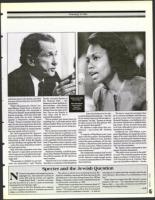
Brooks, executive director of Specter at the Anita
Hill hearings.
the National PAC — the
largest pro-Israel political ac-
Antia Hill defends
herself against
tion committee — and a former
Specter's
Specter staffer. "But Dole and
interrogation
Gramm have the same prob-
lem. One on one, Specter is
Party that believes in low tax-
very witty, and he has a
es and limiting social programs — but who
warmth that projects.
"But in politics, he's always been the do not want to sign on to the far-right so-
cial agenda," he said. "Specter is aiming
underdog; he's a self-made person who's
for basic country-club Republicans who
always excelled. When you're driven that
way, you come across as not being per- do not support that agenda."
Mr. Specter is right about that con-
sonable."
stituency — up to a point, Mr. Ginsberg
But an abrasive personality may be the
least of Arlen Specter's problems as he said.
"A majority of Republican voters may
subjects himself to the self-flagellation of
agree with that position. But Republican
a presidential campaign. More daunting
have different views, and they
is the possibility that his description of a activists
control
the
party machinery. So it's very
kind of Republican silent majority eager
unlikely a Republican like Specter can
to support "an economic conservative and
win the nomination. What he can do is
a social libertarian" may be more fantasy
demonstrate the strength of that grass-
than political reality.
roots
constituency."
Benjamin Ginsberg, a political scien-
The widespread perception that he can't
tist at Johns Hopkins University, said that
win the nomination may make it difficult
the political equation for Mr. Specter is
for Mr. Specter to raise enough money
more complex.
to mount a sustained effort in New Hamp-
"Specter and a lot of others calculate
that there is a majority in the Republican shire and Iowa.
0
CL
"He has to create the perception that
he is a serious candidate, and that mon-
ey given to him isn't lost money," said
Howard Friedman, a top Baltimore Jew-
ish activist well known in political fund-
ing circles. "So far, he hasn't been able
to do that, although he has an excellent
reputation as a senator."
California Gov. Pete Wilson, a pro-
choice Republican who enjoys the advan-
tages of his state's big block of electoral
votes, is attracting the interest of many
Jewish givers who are sympathetic to Mr.
Specter's politics but are convinced he
can't win the nomination.
Mr. Specter seems undaunted by that
almost universal assessment.
"We need to come up more in the polls,"
he said. "The essential question at this
stage is to achieve a critical mass. ANew
York Post poll has us at 7 percent. That
may not sound like a whole lot — but be-
Specter and the Jewish Question
umerous newspaper and magazine stories
highlight Sen. Arlen Specter's grilling of
Anita Hill and his pivotal vote against
Judge Robert Bork — but few even men-
tion the fact that he is a Jew in a party increasingly
dominated by the Christian right.
A recent story in The New Republic and a segment
in a Time magazine roundup of candidates ignored his
religion and ethnic identification.
N
The silence is all the more surprising because Mr.
Specter's candidacy represents the first real run for the
presidency by a Jew since Pennsylvania Gov. Milton
Shapp, a Democrat, made a barely remembered try for
the Democratic nomination in 1976.
"There's been a surprising lack of comment about it,"
said University of Virginia political scientist Larry
Sabato. "The explanation could be that it just doesn't
matter anymore if a candidate is Jewish — or that his
campaign is not taken seriously enough to get into his
vital statistics. Most likely, it's a combination of the
two."
Other observers suggest that Mr. Specter's unique
position in the race — as a Republican critic of the re-
ligious right — may make columnists uncomfortable
bringing up the religious issue.
LC"
CT)
ti
CC
45