

From Home
Peter entered the home at age 10 and did not have
many visitors in the three years he stayed. Every
chance he had, he would leave to see his mother.
`There was something in me that wanted so bad-
ly to get the hell out," he said.
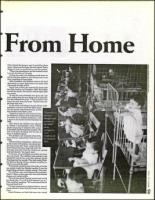
During the week, the children would dress for
school and then gather in the dining room to eat
their breakfasts at long tables.
After breakfast, the children went tc the local
elementary or junior high school; not many were
old enough for high school.
Sarah was 8 when she entered the home with
her little brother in December 1938. Her father
had left the family. Her mother worked night shifts
as a nurse.
"It was the most miserable year of my life," she
said, adding that she was doing well in school be-
fore she entered the home. "I had a teacher who
hated the kids from the home. I failed every sin-
gle class that year."
So did others, including an 8-year-old boy so dis-
turbed by a move to a private foster home
that his grades slipped drastically, and he
was forced to stay back a year.
"Individual reports were received from "Contrary to
the McKerrow School which indicated that the best
a number of our children daydream," said thought and
a report to the home's board of directors in
practice in
1938.
After school, the children were allowed the field,"
to attend a photography class. Others
played ping-pong or tinkered with a mod- these
el chemistry set that had been donated. The youngsters
side yard of the building was the site of
were
many a childhood game.
The children also attended United He- residents of
brew Schools, apparently without much the home in
relish.
"Hebrew School attendance, rather poor 1937.
in the month of December, was almost per-
fect last month after Sup't. visited the He-
brew School having a long talk with the
principal and later with the children as a group
and individually," the report read.
To be sure, not everything was awful, not every
day was lonely. The children had outings to see
vaudeville-type shows, tour radio stations, see the
Thanksgiving Day parade. They had weekly Shab-
bat dinners during which a resident would be in-
vited to eat with the staff.
"Everybody wanted to be in that room, to be the
one picked to light the Shabbat candles. It was the
closest thing we had to a family setting," Peter said.
The children also would harass the caretaker,
Peter C. Kent, a stern man who wore wire-framed
glasses and walked stiffly.
"He had this thick German accent and would
say things like, 'You will do this because I say so,"'
Peter recalled, laughing. "We would stand behind
him and mock him."
The food, prepared in a kosher kitchen, was not
memorable but wasn't bad; the house was always
clean.
Louis Fireman, an Oak Park man who visited