
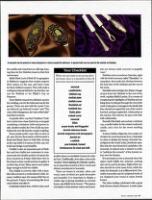

A mezuzah can be placed on every doorpost in a home except the bathroom. A special knife can be used for the challah on Shabbat.
the candles and wrap them in a silk bag, keep-
ing them for the Shabbat closest to their first
anniversary.
Rabbi Mark Loeb of Beth El Congregation
in Baltimore suggests that couples engrave
their names on the cup, and leave room
for their children's names. They will create a
multi-generational kiddush cup that they can
use for Shabbat or for Elijah's Cup on
Passover.
Some Rabbis request two kiddush cups for
the wedding, one for the bride and one for the
groom. There are sets with the words "I am
my beloved; my beloved is mine" and "The
voice of the bridegroom, the voice of the bride"
inscribed on them.
A popular silver cup that Tradition! Tradi-
tion! carries has a base that forms a chuppah
containing a miniature bride and groom in-
side. Another model, the Tree of Life cup sym-
bolizes the new life that the couple is starting.
Some people prefer cups with no stem at
all, says Avrom Borenstein of Borenstein's
Book and Music Store in Oak Park. As long
as the cup holds 3.3 ounces of wine, any ma-
terial and design is permissible.
Challah is also an important part of Shab-
bat, and two challot are customary to com-
memorate the double portion of manna the
Jews received on Friday while they were in
the desert so they would not have to gather it
on their day of rest. Many stores carry plates
large enough to hold two challot.
The challah is covered, often with a beau-
tiful silk-screened or embroidered cloth, be-
cause, tradition says, the manna didn't lay on
the ground. A layer of something like frost
came before and after it.
A Sabbath-related item, which is also used
Your Checklist
When you are ready to set up your Jew-
ish home, here is a checklist of the 18
items that mitzvah mavens recommend:
mezuzah
candlesticks
kiddush cup
challah plate
challah cover
Havdalah set
tzedakah box
Seder plate
matzah cover
menorah
Bible
prayer books and Haggadot
Jewish reference books
Jewish magazines and newspapers
Jewish art
a sukkah
your ketubah, framed
kitchenware for meat and milk
at other times, is a tzedakah [money for char-
ity] box. Traditionally, Jews place coins in the
"pushka" before lighting the Sabbath candles,
as an important symbol of Jews' moral and
ethical commitment to humanity.
There are boxes in ceramic, silver and
wood, some of which are quite decorative
and beautiful. It is important to display a
visible sign of giving tzedakah in a Jewish
home, says Rabbi Irwin Groner. "The genius
of Judaism is that abstract values and princi-
ples are always made concrete in tangible
ways."
Shabbat ends at sundown Saturday night
with the brief ceremony called "Havdalah," or
separation, that marks the division between
the holy time of the Sabbath and the rest of
the week.
Havdalah acknowledges the distinct change
of pace from the Sabbath to the rest of the
week, explains Rabbi Landau. It is a means of
recapturing the highlights of Shabbat and uti-
lizing them to help get through the rest of the
week. It also gives a message to the family that
they should not regard the rest of the week's
hurried, perhaps neglectful, relationship as
the real one. The real one, he says, is the Sab-
bath relationship.
Beautiful Havdalah sets include a kiddush
cup, a candle holder for the twisted multi-wick
candle, and a box for the sweet smelling
spices.
A minor holiday religiously, but a major cel-
ebration for most American Jews, Chanukah
is a time to display the beauty of Jewish ritu-
al objects to the world. In fact, Jewish law spec-
ifies that the nine-branched candelabra, the
menorah, be placed near a window in order
to "publicize the miracle" of the Jewish vic-
tory over the Syrians.
It is necessary to own a menorah since the
object itself fulfills the mitzvah; nothing
else can be used in its place. Eight of the can-
dles should be at the same level, while the
ninth, the shamash, is at a different level. Dec-
orative menorahs may be sculptural works of
art, displayed year round in many Jewish
homes.
The other holiday celebrated with a great
deal of home ritual is Passover. A seder plate
STYLE • BR' DES 1 94 -)5 • 47