

Heal
MOMMEMMOMAMMZ
.
0
PHOTO BY GLENN TR IEST
Hearts
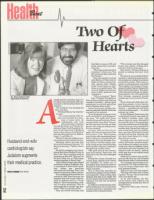
Drs. Arlene and Barry Levine
repair hearts at Henry Ford.
Husband-and-wife
cardiologists say
Judaism augments
cti) their medical practice.
I-U
CD
H-
LU
w
CO
dL
RUTH LITTMANN STAFF WRITER
weirdly familiar sensation came over
Dr. Barry Levine during his 1981 pre-
sentation to the American Heart As-
sociation.
For a while he was stumped, but
then it hit him.
"It felt just like my bar mitzvah,"
he says.
Dr. Levine and his wife, Ar-
lene, have teamed up in prac-
tices of many sorts. As
cardiologists, they work
with heart failure patients
through the Heart and Vascular In-
stitute at Henry Ford Hospital in De-
troit. On the home front in Bingham
Farms, they observe the lifestyle of
observant Jews and rear two children,
Lionel, 7, and Edlyn, 6.
The Drs. Levine say religious prac-
tice enhances their medical practice.
"Someone said to me once that
we're in the business of miracles," Dr.
Barry Levine says. "I believe that is
true."
He did his residency and intern-
ship at Beth Israel Medical Center in
New York. She completed medical
programs at Harvard. They met in
the mid-1980s and, in 1990, began
working together at Henry Ford.
Their medical backgrounds differed
as did their religious traditions. Bar-
ry specialized in heart failure medi-
cine. Arlene was practicing
interventional cardiology. Barry was
reared Conservative; Arlene, secular.
But something clicked and the two
married in 1986. Some time ago, the
husband-and-wife Levine team de-
cided to dedicate itself to a Torah
lifestyle. They had questions, med-
ical, as well as existential. "Why do
some people die so young?" they won-
dered. "Why must people suffer?"
They say Jewish teachings help
shed light on issues of life and
death, issues they encounter
every day.
"This must sound somewhat
simplistic," Arlene says, "but
first we just sat down and read
the Tanach."
They also became involved
with Machon L'Torah, led by
Rabbi Avraham Jacobovitz,
who (among other things)
holds Torah classes at their
home on a regular basis. The
Levines' religious pursuits put
some of their questions into
perspective.
"Life is a journey," Barry
says. "(It helps) if one believes
that, as Jews, we have souls that are
coupled to our bodies — that our souls
existed prior to our birth and will go
back to Hashem after we die."
Arlene Levine says Judaism nur-
tures an optimistic attitude which she
transmits to her patients.
"A lot of patients we see are truly
at the end of their usual therapies,"
she says. "We really don't know
whether things will work out. We en-
courage them to have faith. The peo-
ple who tend to do the best are those
people with religious backgrounds.
It's very striking."
Of course, faith isn't the only an-
tidote. The Levines treat more than
900 patients a year. Their patients
come to them after experiencing heart
failure. Many are on waiting lists for
transplants. The need for hearts, how-
ever, always outruns supply, espe-
cially during an age when technology
boosts people's chances of making it
through acute cardiac events.
"The good news is they survive
their heart attacks," Barry says. The
bad news is now they have damaged
hearts."
For the Drs. Levine, the trick is to
sustain their patients until hearts
are available. Or, better yet, to
strengthen their patients' hearts to
the point at which transplants are no
longer necessary.
Part of what they prescribe for
heart failure patients is "the old-fash-
ioned approach." Stop smoking. Stop
drinking. Eat right. Lose weight. The
doctors closely monitor their patients'
regimens, but also rely on patient
compliance.
In addition to administering estab-
lished medications, the Levines have
research protocols to strengthen the
muscles of the weakened hearts.
"We're trying to put their damaged
hearts into a better working envi-
ronment," Barry Levine says.
Says Arlene: "All heart therapy is
geared at making the heart work
less."
The doctors have published their
research in national journals and con-
duct seminars at medical conventions
around the country. Their most re-
cently co-authored study was titled
"Reversibility of Pulmonary Hyper-
tension Predicts Clinical Outcome For
Heart Failure Recipients." The study,
which described methods for identi-
fying patients who will benefit from
their therapy, appeared several
months ago in the journal Circula-
tion.
The Levines don't hide their reli-
gion from patients. In fact, they be-
lieve Judaism gives them a special
identity — something beyond white
coats and stethoscopes — to which
patients can relate.
In their Bingham Farms home, the
Levine family recently regrouped af-
ter Edlyn's birthday party with
games, pizza, ice cream, cake and 19
six-year-olds. How do the parents bal-
ance their professions and family life?
Arlene Levine says she is grateful for
excellent help. Beyond that, both par-
ents awake early, help the children
dress, get them off to school (Lionel
attends Yeshiva Beth Yehudah; Ed-
lyn, Beth Jacob. School For Girls),
then they go to work.
Evenings, after the children fall
asleep, the doctors complete neces-
sary professional reading, and on Sat-
urday they observe Shabbat. Barry
and Arlene agree that Shabbat is an
island of time for family, without
which their days at the hospital would
be far different.
Observant Judaism has put bal-
ance into life, they say, and it's helped
them become better communicators.
"I'm a happier person being an ob-
servant Jew," Dr. Barry Levine says.
"I can see reasons where there were
only questions before."
Arlene, he says, is his best support.
'e help each other and we learn
together," he says. "It's an important
part of our family life."
As for their patients, the Drs.
Levine believe that Judaism has
strengthened an already firm ethic of
determination.
"We never," Barry says, "stop try-