

6, 6
'Jewish Ca
any Jewish par-
ents choose to
send their chil-
dren to "Jewish"
summer camp.
But ask them, or
even camp directors, to define a
Jewish camp and you will hear
some surprising answers.
"If you have a thousand Jew-
ish kids in camp does that make
it Jewish?" asks Harvey Finkel-
berg, executive director of Fresh
Air Society, which runs the De-
troit Jewish community's Tama-
rack Camps.
That definition was good
enough, even for the Fresh Air
Society, 10 years ago. But it
doesn't hold any longer.
While Tamarack's Camp Maas
still emphasizes a Friday night
Shabbat dinner, Fresh Air has
added a regular Havdalah ser-
vice Saturday evening, Judaic
programs on Tuesday and Thurs-
day nights and an infusion of Ju-
daism throughout the week.
"If you came to camp on any
Wednesday afternoon, could you
tell Tamarack is a Jewish camp?"
Mr. Finkelberg says. 'When we're
successful, the answer is yes."
Campers don't go to the nature
center anymore. Now they go to
teva — Hebrew for nature.
They sing "Hatikvah" at the
end of each day, pass by Camp
Maas' Holocaust memorial, do a
tzedakah project each ses-
sion and, during thun-
derstorms, say the
Hebrew prayer for light-
ning.
"It's what sets us apart
from other camps that
have Jewish children,"
Mr. Finkelberg says.
In the 1960s and '70s,
Jewish communal camps
were less Judaic. "Now,"
says Mr. Finkelberg, "in-
termarriage has hit us in
u) the face. We have all the
bells and whistles of every
other camp — that gets
=
the
kids in. Then we have
(I)
— to teach them what it is
LIJ
to be Jewish."
Of the 1,800 children who at-
E,- tended Tamarack Camps last
cc year, 600 were unaffiliated with
Li, synagogues. The only knowledge
° of Judaism some receive comes
= from camp.
It is done in an informal way.
)—
n A session last year on anti-Semi-
e,,foldceirstTin
tism
counselonrs-
'th
th
1L fr ontethd with
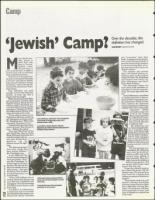
Joshua Markzon, Esther Sara Taxon and Andrew
Touma show off challah they made at JCC
Summer Camp in 1993.
Levi Gottlieb, Gamliel Resnick, Michael
Blyachman and Yisroel Greenes bake challah for
Shabbat at Camp Ganeinu.
JCC Summer Camp counselors Michal
Shafir and hat Salami prepare a cow for
Israeli day.
Camp Ganeinu has all the youngsters
participate in daily prayers.
n
Over the decades, the
definition has changed.
ALAN HITSKY ASSOCIATE EDITOR
and "evacuation" from their
bunks. A program on the ship Ex-
odus and the British blockade of
pre-state Israel had the campers
travel across Camp Maas via ca-
noe, boat and on foot to get past
"British soldiers."
The campers also present
plays with Jewish themes, in-
cluding a night at the mythical
village of Chelm. Mr. Finkelberg
says campers "won't find a eli-
gious atmosphere, but they'll
learn about Judaism."
The Tamarack Camps now
have seven staff members re-
sponsible for Jewish program-
ming. Ten years ago, there was
one.
Lenny Silberman, a consultant
on camping services to the na-
tional Jewish Community Cen-
ters Association (JCCA) in New
York, believes the Tamarack
Camps' experience is following a
national trend. Of 17 communally
sponsored Jewish
- overnight camps (out
of 30 in the United
States) that responded
to a 1993 JCCA survey,
all reported that they
had a Jewish educator
or rabbi on staff.
Mr. Silberman says
an "interesting phenom-
enon" is going on. Most
camps have Jewish staff,
Jewish programming and
Jewish daily activities,
such as saying HaMotzi
before meals and Birkat
HaMazon afterward, and
having a Jewish word for
the day.
The best learning is ac-
complished, Mr. Silberman
says, when the Jewish ed-
ucator or rabbi "just walks
around camp, talking to
kids informally. When it's a
rabbi, it gives the children a
different perspective: 'Did
you see the rabbi on the ropes
course? Was that cool!'
"It can't be a Jewish camp to-
day without this person," Mr. Sil-
berman says. He also believes
that it can't be a Jewish camp
without an extensive Shabbat ex-
perience.
`Where clearly needs to be a dif-
ference in the day, from Friday
afternoon preparations for Shab-
bat to Saturday evening Hav-
dalah." The programs, activities,
even leisure time, he says, must
point to Shabbat as a special time
of the week.
r"/
N