

H E A T H
Hedgin' Your Bets On
Ant i
IF
or years, the common
Rx for the common
cold was chicken
soup. Today, prevail-
ing wisdom is a bit
more complex: Double
up on vitamin C,
make sure you're taking vitamin
E and by to supplement your diet
with betacarotene.
In the past decade, "antioxi-
dant" vitamins — C, E and beta-
carotene — have been headlined
by good news. First came reports
that they protect against certain
cancers. Then antioxidants were
associated with a reduced risk of
developing coronary heart dis-
ease and cataracts.
But then came the news of a
study published last April in the
New England Journal of Medi-
cine. A team of Finnish scientists
reported that heavy smokers
were unable to lower their risk of
developing lung cancer by taking
vitamin E or betacarotene. The
study also documented a slight
increase in the risk of cancer
among those who took betac-
arotene. Neither vitamin ap-
peared to affect the risk of
cardiovascular disease.
Although these results con-
tradict countless other studies,
this trial was one of few controlled
experiments testing effects of an-
tioxidant supplementation. Most
other studies were from informal
observation. While somewhat
confusing, the study has raised
several issues.
First, there still is no consen-
sus in the scientific community
that taking antioxidant supple-
ments prevents disease, improves
quality of life or promotes longevi-
ty•
That's the bad news.
The good news is that many
nutritional specialists, biochem-
ical researchers, physicians and
other scientists remain convinced
that antioxidant supplements
aren't detrimental. Research just
hasn't been able to determine
how many or how few antioxi-
dant vitamins people should take.
Family doctor David Rosen-
berg, a staff physician at Sinai
Hospital and a geriatric special-
ist, agrees that there is potential
merit in taking vitamin supple-
ments.
li d ants
RUTHAN BRODSKY SPECIAL TO THE JEWISH NEWS
`The Jewish population is get-
ting older, and I find that I'm fre-
quently telling patients to take
vitamin supplements, particu-
larly when I know that they just
aren't going to eat the foods that
will provide them with the prop-
er nutrition," he said. "Re-
searchers say we still don't have
enough evidence to make a rec-
ommendation for how much of
the supplements everyone should
"thieves." When free radicals by-
pass the body's defense system
and go unchecked, they rob elec-
trons from molecules of healthy
body cells. Free radicals, there-
fore, transform the molecules of
healthy cells into other free rad-
icals, thus permanently damag-
ing cell membranes. This damage
destroys the previously healthy
cell's ability to reproduce and me-
tabolize.
wreak, the body produces com-
pounds known as "antioxidants,"
which serve to stop the creation
and spread of free-radical chain
reactions.
There is no ideal formula for
exactly how many antioxidant vi-
tamins the body needs to stay
healthy.
Gynecologist Stanley Dorfman
in Bloomfield Hills tells his pa-
tients to take vitamin supple-
or minerals are missing from
your diet, try eating foods that
are the rich sources of these nu-
trients," she suggests. "By know-
ing which foods to choose, you can
make sure you'll fuel your body
with premium nutrition for good
health and top performance."
The Alliance for Aging Re-
search was the first public health
organization to officially recom-
mend vitamin supplements to
ward off heart disease and can-
cer. It advised Americans to take
large doses of vitamin C, vitamin
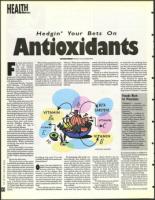
BETA
CAROTENE_...
VITAMIN
zettIttO
VITAMIN
***. ,
,stAk•
ILLUSTRATION BY JANE SANDERS
By damaging cells inside var-
ious tissues, free radicals can
cause "oxidative stress," which
paves the way for the develop-
xygen, the same element we ment of clogged arteries, various
need to keep breathing, can cancers and other debilitating
become a bad guy. People conditions, researchers believe.
don't use all the oxygen they Free radicals also can accelerate
breathe. Anywhere from 2 to 4 the effects of aging. Environ-
percent of oxygen intake leaks mental pollutants, such as ciga-
out and gets mixed up in bio- rette smoke and exhaust fumes,
chemical reactions that produce in addition to radiation, excessive
very reactive and potentially dan- sunlight, certain drugs and stress
gerous compounds called free rad- also increase the production of
free radicals.
icals.
To protect itself from free rad-
Free radicals are the culprits.
They can be described as electron icals and the havoc they can
be taking, but most of us can
probably benefit from some sup-
plementation."
O
ments. (Some doctors do not,
saying vitamins are superfluous
if a person eats a healthy diet.)
"I advise most of my patients
to take vitamins C and E. (I ad-
vise) many others to add betac-
arotene to their list because
there's enough evidence to
demonstrate that they must be
doing some good and there's no
evidence yet to show that they do
harm.
"I'm following my own advice,"
he says. "I take all three."
Lisa Goodgall at Sinai Hospi-
tal offers a dietitian's perspective.
"If you think certain vitamins
E and betacarotene in addition to
the amounts of those substances
received through food.
Getting enough vitamin C in
your food is relatively easy: cit-
rus fruits and juices, strawber-
ries, green and red peppers,
broccoli and potatoes. One way
that vitamin C might help pre-
vent cardiovascular disease is by
improving cholesterol levels.
Several studies have indicat-
ed that people with high levels of
vitamin C in their blood have
more of the "good cholesterol"
(high-density lipoprotein) than
people with low blood levels of vi-
tamin C.
Scientists aren't sure exactly