

says, those who blame, are in denial.
They want to reassure themselves
that if they find fault with the victim,
then maybe they can avoid the same
fate.
Torturous Mending
LLI
CI)
LLI
CD
/-
LU
LU
F-
5 8
A study on post-traumatic stress doc-
uments that 80 percent of parents' mar-
riages fall apart after the murder of a
child. The tendency is for one spouse
to blame the other.
Often, healing begins at the time a
killer is convicted. But in spite of the
courtroom outcome, survivors say
their families feel violated and disjoint-
ed.
"You have people who turn away from
God," Ms. Goldsmith says. "But for every
person who turns away, there's anoth-
er who says, 'My faith is what
carried me through! "
Rabbi Daniel Polish of Tem-
ple Beth El says the Jewish tra-
ditions of sitting shiver and
reciting kaddish each day for a
year help mourners recover. But
parents of murdered children
face other issues.
"Parents don't expect to bury
their children," he says. "The
tragedy is compounded because
the deceased has never had the
chance to live out life ... There is
also the strong desire for re-
venge."
Hyman Eisenberg, a former
national POMC president from
the St. Louis area, almost lost
his faith forever when his 22-
year-old son, Greg, was mur-
dered on Aug. 24, 1981.
Greg was deaf.
Mr. Eisenberg and his wife,
Phyllis, sent him to the St. Louis
Jewish Vocational and Reha-
bilitation Center to prepare him
for independent living. They
thought they were doing the
right thing. They moved Greg
into a boarding home for
physically challenged adults, not
far from Jewish Hospital
n the city. The boarding home
had a 24-hour surveillance
system. Locked iron gates
prevented an intruder's easy en-
.
But Greg's killers didn't come
from the outside. They were
neighbors, two other deaf men,
ages 20 and 22, living in the
same facility.
These men had raped a 17-
year-old deaf girl only days be-
fore. Seeking refuge, the girl
confided in Greg. Exposed, her trial. The trial itself lasted 11 weeks.
attackers killed Greg in a surprise knif- Both men were convicted and sentenced
tolife in prison. There have been six ap-
ing.
That was the quiet Sunday evening peals.
"It's never over for the family," Mr.
Mrs. Eisenberg had climbed into bed
Eisenberg
says.
early. She wasn't feeling well. When the
Raised
an
Orthodox Jew, Mr. Eisen-
phone rang, Mr. Eisenberg picked up
berg
for
the
first
time in his life began
the receiver and heard an unidentified
voice intone: "Greg is dead." Shocked, questioning God. Until the murder, he
he somehow made it up the stairs to tell believed that good people were destined
to lead good lives.
his wife.
"I felt that, deep in
Receiving the phone
my heart, in some way
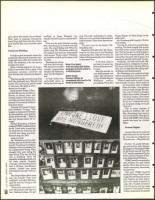
call was hard enough. Below: A car parked
God would protect me,"
The funeral was hard in the rain outside Adat Shalom
he says.
enough. Augmenting synagogue carries the protest of
After the murder, he
the pain, Mr. Eisenberg a victimized parent.
was
disillusioned and
says, were the legal bat-
angry.
His wife placed
Bottom
of
page:
tles.
Murdered
children
are
a
copy
of Rabbi Harold
It took nearly two-
remembered
at
the
Love
For
Life
Kushner's
well-re-
and-a-half years to
benefit
at
Adat
Shalom.
When
Bad
ceivedbook,
bring the first case to
Things Happen To Good People on the
coffee table.
Mr. Eisenberg didn't touch it. Not for
nine months.
One day he picked it up and began
reading. The book helped him accept
that God hadn't caused Greg's death,
that "God put people on earth and gave
men free will to do good and bad. And
most often, the good will do good, and
sometimes the bad will do bad," he says.
Gradually, his faith came back. Mr.
Eisenberg took to writing his own book,
The Inner Grief of Men Dealing With the
Pain. In it, he describes "the coping trail"
of di stress and determination.
Mr. Eisenberg, who works for a large
airline manufacturer, stresses the im-
portance of remaining determined.
"When I went back to work, it was
kind of tough," he says. "But I made up
my mind that when I walked
down the halls, I was going to
hold my head up high. My mis-
sion was to become stronger
rather than weaker. Because if
I became weaker, then there
was nothing I could have done
for my son. I wanted his mem-
ory to remain strong. It was all
I had left."
Like so many parents of
murdered children, Mr. and
Mrs. Eisenberg have made a
vow to help others. They got in-
volved with POMC. One of their
quests has been for victims'
rights.
Victims' Rights
Justice will only be achieved
when those who are not injured
by crime feel as indignant as
those who are. —King Solomon
On Oct. 18, nearly 300 peo-
ple gathered at Adat Shalom
Synagogue in Farmington Hills
for the fourth annual "Love For
Life" benefit, sponsored by the
metro Detroit chapter of Par-
ents of Murdered Children.
POMC benefits memorialize
area children who died violent
deaths. They also serve to in-
crease community awareness,
sponsors say.
This year, POMC honored
Oakland County Circuit Court
Judge Edward Sosnick and his
wife, Darlene, for their dedica-
tion to the needs of parents in
crisis. Mrs. Sosnick volunteers
with the group and the judge
conducts a "court school" to help
victims understand the judicial