

Parents of murdered children struggle
- to come to terms with the incomprehengi
PHOTO BY GLEN N TRIEST
RUTH LITTMANN STAFF WRITER
w
(/)
LU
CC
LU
LU
56
he irony is, he published comic
books.
Someone murdered Todd
Loren, creator of Revolutionary
Comics, on June 17, 1992. The 32-year-
old entrepreneur, a Southfield High
School graduate, was bludgeoned in his
San Diego condominium.
Investigators found no signs of forced
entry, and they've never tracked down
the killer.
Suspicion has fallen on a stranger re-
sponding to the classified ad for Mr.
Loren's van. There was another suspect,
a vagrant Mr. Loren hired in a gesture
of good will. The va-
grant later was found
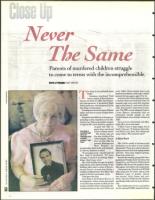
Rose Gold of
to have a felony record.
Southfield holds
Mr. Loren was not
fast to the
the sole victim of the
memories of her
murdered
1992 tragedy. People
grandson, Todd
close
to him, like his
Loren.
parents, Marilynn and
Herb Shapiro, his
grandmother, Rose Gold, and his broth-
er, Steven, continue to bleed.
"It never goes away," says 85-year-old
Mrs. Gold of Southfield. "If I were
younger, I would do something. Some-
thing. I don't know what."
Mrs. Gold shuffles through her grand-
son's old fan mail, stacked neatly on her
kitchen table next to piles of Revolu-
tionary Comics. A music box chimes a
rendition of Beethoven's "Fur Elise " She
points to the toy and smiles, wryly.
Todd gave her that.
According to the Federal Bureau of
Investigation, violent crimes decreased
in the first three months of 1994, but the
number of child victims of homicide sky-
rocketed between the mid-1970s and
early 1990s. These deaths shot up 46
percent for children under age 1 and 64
percent for teen-agers, ages 10 to 14.
Overall in the United States last year,
a violent crime occurred once every 16
seconds; rape, once every five minutes;
aggravated assault, once every 28 sec-
onds. And murder: once every 21 min-
utes. The FBI's newly released Uniform
Crime Reports documents that an
estimated 24,526 people in the
United States were murder victims in
1993.
For survivors of homicide, like Mrs.
Gold, life is never the same.
"I don't want to stay angry, but it
hurts," she says. "It hurts me that who-
ever did it is out there. The animal got
away with it. Who could be next?"
A Dirty Word
Mrs. Gold's words of outrage script
the battle cry for other living victims
of homicide. There is no solace, they say.
Many survivors find that coping means
activism. They join support groups.
Some start their own.
Around the country, groups like Com-
passionate Friends, Save Our Sons And
Daughters, and Parents Of Murdered
Children offer forums for people to share
their agony with others who understand.
Compassionate Friends and SOSAD
offer programs for those coping with
different types of deaths, includ-
ing murder, fatal illness and acci-
dents. Parents Of Murdered Children
specifically deals with survivors of homi-
cide.
Rita Goldsmith serves as president
for the national POMC, based in Cincin-