
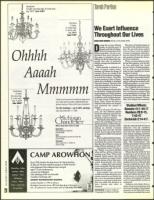

Georgetown
12 lights, 30 inches high, 30 inches wide.
Reg. $59700 Sale $34995
Americana
12 lights,
27 inches high,
31 inches wide.
Reg. $99600
Sale $71995
:0)
r. 11 .
i?"'k
1
r
4'
We Exert Influence
Throughout Our Lives
RABBI IRWIN GRONER SPECIAL TO THE JEWISH NEWS
Ohhhh
Aaaah
Mmmmm
Fontainbleau
12 lights,
38 inches high,
31 inches wide.
Reg. $1,42000
Sale $99995
Create an environment of traditional elegance for
your home with the quality craftsmanship and
graceful styling of these solid brass chandeliers.
For the holidays — up to 40% savings.
Sale ends December 17, 1994.
ichiA
handc tor
1'A
Where Good Ideas Come To Light
Bloomfield
6580 Telegraph at Maple Rd.
810-626-2548
Novi
45319 Grand River, One Mi. W. of Novi Rd.
810-344-0260
Rochester
200 E. Second St., E. of Main St.
810-651-4302
CAMP ARO
Windsurfing • Sailing
Canoeing • Riding
Kayaking • Tennis
Backpacking
Archery • Nature
Drama • Canoe Trips
Arts and Crafts
Since 1934 Arowhon has been known for intense teaching
of skills and "the best waterfront program in North America."
In the Algonquin Park wilderness boys and girls
aged 7-16 are simultaneously
nurtured and challenged.
Take advantage of the very favorable
Canadian $ exchange rate!
DETROIT INFORMATION SESSION:
Sunday, December 11, 1994 at 4:00 p.m.
Birmingham Community House, 380 South Bates Street in Birmingham
Info.: 72 Lyndhurst Ave. Toronto, Ontario M5R 2Z7 Tel (416) 975-9066 ,
uring the course of these
weeks, we read the story of
Joseph and his brothers.
From the perspective of the
biblical narrator, we are to un-
derstand that every element of
this saga is related to the un-
folding of a divine plan that tran-
scends this tale of brotherly
hatred., revenge and ultimate rec-
onciliation.
Each episode is related to a
chain of events whose conse-
quences will shape the future of
a people. Thus, as a result of the
hatred of the brothers of Joseph,
, he is sold into slavery. The Mid-
ianites transport him to Egypt,
where he is available to interpret
Pharaoh's dreams. Because of his
wise interpretation, he is elevat-
ed to the position of viceroy.
Then, he becomes the provider
for his family, bringing his father
and brothers and their families
to Egypt. This group of 70 became
numerous and multiplied great-
ly in the course of the genera-
tions. Then, "there did arise a
Pharaoh who knew not Joseph"
and enslaved the people of
Joseph.
This is all part of God's pur-
pose, for the Hebrew people
would be redeemed, and their re-_
deemer would be Moses, the
greatest of all the prophets.
The Exodus from Egypt would
lead to the unfolding of an even
greater purpose, which is the giv-
ing of the Torah, thereby estab-
lishing an eternal covenant
between God and the Jewish
people. Every step of the drama
is required to fulfill God's grand
design.
From a philosophical perspec-
tive, does this mean that we do
not direct the course of events,
that the tide of history carries us
along without seeking our will?
I encounter many who say to
me: "Rabbi, I am a born fatalist;
what will be, will be; when my
number is up, I'll go." When chal-
lenged, these people can cite
many incidents to support their
belief, stories of how fate inter-
vened dramatically into their
lives — a plane that was missed
or an automobile ride that wasn't
taken, and this made all the dif-
ference in the world.
Just consider how our lives
would have been altered if, at a
certain moment in our family his-
tory, we or our parents or grand-
parents or great-grandparents
had not made the decision to
leave Europe and come to
America.
Irwin Groner is senior rabbi of
Congregation Shaarey Zedek
The story of Joseph causes us
to confront this existential ques-
tion: Do we truly have control
over our lives, or are we subject
to laws of causation which gov-
ern our actions? How we answer
this question shapes the charac-
ter of our existence.
When a person believes that
he has lost mastery over his life,
he has abdicated his moral
power. From a Jewish perspec-
tive as well as a psychological
point of view, timidity is a worse
sin that chutzpah.
The person who believes that
he is helpless, has made himself
helpless. He who has declared he
can do nothing has created a self-
fulfilling prophecy or, even worse,
a self-justifying prognosis.
The Yiddish term for fate is
bashert. Those who misinterpret
this concept have written their
own prescription for failure. We
would say bashert only after the
fact and not in advance. The stu-
dent who begins the semester
Shabbat Miketz:
Genesis 41:1-44:17
Numbers 28:9-15,
7:42-47
Zachariah 2:14-4:7.
with the attitude that he has no
influence over his academic
achievement, will fail. A husband
and wife who take a detached
view of their marriage, uncertain
as to whether they will be joyful
or miserable, will have an un-
happy and unfulfilled relation-
ship. The businessman who
forfeits all initiative because the
market forces are not under his
control, has already begun his
journey into bankruptcy.
Where does the truth lie? Are
we driving or are we driven? Are
we the masters of our fate or its
subjects? Judaism, in the fullness
of its wisdom, declares that both
positions are true, with each side
having a legitimate claim. Man
is both strong and weak, power-
ful and helpless. Much of his life
is beyond his control, but a mar-
gin of freedom is available to each
of us and within that slice of life
which is ours, we are judged. This
is where our humanity is tested
and our responsibility as Jews is
measured.
Judaism articulates this po-
larity of man's powerlessness and
his moral strength with greatest
intensity on the High Holy Days.
Our prayers contrast the power