
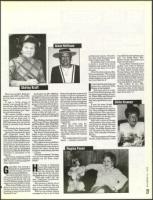

was called then the secretary gen-
eral, was Golda Meir," Mrs.
Kramer recalls. "She spoke at our
home several times."
Young Billie watched as her
mother was active in Pioneer
Women and countless pro-Zion-
ist clubs. Billie herself joined
Young Judaea, then other Jew-
ish groups. After marrying, she
and her husband became active
with the ZOA and Mrs. Kramer
served as chairman of a number
of annual Balfour celebrations.
The mother of two, Mrs.
t wasn't just his good looks and
brains that attracted Billie Kramer says her family has al-
ways been close to the Zionist
Kramer to her husband.
Both were active in a num- movement, "and it always will be
ber of local Zionist groups, like part of our lives." ❑
the Zionist Organization of Amer-
ica. When Billie met Richard at
one such meeting, they found
they had a great deal in com-
mon.
It was the same thread
that drew her to many oth-
er Jews throughout the commu-
nity. They belonged to different
organizations; they came from
different backgrounds. "But Zion-
ism is Zionism, and there's a thin
line that separates us all."
Billie was a native of Chicago,
whose parents were active with
such groups as Jewish National
Fund and Israel Bonds. Her
mother, whom Mrs. Kramer says
was "steeped in the labor move-
ment," was a founder of Pioneer
Women.
`The first president (of Pioneer
Women, today Na'amat), or what
professional reasons. Nonethe-
less, they made frequent trips to
Israel, beginning in 1962.
"I remember when I was living
in Berlin I would think about
Palestine and wonder, But how
will I ever get there, it's so far!"
she says.
Of her first trip to Israel, Mrs.
Feuer remembers, "The minute
the plane went down, everybody
started singing. It was such a feel-
ing I can't describe it."
That was how Mrs. Kraft got
started with JNF in the 1930s;
she has been a supporter ever
since.
It was a "lively group of
friends" who formed the JNF in
the old days, Mrs. Kraft says. It
also was a dedicated bunch of
women, all of whom were "capa-
ble and hardworking."
The women hosted a major
fund-raising event each year as
well as put on plays and, of
course, passed out the familiar
JNF blue boxes that can still be
found in virtually every Jewish
home.
"We raised a lot of money with
those boxes," Mrs. Kraft recalls.
Among the projects the local
JNF supported under Mrs.
Kraft's leadership was a drive to
raise $100,000 for a family recre-
ation center in Kiryat Shemona,
in memory of the children mur-
dered there by Arab terrorists in
1974. When Mrs. Kraft's hus-
band, Jules, died, she established
the Jules and Shirley Kraft Fam-
ily Forest in Jerusalem in his
memory.
The former president of JNF
and life member of the Women of
JNF remains a strong supporter
of theorganization.
olda Meir was coming to
Detroit for an appointment
with 60 women. One was
named Anne Helfman.
The native Detroiter was to re-
ceive an award for her work on
behalf of Israel Bonds. She was
one of 60 Detroit women who had
raised more than $1,000 in bonds.
When Anne Plotkin was 4, her
father was active with the Labor
Zionists and often "went around
knocking on doors for the Jewish
National Fund."
G
As she grew up, Mrs. Helfman
would continue work on behalf of
the JNF as well as join the Adat
Shalom sisterhood, which became
the first in the city to work, as a
group, for the Israel Bonds drive.
"That was when you could buy
a bond for $50," she says. "Little
old ladies — look who's calling
whom a little old lady now —
would save nickels and dimes and
quarters until they could afford
one."
Mrs. Helfinan has been active
with Pioneer Women, Hadassah
and B'nai B'rith. After World War
II, she wrote countless letters in
an effort to secure a place in Is-
rael for Holocaust survivors.
Her days of volunteering often
began in the morning and con-
tinued until 4 p.m. Mrs. Helfinan
credits her parents with foster-
ing her Zionist identity.
The eldest of seven children,
Mrs. Helfman says all the mem-
bers of her family were active on
behalf of the cause, though they
thought it would remain just that
— a cause.
"We had our dreams," she says,
"but we never thought we would
actually see the state estab-
lished."
er friends in Hadassah
were a little surprised, but
Regina Feuer had no doubt
she was doing the right
thing when she let her 16-year-
old daughter go on a trip to Israel.
"What else could I do?" she
says. "I told them: Tm half moth-
er and half Zionist.' "
She was born in Berlin, the el-
dest of three children. Her par-
ents were longtime Zionists and
Regina was active in Habonim.
With the rise of Hitler, Regina
managed to flee to the United
H
States (though her parents and
brother would be murdered by
the Nazis). She was 22 when she
came in 1937 to New York, where
she married, had three daughters
(a son was later born in Detroit)
and welcomed her in-laws into
her home.
The Feuer family moved in
1949 to Detroit when Regina's
husband, Arthur, a physician,
found work here. It was while in
Michigan that the couple became
leading members of the Zionist
community.
With his wife's help, Dr.
Arthur Feuer founded the
Friends of Israel Cancer Society.
He also was president of Ameri-
cans for a Progressive Israel, in
which Mrs. Feuer still remains
active.
The couple planned to make
aliyah — a decision canceled for
Regina Feuer
I