

2 ■
FALL1994 ISSUE
■
SINAI HOSPITAL
HealthNews
Special Services to Meet
Special Needs of Women
i2,;;;,.*K; •
omen today have many different roles to
fill —wife, mother, boss, student, or elder
caregiver. "The challenge of juggling two,
— ,., three or even four roles can bring tremen-
dolls pi-essure and lead to distress," explains Dr.
Hotchkiss, an expert in women's mental health.
Many women must cope with life events such as re-
entering the work force or joining the "sandwich gen-
eration" in which they care for elderly parents and/or
adult children. Or they may need to deal with the range
of emotions associated with separation, divorce, grief
and loss, substance abuse in the family, or domestic
violence. "Many of these women may need profession-
al help to continue functioning in their everyday lives,"
says Dr. Hotchkiss.
Sinai's team of women's healthcare professionals,
which also includes psychiatrist Rosalind Griffin, M.D.,
is dedicated to helping women cope with the challenges
of life. Dr. Griffin, who is also an expert in women's psy-
chiatry, acknowledges that the emotional struggles of
daily life may often lead to or aggravate existing med-
ical problems. Sinai's team of women's healthcare pro-
fessionals treat women and their loved ones who are
\NT
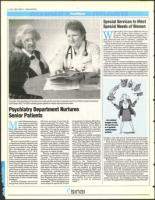
Physicians in the Department of Psychiatry work closely with the Sinai Senior Assessment and Clinic (SSAC) directed by Geriatrician
Sarah Gelberd, M.D. The SSAC evaluates geriatric patients for medical and psychosocial needs.
Psychiatry Department Nurtures
Senior Patients
ental illness among se-
nior citizens is growing
at an alarming rate. As
the population ages,
more ancT more older adults are
being diagnosed with depression
or related problems. These patients
require specialized care for both
their mental and physical condi-
tions.
Several mental health concerns
of seniors are directly related to the
psychosocial aspects of the aging
process, according to Sinai Hospi-
tal's Development and Quality
Manager Judy Paull, R.N., M.S.
"Many life experiences compound
the physical effects of aging," she
says. "In addition to growing older,
many senior patients are experi-
encing unemployment for the first
time, loss of a spouse or close rela-
tives and friends, loneliness, or fi-
nancial burdens. Some are faced
with illness or physical limitations.
These are significant changes in
one's life and all of these circum-
stances can significantly contribute
to depression or other mental health
problems."
At Sinai Hospital, seniors suf-
fering from mental illness can ben-
efit from an array of services de-
signed especially for them. "The
most important thing is to first iden-
tify any medical conditions that
may affect the psyche in geriatric
patients," says Chief of Inpatient
Service Ronald Trunsky, M.D., an
expert in geriatric psychiatry.
"We look at a patient's prescribed
medications to determine if the
medication may be causing some
secondary side effects," explains Dr.
Trunsky. If medications are found
to be the culprit, the psychiatrist
will consult the patient's attending
physician to adjust dosage.
The key to geriatric psychiatric
treatment is interaction, notes Dr.
Trunsky. "Once patients are sta-
bilized, we get them involved in
group activities and daily functions
that give them a sense of belonging
and worth," he says. 'They want to
talk about the future and their re-
lationships. And they want to live
enriched lives — just like all of us."
After discharge, many patients
are referred to one of Sinai's three
Day Hospitals where group activi-
ties and interaction continue to be
encouraged. "We've developed treat-
ment programs specifically for geri-
atric patients," explains Albert Bay-
er, M.D., Chief of the West Bloom-
field Day Hospital, which offers a
program designed to meet the
unique needs of geriatric patients.
`The groups are smaller and involve
careful one-on-one care."
In addition to readily available
medical and psychiatric care, Sinai
has another service for geriatric pa-
tients. The Sinai Senior Assessment
and Clinic (SSAC) works closely
with the Department of Psychiatry
to provide comprehensive care for
senior patients. Directed by Geri-
atrician Sarah Gelberd, M.D., the
SSAC evaluates geriatric patients
for medical and psychosocial needs.
The SSAC assists families of geri-
atric patients and often refers pa-
tients to the Department of
Psychiatry for specialized care. Drs.
Gelberd and Bayer work closely
with one another to coordinate
treatment between the SSAC and
the West Bloomfield Day Hospital.
As Dr. Trunsky notes, "Sinai's
diversity makes it an ideal health-
care facility for senior patients'
physical as well as emotional
needs."
sinal
...the emotional
struggles of daily
life may often lead
to or aggravate
existing medical
problems.
trying to cope with sexual dysfunction, breast cancer
or other cancer diagnoses, menopause and infertility.
Sinai has also devoted special attention to women
experiencing prenatal and post-natal disorders. The
hospital offers support groups and individual counsel-
ing for women who have suffered a miscarriage or preg-
nancy loss. Another support group is available for
women who are pregnant again after having a prior
loss and are struggling with conflicting feelings of
sadness over their previous birth loss and joy over the
impending birth.
Following the birth of a baby, nearly 50 percent
of mothers experience some form of post-partum
mood changes. Commonly known as the "baby blues,"
symptoms include feelings of extreme sadness or
depression. Although most symptoms subside within
days of the birth, Dr. Hotchkiss notes that approxi-
mately five to 10 percent of new mothers have severe
cases requiring treatment which Sinai provides.
"That's the true benefit of a comprehensive health
system like Sinai," Dr. Hotchkiss says. 'We can help
a woman through all the challenging times of her life."