
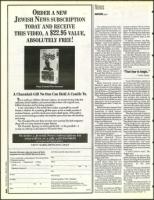

ORDER A NEW
JEWISH NEWS SUBSCRIPTION
TODAY AND RECEIVE
THIS VIDEO, A $22.95 VALUE,
ABSOLUTELY FREE!
IMPASSE page 1
A Chanukah Gift No One Can Hold A Candle To.
This is a gift your children will never outgrow. An award-winning video that
celebrates Jewish traditions and communicates to them with original music,
brilliant characters and fun loving animation.
A new subscription to The Jewish News makes a great gift for yourself,
friends or relatives. It's a yearlong gift that opens up into a weekly surprise of
exclusive features, up-to-the-minute news and in-depth stories. All brought to
you by award-winning journalists who treat the issues of the day with sensitivity
and caring.
Plus, throughout the year there are even more surprises like Style magazine
along with our many seasonal in-paper features.
This Chanukah, figuring out what to get the kids - or the grandkids - is
as easy as ordering a subscription to The Jewish News.
To order a Jewish News subscription for
yourself or as a gift, call 354-6620
or return the form below.
NEW SUBSCRIPTIONS ONLY
Receive 52 issues plus six issues of Style
magazine for only $39.00 ($54 out of state).
-
(1)
w
Cr)
❑ I'd like to send the subscription as a gift to:
-
❑ Yes, I would like a subscription to The Jewish News.
❑ Payment enclosed.
❑ Charge to my ❑ MasterCard ❑ VISA
Exp.
Card #
None
Address
Ciy
State
Zip
Signature (required)
Phone
LU
My Name
Gift card message
Send the free gift to: ❑ Me ❑ Recipient
My Address
LL1
UJ
City
1--
8
Phone
SicrIe
Zip
Please send all payments along with this coupon to:
The Jewish News, P.O. Box 2267, Southfield, MI 48037-2267
or call 354-6620 or 1-800-875-6621 out-of-state, 8:30 a.m. - 5:00 p.m.
All phone orders must pay by credit card.
All orders must be received by November 7, 1994.
AD 994
"It is nothing more than a dis-
honest distortion to in any way
suggest that the Farrakhan is-
sue characterizes blacks and
Jews and their relationship to-
gether," he says. "The fact of the
matter is that we in Detroit have
and will live together, must live
together, want to live together."
Even so, Mr. Lobenthal criti-
cized black leaders who uphold
the Rev. Farrakhan as a hero.
"You (the black community)
might not be able to denounce
him, but you can't elevate him,"
he says. "Here's a guy who lies
about Jews, who encourages
blacks to treat Jews badly. You
say to Jews that 'We're going to
make this man a hero,' and then
you say to Jews, 'Don't worry
about it.' That's a contradiction."
Rabbi Dannel Schwartz of
Temple Shir Shalom countered
Mr. Lobenthal and called him a
"politician" understating the lev-
el of tension between blacks and
Jews.
Rabbi Schwartz served on
Monday's panel of clergy who
posed questions to the speakers.
The panel also included Rabbi
David Nelson of Congregation
Beth Shalom and Rabbi Sherwin
Wine of the Birmingham Temple.
"To say that it's the press' fault
and not all of our faults is a mis-
take and is lying to ourselves,"
Rabbi Schwartz said. "I really be-
lieve that."
Rabbi Schwartz stressed that
Jews must demonstrate more
sensitivity to black history.
Jewish leaders should address
the aftermath of centuries of slav-
ery by talking about reparations,
instead of exclusively focusing on
their own Holocaust.
"I really believe that the ADL
should be working on a mutual
respect and an admission of our
own guilt, too," he said. "Our own
guilt, not in causing slavery, but
in not recognizing pain."
The Rev. Smalley replaced
Hartford Memorial Pastor
Charles Adams, who left on a
Middle East trip Monday with
President Bill Clinton to attend
the Israel-Jordan accord signing.
"I know there is a lot of fear
that operates in both our com-
munities and that fear is tragic,"
she said, noting several factors
exacerbating the tension between
blacks and Jews.
People are not sufficiently ed-
ucated about ways the two
groups worked together during
the civil-rights movement, she
said. Furthermore, the physical
separation of black children in
the cities and whites in the sub-
urbs only serves to reinforce at-
titudes of us-and-them.
"I know most black children
only see black and white," she
said, pointing to the Eight Mile
Road border between Detroit and
suburbia.
"I know we teach our children
how to be racist," she said. "We
do it by our inability to cross lines
in great numbers. We do it when
we refuse to share our resources
fairly. We do it when we are un-
able or unwilling to be with each
other across a border that I've
learned to almost hate in the
Detroit area."
A major concern, the Rev.
Smalley said, is that wealth will
continue to move out of the inner
city, leaving blacks without hos-
pitals and other institutions nec-
essary for survival.
As for the Louis Farrakhan is-
sue, the Rev. Smalley says she
looks to a different black leader,
Cornel West, who advocates un-
derstanding, cooperation and
peaceful reconciliation through
honest and ethical behavior on
both sides.
"That fear is tragic."
— The Rev. Smalley
"Louis Farrakhan speaks to
the brokenness that many black
people feel," she said. "He is able
to speak very passionately about
the state of economic blight that
many black inner-city people ex-
perience. He speaks to the ab-
sence of black males in homes.
And whether the methods he
uses to talk passionately about
these ills is right or wrong, this
is what happens. Black leaders
who have the same status in the
community as Louis Farrakhan
does must be willing to sit down
and reason with this man ...
• "But Jews have got to learn to
accept the fact that (some) blacks
are always going to respect
Farrakhan and that respect for
Farrakhan does not mean they
will do things to you," she said.
If Marty Bulger could do one
thing to help blacks and Jews im-
prove relations, he would edu-
cate people about the real scene.
The Southfield middle-school
teacher was one of few blacks in
the audience Monday night. He
hears myths emanating from
both communities. Too many
blacks consider Jews dollar-driv-
en opportunists. Too many Jews
think blacks just want monetary
hand-outs.
"I don't believe that," Mr.
Bulger says.
Education is the key to inter-
ethnic harmony, he believes. But
there's one thing Jews shouldn't
expect from blacks: An all-out de-
nunciation of the Rev.
Farrakhan.
"In our community, Farrakhan
is someone who brings us out,
who lifts the sense of self," Mr.
Bulger said. "But (his) finger-
pointing and name-calling has
got to stop. It gets us nowhere.
It's wrong.
"I believe the denunciation of
Farrakhan is not going to hap-
pen from the black community
as a whole because of the influ-
ence he has on lifting young black
children's sense of self." ❑