

4
Recent forum
addresses
end-of-life issues.
JENNIFER FINER STAFF WRITER
inure
tore and their future is the end of their life,"
she said.
She told the audience of one occasion
where a man refused a potentially life-sav-
ing amputation. He made no legal plans
and had no known family, except for sib-
lings — but they were not on speaking
terms.
The court said this man was not compe-
tent to make medical decisions. It appoint-
ed Ms. Donaldson to decide for him, and he
ended up having the amputation against
his will.
"What can we learn from this man?" Ms.
Donaldson asked. "In his decision to control
everything, he controlled nothing. He was
deprived of his decision-making
process. When he died, his property
went to his siblings who had no use
for him."
Most people know they need end-
of-life legal planning. They just don't
want to acknowledge it, the panelists
said. But many individuals are un-
aware of hospice as an option to make
a dying person as comfortable as pos-
sible in their home.
Hospice is a program of care and
support for terminally ill patients and
their families.
"Many doctors and families are
hesitant to discuss hospice," Dr. Finn
said. "There is a common notion that
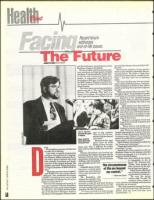
Left, Dr. John Finn swer to the question hospice helps people die. It doesn't help peo-
discusses the option `Why me?' The circum- ple die, it helps dying people. Hospice care
of Hospice.
stances of life are beyond is intensive care. Hospice tries to keep the
patient as comfortable as possible and feels
our control."
Above, Gabrielle
dying needs to be de-medicalized."
Because
of
this,
legal
Osooli takes notes
David Techner of Ira Kaufman mlled this
plans must be made
during the forum.
ahead of time, the pan- the "home-court advantage."
"People feel comfortable in their own sur-
elists said. This is difficult for people
ng.
he says.
roundings,"
don't
want
to
acknowledge
their
own
mor-
's something everyone will face but
Almost half of the inquiries to the Ira
tality.
we often fail to address.
Patricia Donaldson's job involves ad- Kaufman Chapel are for someone who died
II) yiIt Last week, a roomful of community
a hospital, ac-
members who gathered at Congrega- ministering the estates of people who die at home as opposed to in
to David Techner.
cording
leaving
no
known
heirs.
She
stressed
the
tion Shaarey Zedek confronted the is-
"There was a time where it was virtual-
sue with a panel of experts who work importance of planning, which includes
ly impossible to die at
drafting
a
will
and
appoint-
with critically ill patients and family
home," Mr. Techner said.
ing
a
durable
power
of
at-
members of the recently deceased. The
"Today, more people are
program was titled "Facing the Future: torney.
able to remain in the com-
A
durable
power
of
attor-
An Open Discussion of End-Of-Life Is-
fort of their own homes."
ney gives a second party
sues."
Rabbi Groner offered ad-
control
over
one's
finances
"Each day we come closer to death,"
vice
to family members fac-
said WJBK-TV2 news anchor Sherry if he or she becomes inca-
ing the loss of a loved one.
pacitated.
Margolis, who moderated the forum.
— Rabbi Irwin Groner
"Be sure the person
Ms. Donaldson also
"(Death) is something we try not to think
wants
to talk," he said. "Be
about because it's painful, but it's so im- stressed the necessity of ap-
sensitive, listen, respect si-
pointing
a
medical
power
of
portant to think about it."
lence, describe your feelings and reminisce;
That was the message delivered by fo- attorney to make life and death decisions memories are wonderful.
about
treatment
if
the
patient
cannot.
Fail-
rum panel members Patricia Donaldson,
`The most important message for the dy-
an Oakland County public administrator; ure to do so could result in a court-appointed ing is to let them know they will not be for-
guardian,
like
Ms.
Donaldson.
Dr. John Finn, the medical director of Hos-
"I've been involved as a total stranger gotten, they are loved and they have
pice of Southeastern Michigan; Rabbi Ir-
when
people fail to make plans for their fu- touched lives." 0
win Groner of Congregation Shaarey Zedek:
and David Techner, funeral director at Ira
Kaufman Chapel in Southfield.
The forum dealt with the physical, spir-
itual, emotional and legal aspects of death
and dying. It was sponsored by Jewish Fam-
ily Service and its education forum com-
mittee, in cooperation with Hospice of
Southeastern Michigan, the Michigan Jew-
ish AIDS Coalition, National Council of Jew-
ish Women Greater Detroit Section and
Sinai Hospital.
"The most heart-wrenching question a
patient can ask is: 'Why me?' " said Rabbi
Groner. "The question 'Why me?' is a
lament. It's a scream. The patient is crying
out in pain and bitterness. What's the an-
CO
UJ
LLI
F-
CD
CC
LLI
CI
LU
56
The circumstances
of life are beyond
our control."