

to Sandra VanBerkleo, who teaches
American constitutional history at
Wayne State University. She has writ-
ten a book about the law and feminism,
to be published by Oxford Press.
"Men and women began banding to-
gether in the 1830s," said Ms. Van-
Berkleo. "There were many factions.
The core group dealt with the question,
`What is meant by freedom?' This ini-
tial movement had at least a dozen
points of view — from abolitionist, to
economic freedom, to the right to vote."
Ultimately, the unifying force be-
came known as Women's Suffrage,
commonly concerned with winning the
right to vote. Until 1919, American
women were not counted on election
day. By 1994, women make up more
than half the population, and a deci-
sive voting block.
It's unfair, however, to draw any as-
sumptions about the women's vote, as
former presidential candidate Walter
Growing up in the fertile farmlands
of northwest Iowa, she witnessed the
intimidation tactics of the KKK toward
the town's Catholics and Jews. After
moving to Pennsylvania where she was
employed in a factory with dreadful
working conditions, Ms. Jeffrey's social
conscience was awakened.
Eventually, she found herself work-
ing for organized labor, where she
headed the Women's Education De-
partment at the United Automobile
Workers. Her political organizing
brought her to Mississippi during the
voting registration drives. She also
walked alongside Walter Reuther in
civil rights marches.
By the early 1970s, Ms. Jeffrey joined
Bella Abzug, Gloria Steinem and oth-
ers to form NOW and the National
Women's Political Caucus. "We were
aware that the women's movement
needed a political arm. Our purpose
was to elect women to office at every
her treatment for an impending ulcer
was the incentive to write The Only
Boobs in the House Are Men, a book
that offers a series of anecdotes of her
life as a female legislator. Many of the
anecdotes deal with how gender politics
play a role in issues such as breast can-
cer, family planning and abortion.
Candid and outspoken, Ms. Berman
is the type of feminist that Rush Lim-
baugh derisively calls a FemiNazi.
"People in the right wing use 'femi-
nism' to threaten people to think that
a woman wants more than she de-
serves," said Ms. Berman. "I've never
known a progressive women who
thought there was anything wrong with
making a decision to stay home and
take care of their children. That's every
bit as admirable as going out and work-
ing. People like Rush Limbaugh twist
these terms."
During the last 20 years, Ms.
Berman has been one of the increasing
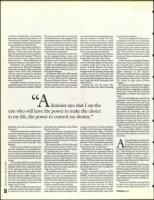
feminist says that I am the
one who will have the power to make the choice
in my life, the power to control my destiny."
Mondale and other candidates have
found out.
Unfair generalizations about femi-
nism have created many negative con-
notations. "The response I hear from
students is, `I'm not a feminist, no way'
— A sort of abject refusal to associate
with this dirty word," said Ms. Van-
Berkleo.
A dirty word, perhaps to some. But
to most, feminism is a contradiction.
Few other terms can incite high rever-
ence as well as crass revilement. Or, be
seen as inclusive and liberating as well
as exclusive and discriminatory based
on sex.
"Some people believe in equality but
won't call themselves a feminist," said
Mildred Jeffrey, 82, a legendary fight-
er for women's issues in the last 50
years. Ms. Jeffrey, former chair of the
Michigan Women's Foundation, was
featured recently in MS. magazine as
one of the 100 top feminists in the coun-
try. "It's very simple, we just want full
and equal opportunity for women in all
aspects of our lives."
Ms. Jeffrey's political experiences
composes a quilt of the social struggles
in America of the last half-century.
level, from the courthouse to the White
House," she said.
Twenty years ago, the provocative
images of bra burners and libbers" be-
came the stereotype of feminists, ac-
cording to Jackie Beyer, director of the
Women's Studies Program at Wayne
State University.
Ms. Beyer's book, All That Hollywood
Allows, focuses on how women were
portrayed in some of the most popu-
lar melodramas of the 1950s.
`The media tends to report on the ex-
tremes, so you get people who get more
publicity who are male bashers or bra
burners and the public gets this gen-
eral impression that feminists are in-
tolerant and without a sense of humor,"
she said. "Some of my best friends are
male. I'm married to one."
Nonetheless, most feminists agree,
the tension at the center of the move-
ment is the goal to fundamentally
change a male-controlled political struc-
ture. Feminists claim social change re-
quires a new approach to politics and
a better understanding of gender.
For 12 years as a state representa-
tive, Maxine Berman observed her
male colleagues. And, she jokingly said,
number of women in elective politics.
In 1982, only 10 percent of state legis-
lators were female. Today, the figure
stands at 20 percent. "Women play ex-
traordinarily important roles on laws
regarding health care, spouse abuse,
" rape, and children's issues," said Ms.
Berman. "But in a broader sense, dear-
ly, women are playing a role on all
issues from taxes to education."
Watching her mother struggle to
compensate for the unexpected loss of
income when her father died, Carol
King knew early on that a woman's
place was anywhere she could dream
it to be. With her mother as a role model
together with lessons learned from
watching her father, a union organizer,
Ms. King has shown that "you fight for
what you believe in."
Today, as executive director of the
Michigan Abortion Rights League
(MARL), she's been on the winning side
of recent court rulings reversing the
24-hour waiting period and informed
consent laws for abortions. Ms. King
claims that since the Roe vs. Wade
ruling and recent court decisions, "the
right to choose" has become a funda-
mental constitutional right, a key tenet
in any feminist agenda.
"You can be opposed to abortion on
a personal level and try to dissuade
someone on a personal level, but you
cannot be a feminist and advocate for
a public policy that denies women a
fundamental right to choose," Ms. King
said. "We must have autonomy and
bodily integrity. It's more than a right
to privacy, it's an intimate, emotional
life decision."
In the courtroom, Elizabeth Gleicher
works day-to-day on problems women
face in health care. A partner in Gle-
icher & Reynolds, P.C., she is recog-
nized as one of the top reproductive
rights attorneys in the country.
"Women's health problems, including
obstetrical problems, are considered
less important than men's," she said.
"I'm trying to right some of those
wrongs."
Ms. Gleicher learned about "taking
a stand" from her parents. Her father,
Morris Gleicher, a legendary political
consultant, was involved in political
campaigns in Detroit for nearly 50
years.
Her pro bono legal case work for the
American Civil Liberties Union of
Michigan includes some of the most
controversial and scrutinized public
suits: she challenged the ban on Med-
icaid funded abortion, the 24-hour wait-
ing period for abortions, and the
informed consent law. Recently, Ms.
Gleicher's suit against Blue Cross on
behalf of women with breast cancer
seeking coverage for bone marrow
transplants pushed the reluctant in-
surance carrier to pay for the surgery.
The emergence of women's health
care issues, said Ms. Gleicher, is part
of the stronger political role women are
playing in the legislature and in the
courtroom.
Am,
lthough Rabbi Amy Brodsky
of Temple Emanu-El is one
of only three female rabbis in
"chigan, she's reluctant to
credit feminism for paving a path for
her. "None of this was an issue for me.
I never thought that I could or couldn't
become a rabbi because I was a
woman," she said. "I was raised to be a
person to help others and it didn't mat-
ter that I was a woman."
Temple Israel Rabbi Josh Bennett,
who was recently ordained, recalled
that his classes at Hebrew Union Col-
lege-Jewish Institute of Religion had a
50/50 breakdown of women and men.
He supports the feminist struggle for
equal rights, but he resists calling him-
self a feminist.
"Women in Judaism are searching
for new ways to be equal partners in
tradition and religious practice," he
FEMINISM page 60