

streets, and later Cortland near Linwood.
It was, he says, the kind of place where
"you never locked your door at night, you
slept on your porch, and everybody was
your neighbor."
Though a streetcar ride was just a nick-
el, money was always tight. Mrs. Weis-
ling took a job at Darby's restaurant
downtown and managed, at times, to
bring home some flanken and potatoes,
carefully wrapped in cheesecloth. Mort
found work, too, in a lingerie shop.
"At first I was putting on price tags,
then I started selling bras. That's when
satin bras were really popular," he says.
"When I began, I didn't know anything
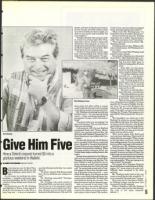
Mort Weisling in Korea.
Mart We!sling
I>
Give Him Five
How a Detroit corporal turned $5 into a
glorious weekend in Waikiki.
ELIZABETH APPLEBAUM ASSOCIATE EDITOR
B
y the time he was 15, Mort Weis-
ling already knew all the ins and
outs of finding a great deal in De-
troit.
For 35 cents, he could get an entire
breakfast — complete with meat, eggs,
toast and wheatcakes. For $1.15, he'd find
a lunch of Coney Islands and a drink and
`Th dessert.
By the time he was 20, Mr. Weisling
/-)
was fighting in Korea. Later based in
Waikiki, he managed to make $5 go a
long, long way — a story so impressive
even the Honolulu Advertiser ran a piece
about it.
"To what," reporter Bob Krauss asked
him, "do you attribute your unique suc-
cess?"
Mr. Weisling responded: "Strategy,
man, strategy."
Mr. Weisling, who today resides in
Bloomfield Hills, was born and raised in
Detroit, the son of an immigrant mother
from Lithuania and a father from Hun-
gary. He grew up in the old Jewish neigh-
borhood on Euclid between 12th and 14th
about sizes, but after awhile a woman
would walk into the store and I could go
to the shelves and get a bra just like that."
Mr. Weisling was sinking his teeth into
his life's career — he was entering dental
school — when something happened. "I
got patriotic," he says, "and I went and en-
listed."
"You knew what you were doing," he
says of his decision, "but you didn't know
what you were doing."
It all started in 1950, the year England
recognized Israel and "Tzena, Tzena,
Tzena" was a popular song and Sen. Joe
McCarthy told President Truman the U.S.
State Department was riddled with Com-
munists.
On June 25 of that year, North Korean
forces invaded South Korea, capturing
Seoul. Headed by Douglas MacArthur,
United Nations troops landed in South
Korea but were forced to withdraw. When
all peace-making attempts failed, the
United States began sending forces to.the
region.
Among those stationed on the 38th par-
allel was an infantryman named Mort
Weisling. Life, he says, was like this: "No-
body bathed or had hot food for two to
three weeks at crack" and everybody
lived in trenches that were "cold, cold, cold,
cold." He worked side-by-side with a Turk-
ish brigade so fierce they thought noth-
ing of bringing back souvenirs — ears
sliced off the enemy. Yom Kippur services
were in a tent; Rosh Hashanah dinner fea-
tured a piece of gefilte fish. He dealt with
anti-Semitism among his own unit; "You
learned to survive and you learned to cope.
And you learned to get along." The
greatest thing in the world was Gobel
Beer, made right at home in Michigan,
cooled in 50-caliber ammunition boxes,
and maybe a bite of meat ("My mother,
God love her, sent me salamis wrapped
in foil, and clean sheets and a pillow").
"Most of all," Mr. Weisling says, "we
looked forward to the letters from home."
Several months into duty, Mr. Weisling
chanced to see a soldier "dressed impec-
cably." His nameplate read "Greenberg."
"You've got to get me out of here," Mr.
Weisling told him.
Greenberg had an idea. Military offi-
cials needed typists. Did Weisling know
how to type?
Know how to type? Mort Weisling could
type 60 words a minute.
He proved it, whipping out a document
on an old R.C. Allen typewriter that so im-
pressed supervisors Mr. Weis-
ling was sent right away to
military headquarters 30 miles
away.
Soon after, he was trans-
ferred to the 25th infantry di-
vision, based in Hawaii. His job
— "it was like a blessing, I can't
even tell you" — was oversee-
ing vacation duty for officers.
Cpl. Weisling made $100 a
month, most of which he sent
home. What did he need all
that money for, when he could
easily get by on $5.
His plan, he told the Hon-
olulu Advertiser, went like this:
"Saturday afternoon you buy
a round-trip ticket on the bus
to Honolulu. That's one buck.
Then you buy a round trip tick-
et on a Honolulu bus to Waikiki You have
spent $1.30. You are in Waikiki It is din-
ner time. You go to the Barbecue Inn
where, for $1, you get an eight-course
meal. That night, you rent a room at Fort
DeRussy for 75 cents. That means you've
spent $3.05. There's plenty left. You're liv-
ing.
"For breakfast, you walk over to the
Melting Pot where you can get flapjacks
and coffee for 35 cents. You take it easy
on lunch, just 25 cents for a hamburger
and a Coke, so you can have a big dinner.
This will take you to the Waikiki Sands
where, for $1.25, you may go to the sal-
ad bar and eat all you want.
"Now you've spent only $4.90 and
you've got your fare home. There's still 10
whole cents in your pocket. When you get
to the bus depot, you'll see a little man
there selling peanuts. You buy a sack and
live it up all the way back to the barracks."
After the war, Mr. Weisling returned
to Detroit where he found work selling
vacuum cleaners. Today, when not play-
ing golf, he serves as head of Giant, the
home-improvement business he founded.
Recently, he was doing some basement
cleaning and discovered much of his old
war memorabilia. "What am I going to do
'with all this?" he thought.
The Jewish War Veterans National
Memorial Museum and Archives in Wash-
ington, D.C., knew what to do with it all.
Officials have accepted it for their
archives.
Mr. Weisling looks back at his war
years as terrifying but also wonderful. "I
try to remember the good part," he says.
Nine years ago he returned to Waiki-
ki. Nothing, he says, was the game. And
that goes for the $5 weekend.
While in Waikiki in 1985, Mr. Weisling
met up again with reporter Bob Krauss.
The cost of the same weekend:
$49.92.0