

\....... 71`ft ■
annah is 26 years old. Her
dark eyes are glazed. Her teeth,
worn and yellow. Her once-sturdy
back now sags.
These days, Hannah gets plenty of
rest. Extra feed, too. She earns the
royal treatment. It wasn't always that
way.
Workhorse.
A child with cerebral palsy? He was Han-
nah's. A mangled soldier with half his brain
missing from a terrorist attack in Lebanon?
Hannah's, too. A 60-year-old victim of a stroke?
Also Hannah's. A girl paralyzed in a motor
vehicle accident? Hannah again. A teen-ager in
trouble with the law? Blind 5-year-olds? An 80-
year-old who spent most of her time in a con-
valescent home bed? They all belonged to
Hannah.
Nearly 80,000 in all. That's how many times
Hannah has carried disabled riders in her
saddle since 1986, when the former Golan
Heights cattle horse became the first mount for
the Therapeutic Riding Club of Israel.
Anita and Giora Shkedi's dream of promot-
ing the recovery of the disabled through horse-
back riding started with Hannah. Today, there
are 15 horses (with three more on order from
the United States), contracts with the Ministry
of Defense and almost 200 participants each
week.
"She's the queen of queens," Ms. Shkedi says
of Hannah. "What an amazing temperament.
She'd never lose her rider. She'd rather fall on
the floor herself."
It takes the Shkedis about four years to train
a horse for their program. The biggest obstacle
is changing the horse's instincts to run.
The Shkedis' office, stable, paddock and rid-
ing rings have been at the Beit Yehoshua
moshav, just southeast of Netanya, since 1989.
A generous admirer of their program, who was
afflicted with multiple sclerosis and recently
died, let them use his land.
Rehabilitating the disabled through "hippo
therapy" and therapeutic riding is growing in
popularity in several countries, including Eng-
land, the United States and Canada. Among.
the prominent users of therapeutic riding is Jim
Brady, former presidential press secretary to .
Ronald Reagan, who was shot in the head in
1980 and still participates in the program at
Rock Creek Park in Washington, D.C.
The North American Riding for the Handi- .
capped Association lists 18 programs in Michi;
gan, including the Tollgate 4-H Center in Novi,
the Oakland County 4-H Center in Pontiac and
H arill
the Banbury Cross Therapeutic Equestrian doing anti-social things, like popping out his
Center in Metamora.
glass eye into people's tea.
The Shkedis were the first to introduce ther-
"Now, after three or four years, he can feel
apeutic riding and hippo therapy to Israel. Now, sad or happy, his memory has come back and
it is available in five locations, including facil- he completely uses the other side of his brain.
ities in Gamla and Afula opened by some of the He does no other therapy except riding three
couple's former riding instructors.
times a week."
"Hippo therapy" is the most basic treatment
While Israel's ongoing battle with terrorists
available. A passive rider is influenced by the is well chronicled, many of the center's patients
rhythm and motion of the horse, from the steady come from an equally crippling, but less-
4/4 beat of the hoofs to the rolling motion of the publicized source — automobile accidents.
gait. At later stages, the rider becomes more
Here, too, the center has achieved significant
active as various games encourage him to results.
exercise more of his body. For example, a rider
"We have a girl who's been with us for two
might lie face-down on the back of the horse years with a head injury she received from a
road accident," Ms. Shkedi says. `We needed
while playing with a ball in his hands.
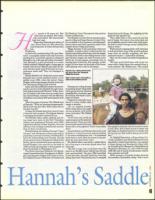
Opposite: Gal, a blind and deaf Israeli
boy, gets a ride at the Therapeutic
Riding Club of Israel.
Right: A trainer leads a blind child to a
world of self-confidence and fun.
Therapeutic riding focuses
on teaching proper riding skills
while going beyond physical
rehabilitation. A primary goal
is building self-esteem and a
sense of control.
Progress is typically mea-
sured in years, rather than
weeks or months.
"It's an ongoing process.
With a head injury, you might
not see progress until maybe
seven years later," Ms. Shkedi
explains.
"In the first year, you'll see
rapid progress in the patient's
walk and gait. Then, you want
to see improvement in his emo-
tional state and judgment. That's what takes
time."
Israel's Ministry of Defense believes the wait
is worth it. It has 30 severely injured soldiers
-- an entire rehabilitation unit — on horseback
three times a week. Most have been in the pro-
gram for more than three years.
Ms. Shkedi offers a case study: a soldier blown
out of his jeep in a terrorist attack about four
years ago.
"He had a huge hole in his head when he
came to us. He didn't know who he was. He was
just a moving body," she says. "We found that
in the first year, we could teach him when his
riding days were. The second year, he stopped
four people to help her onto the horse for about
a year. Now, she is down to just a leader and
last week, my husband took her on a leader and
let her run out. She could at last go out and be
free."
Dr. Mitchell Rosenthal, a Wayne State Uni-
versity professor and Detroit Medical Center
specialist in closed-head injuries, was exposed
to hippo therapy and therapeutic riding while
on the staff of the Marian Joy Rehabilitation
Hospital in Wheaton, Ill., from 1986 through
1989. He said he heard of enthusiastic reports
from patients and staff.
While unaware of specific studies showing
the benefits of horseback riding, "this is not a
e
,1-
01
C)
CO
CNJ
CC
UJ
CO
2
UJ
LU
49