

Clearing
The
1161i-daze
A rabbi's survival kit brings
understand'ing and joy
to High Hoiday services.
DE TRO IT JEWISH NEWS
I
w
72
magine this scenario: It's
Rosh Hashanah, and a
congregant has just blown
the first "Tekiah" note on
the shofar. Out of the cor-
ner of his eye he sees an-
other congregant waving
her hand frantically in the
air. He recognizes her, and
she asks, "But why do you
blow the shofar?"
The whats and hows of Judaism are
fairly simple. On Rosh Hashanah, we
blow the shofar, on Yom Kippur we fast,
and when we marry we stand under a
chuppah. Unfortunately, its the whys,
the essence of the religion, which can go
unexplained.
In his holiday "survival kits," Rabbi
Shimon Apisdorf undertakes the formi-
dable task of explaining the whys in such
a way that people who usually spend
High Holiday services counting the ceil-
ing tiles will want to sit up and pay at-
tention, and those who had given up on
worship may venture out to observe at a
local synagogue:
The "Rosh Hashanah/Yom Kippur
Survival Kit" and "Passover Survival Kit"
are just the first two in what Rabbi Apis-
dorf hopes will be a series of "15 books in
five years to educate 500,000 Jews" that
will be printed by Leviathan Press. Rab-
bi Apisdorf told the Detroit Jewish News
he established the publishing company
to disseminate "classical Jewish ideas in
an idiom that would meet today's mind,
today's world, today's curious Jewish
adult."
After studying at the University of
Cincinnati, Rabbi Apisdort a 36-year-old
native of Cleveland who now lives in
Columbus, Ohio, went to Cleveland's
Telshe Yeshiva rabbinical college and
Jerusalem's Aish Hatorah College ofJew-
.
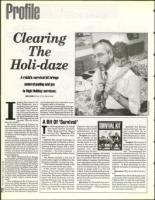
PHOTO BY CRAIG TERKOWITZ
AMY LEVIN SPECIAL TO THE JEWISH NEWS
ish Studies before his ordination as an
Orthodox rabbi in Jerusalem.
While living in Canada eight years ago,
Rabbi Apisdorf unknowingly planted the
seed for his books when he ran a High
Holidays "Adult BeginnOrs Service for
people who are tired of sleeping through
A Bit Of `Survive
I
he following passage is an excerpt
from Rabbi Shimon Apisdorfs
"Rosh Hashanah/Yom Kippur
Survival Kit:" Question: Why
don't we celebrate New Year's in Janu-
ary?
Answer The calendar that begins in
January and.ends in December is known
as the Gregorian calendar and was in-
troduced by Pope Gregory XIII in 1582.
This calendar is based on an even earli-
er calendar — the Julian calendar
which was introduced by Julius Caesar
in 46 B.C.
The Jewish calendar is not only of
much earlier origin, but differs from the
Gregorian calendar in numerous ways.
1)The Jewish calendar is based on the
moon (lunar) and not the sun (solar).
2) The Jewish calendar contains a
number of "new year" dates. This is like
having a fiscal year that overlaps two cal-
endar years. The month of Tishrei, which
begins with Rosh Hashanah, is the be-
ginning of the year vis-a-vis the number
of years, i.e., 5752, 5753, etc. The month
of Nissan, the month in which Passover
falls, is considered the beginning of the
year with regard to the festivals
(Passover, Shavuot and
Sukkot) as well as for the
establishment of the
reign of a Jewish king.
Insights: Our calen-
dar is based on the
moon, and, similarly the
Jewish people are com-
pared to the moon. No
sooner has the moon dis-
appeared into utter
darkness than the first
illuminated sliver reappears. No matter
how dark things seem for the Jewish peo-
ple, we must know that the "light" is al-
ready waiting to reappear. Jewish history
is an ongoing portrayal of this principle.
Also, unlike the sun which is always pre-
sent in its fullest form, the moon pro-
gresses in stages until it is full and
radiant. A Jew must look at life as a con-
stant process of growth and development.
Tiny beginnings can grow to their fullest
growth and potential and even darkness
can be overcome.
Question: On Chanukah the meno-
rah burned for eight days; on Passover
the Jews left Egypt — what happened on
Rosh Hashanah?
,
Answer: The Talmud
relates that man was cre-
ated on the first day of
Tishrei. This being the case,
Rosh Hashanah is a birth-
day of sorts for the human
race.
Insights: The account of
the creation of man in the
Torah states that man was
created "in the image of
God." The meaning of this
is that man possesses free will. Our ac-
tions are not predetermined by any di-
vine, psychological, or sociological forces;
rather we are free to choose and are thus
responsible for the consequences of our
actions ... on Rosh Hashanah we cele-
brate our humanity by exercising our free
will.
Question: Why do we blow the sho-
far?
Answer Since Rosh Hashanah is the
anniversary of the creation of the world,
it follows that it is also the anniversary
of God being sovereign over the world.
Rosh Hashanah is a coronation of sorts
and thus we trumpet the shofar just like
at a coronation ceremony.
❑