

The Suldiah
Stays tip
I
he most recent issue of
the Ann Arbor New
Jewish Agenda
newsletter begins with
an article titled The
Sukkah Fell Down. In
it, an unnamed writer
says: "I was thinking about how
easy it is for an organization to
go down the tubes . . . Miss a
newsletter and the whole damn
organization falls apart."
Is the Ann Arbor New Jewish
Agenda really on its last legs? Not
quite, longtime member Karen
Cooper says.
"The sukkah story really asks
what we are going to do. Pm pos-
itive about NJA. We just got a
grant to educate the Jewish com-
munity about gay and lesbian civ-
il rights. It'll be hard work, but
we still have a viable, interesting
group here."
Despite these disparate views,
the Ann Arbor NJA still appears
to be working toward the goals
set 15 years ago by its founders.
The group says it is fighting
racism and anti-Semitism, sup-
porting feminist activism and
seeking a two-state, Israeli-Pales-
tinian settlement in the Middle
East.
Inspired by an essay in The
Progressive about alienation
among left-wing Jews, founders
of the Ann Arbor NJA first met
in October 1979, with the article's
author, Carolyn Toll.
Her thesis — that leftist Jews
had become estranged from both
the left (because of its anti-Semi-
tism and harsh view of Israel)
and from the mainstream Jew-
ish community (because of its ar-
dently pro-Israel stance) —
resonated deeply among left-lean-
ing Ann Arbor Jews.
The Ann Arbor group's first ac-
tivity was the January 1980
showing of the film We Are All
Arabs In Israel.
Founder Claudia Kraus Piper
recalls that the event was both a
success and a failure: "Lots of peo-
ple came, but we didn't realize
Fifteen years
since its
founding, the
New Jewish
Agenda
continues
to challenge.
STEPHEN SAGNER
SPECIAL TO THE JEWISH NEWS
how negatively the Jewish com-
munity would react. We were
called anti-Semitic and anti-Is-
rael."
Shortly thereafter, national or-
ganizers met in New York to form
local progressive Jewish groups
and establish links among exist-
ing left-wing Jewish organiza-
tions. They planned a national
newsletter and a Conference for
a New Jewish Agenda for the
1980s, from which they hoped to
create a new Jewish politics and
a community using Jewish tra-
dition — religious and secular—
as a basis for action.
Ann Arbor members Ruth
Kraut and Claudia Kraus Piper
say despite these national devel-
opments, the Ann Arbor group
"was always independent." At the
founding convention in Wash-
ington, Ms. Piper recalls, the Ann
Arbor unit was "the only local
group to vote against a nation-
al, centralized organization . . . it
was very unpopular."
From the beginning, Ann Ar-
bor members gathered for month-
ly Shabbat pot-luck dinners,
Jewish holiday observances, dis-
cussion groups and overnight re-
treats. They also undertook
different forms of political ac-
tivism: sponsoring
speeches by dissident
Israeli soldiers, Pales-
tinian leaders and Cen-
tral American
asylum-seekers, donat-
ing blood, gathering
food for the hungry, as-
sisting Honduran
refugees, staffmg a
table at the Ann Arbor
Art Fair, and protest-
ing — against a Meir
Kahane speech at the
University of Michigan,
Nazis marching in Ann
Arbor, apartheid in
South Africa and the Is-
raeli invasion of
Lebanon.
NJA members say
their relationships with
traditional Jewish or-
ganizations have gen-
erally been positive
over the years.
In 1982, the group
was allowed to join the
Arm Arbor Jewish
Community Council
(initially, members
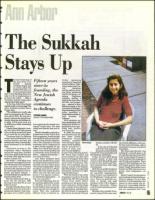
were told their organi- Karen Cooper
Society and the U-M Hil-
zation would "probably
lel.
only be around for a
It has also coordinated
couple of years, and
activities with organiza-
thus was not eligible to
tions such as the Interfaith
be part of the enduring council," Council for Peace and Justice and
Ms. Kraus Piper recalls), and the Palestine Aid Society.
group members say they have
Today, the Ann Arbor group
seen a lot of support. Even when consists mainly of men and
NJA protested at the U-M-spon- women in their 20s and 30s, most
sored Israel Conference Day, living in Ann Arbor and Ypsi-
there was no backlash. (In com- lanti, representing a wide range
parison, a booth of the Philadel- of professions.
phia NJA chapter was physically
Ruth Kraut and her husband,
attacked by members of a right- Michael Appel, both work for lo-
wing Jewish group.)
cal non-profit organizations.
While the boards of Ann Arbor Karen Cooper is an employee of
synagogues would not formally the Washtenaw County govern-
endorse the 1987 NJA-sponsored ment. Some are graduate stu-
"Voices From South Africa" dents or faculty and staff
speaking tour, the group has fos- members of the U-M or Eastern
tered cooperative relationships Michigan University. Others
with a number of Ann Arbor Jew- work for local businesses and cor-
ish organizations, including Tem- porations.
ple Beth Emeth, Congregation
Members cite a number of rea-
Beth Israel, the Jewish Cultural sons for joining NJA: some want
the Jewish affiliation, a few pre-
fer the social activities, others
participate because of political
motivation.
Ms. Kraut says that she "was
looking for a Jewish place to fit
in" and that she has found NJA
to be "a way-station for people to
move between the progressive
and Jewish communities. There
are now NJA members on the
JCC board and the Beth Israel
board. People have gotten more
Jewish via NJA and some have
gotten more progressive via
NJA."
Karen Cooper's involvement is
more personal and social than po-
litical or religious. For her, NJA
has been "a local experience: the
chance to meet people who be-
lieve in it. I was raised with the
belief that Judaism and social ac-
tion are connected, but I was
SUKKAH PAGE 96