

030 01WArMal
'
, AMM.M.:
Lithuania: Few
Jews Survived
RUTH LITTMANtiSTAhAVRITER
T
.:.:1 111S4se
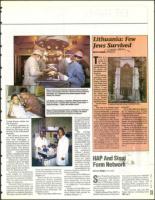
Above: American and Lithuanian physicians perform surgery on
children with urological disorders. Advanced medical equipment
was sparse. U.S. companies have donated supplies through
Healing The Children.
Left: Mothers are mothers, everywhere. Although the scenes in
American and U.S. hospitals differ drastically, human nature —
concern and hope — reign in the children's ward.
Below: At Vilnius University Children's Hospital, Drs. Reitelman
and Kass performed bladder surgery on an infant. The Detroit
dots performed three first-ever surgeries in Lithuania.
United States within the
last 40 years.)
In Vilnius, patients for
the 11 surgeries were se-
lected on the basis of the
severity of the individuals'
disorders.
For instance, the Ameri-
can team treated one new-
born with exstrophy, a
relatively rare condition in
which babies are born with
bladders on the outside of
their bodies. The doctors
spent five hours performing
major reconstructive
surgery, rebuilding the blad-
der and abdominal wall,
along with the bony pelvis.
Lithuanian physicians
would have given the baby
a urinary diversion. "The
child would have had to
wear a bag for the rest of his
life," Dr. Reitelman said.
In another case, the American
team taught its Lithuanian
counterparts how to reconstruct
the base of a patient's bladder.
This, too, had never been done
before in Lithuania.
The third "first" involved a 1-
year-old spina bifida baby. An
improperly formed spine had
caused nerve damage, which con-
tributed to urological disorders.
Through a process called vesico-
tomy, the American team con-
nected the bladder to the ab-
dominal wall, enabling urine to
dribble out.
Were it not for the vesicotomy,
Lithuanian doctors probably
would have implanted tubes to
allow for drainage. But urinary
tubes often cause infection and
discomfort. "It really is a very
primitive form of therapy," Dr.
Reitelman said.
There were other differences.
The hospital had
no signs out front.
There was no in-
formation desk. In-
side, the lobby and
halls were eerily se-
date.
The average
Lithuanian earns
$20 a month. The
average Lithuan-
ian doctor earns a
monthly $150. The
state-run health
system forbids doc-
tors to invest in
new equipment
without govern-
ment approval. In
spite of these rela-
tively low wages
and stoic working
conditions, the doc-
tors were intelli-
gent, eager to learn
and grateful for the
American presence, said Drs. Re-
itelman and Kass.
And, despite all the differences
between medical care in Lithua-
nia and the United States, there
were similarities. In the chil-
dren's ward, youngsters played
— as children do — and mothers
worried.
"In spite of all the differences,"
Dr. Reitelman said, "there were
some things that seemed in-
credibly constant." ❑
here is a
Jewish
ghetto, but
no Jews.
A synagogue still
stands, but only
25 people call
themselves con-
gregants.
Once the bur-
geoning center
of Yiddish pub-
lishing, Lithuania
now holds scant
traces of Jewish
culture. It was
home to nearly
250,000 Jews in
the 1930s, but
lost 94 percent
of its Jewish
population dur-
ing World War II.
It never recov- A memorial has been set up in the Black Forest.
ered.
The lack of a Jewish pres- she said.
"It's a little difficult to digest it
ence became apparent to Dr.
Claude Reitelman, a pediatric all," Dr. Reitelman said. "It made
urologist, during his medical mis- the experience of helping them
sion last month to Vilnius Uni- a lithe bit bittersweet."
When he mentioned the ex-
versity Children's Hospital.
Dr. Reitelman's wife, Sandi, termination to a Lithuanian coun-
joined him for his last day in the terpart, the physician shook his
newly independent country. To- head and said That was not a
gether, the couple saw the Black proud time for the country."
Today, it is difficult to gauge
Forest, where thousands of
Lithuanian Jews were buried the levels of anti-Semitism in Vil-
alive by the Nazis. They also nius — for the most part, be-
saw a Hebrew memorial erect- cause there are so few Jews, Dr.
Reitelman said. However, the
ed to remember those lost.
There is a small Jewish mu- Reitelmans encountered no
seum nearby, where an old Eng- overt prejudice and, at Children's
Hospital, the administrator and
lish-speaking woman, a survivor,
vice administrator are both Jew-
speaks of the tragedies. Lithua
nia was not supportive of its ish. ❑
Jews during Nazi occupation,
HAP And Sin
Form Networ
.
RUTH LITTMANN STAFF WRITER
inai Hospital and a group
of more than 200 affiliated
physicians will become
part of Michigan's largest
managed-care plan this October
— a move administrators hope
will increase Sinai's patient base
by thousands.
Health Alliance Plan (HAP), a
Health Maintenance Organiza-
S
tion representing some 460,000
members in southeastern Michi-
gan and Toledo, Ohio, is forming
a network with Sinai and
SinaiCare PHO, a physician-hos-
pital organization that formed
last year.
The network will add 200
Sinai doctors, including more
HAP page 32