

"newsgroup," Internet patois for
"discussion group." ALT.CON-
SPIRACY features conspiracy
theories of every stripe, a re-
markable proportion of which in-
volve Jews. A recent "thread" —
computerese for a topic woven
through the hundreds of messages
that appear in the newsgroup
every day — featured ardent de-
fenses of a white supremacist
group attacked by federal au-
thorities.
Several months ago, right-wing
extremists tried to use the net-
work to organize a paramilitary
march on Washington. Messages
on gun control talk about "Jewish
gun grabbers." Devotees of Lyn-
don Larouche, who sees vast con-
spiracies involving the ADL and
the Queen of England, periodi-
cally post their convoluted tracts
in ALT.CONSPIRACY, as well as
on other Internet forums.
And the classic, discredited
anti-Semitic forgery, "The Proto-
cols of the Elders of Zion," also
makes frequent appearances on
ALT.CONSPIRACY.
This lurid brew has made
ALT.CONSPIRACY one of Inter-
net's most popular conferences.
The remarkably democratic na-
ture of the "nets," suggested Mr.
Foxman of the ADL, gives con-
spiracy theorists access to im-
mense new audiences, especially
since they enter this brave new
cybernetic world with a veneer of
credibility based on the sophisti-
cated new medium itself, not the
quality of their ideas. Jewish lead-
ers concede that government con-
trol of the tangle of linked
networks is all but impossible.
"Regulation poses some difficult
issues involving freedom of ex-
pression," said Rabbi Cooper. "It
will take a long time to work out
these questions. In the meantime,
there's a tremendous opportuni-
ty for extremists" -- especially
since the networks let them reach
a potential audience that reaches
perhaps as many as 20 million
computer users worldwide. ❑
PRO:
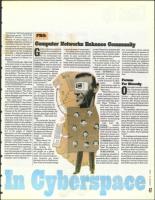
Computer Networks Enhance Community
G
lobal computer network-
ing has the potential to re-
inforce community bonds
for an increasingly dis-
persed Jewish population. That's
part of the intent of such Jewish
bulletin board networks as
KESHERnet and its chief rival,
RESHET, as well as Jewish "fo-
rums" on Internet — informal
meeting places for Jewish sup-
port, conversation, debate
and communal warfare.
("Kesher" and "reshet"
are Hebrew for link"
and "network.")
"Already, we can
see Jewish discourse
overcoming barriers of ge-
ography," said Dov Win-
er, a Brazilian-born
psychologist at Israel's
Ben Gurion University
of the Negev and a major
figure in the Jewish cy-
berspace community. He
cited globe-spanning fo-
rums on Jewish literature,
feminism, social activism, Ha-
lachah, genealogy and Jew-
ish politics — left, center and
right.
The networks, he said,
can enhance the feeling of
belonging to a single peo-
ple, even when those peo- • a
ple are scattered across , 00
0
the planet and often iso- O a q
lated from more tradi-
0
tional community
institutions.
"Many times," he !
said, "new users ex-
press the exhilarat- -r:-
'rEJ
ing feeling of '
belonging to the Jew-
ish people on a global
scale. The fact that dis-
tances are overcome and com-
mon interests are found
between Jews in Melbourne,
New York and London brings
!
a renewed sense of community."
The ability of Jews throughout
the world to interact daily with Is-
raelis, he said, inevitably will
change Israel-Diaspora relations.
"Jews in the Diaspora will be
better able to express their needs
and demand increased participa-
tion by Israel in meeting them,"
he said. "Israel may be better able
to express the complexities of the
problems it faces and the differ-
ing opinions about their solution
that are being proposed."
But internecine warfare, an
ever-present reality in the "real"
Jewish world, also exists in
Jewish cyber-communities. One
of the first Jewish computer net-
works — KESHERnet — was
plagued by what many users
saw as denominational
overkill, as well as occa-
sional invasions by Mes-
sianic Jewish
missionaries eager to
show Jews the error of
their ways.
"Those who post [i.e.,
send messages on • net-
works] tend to be those who
believe strongest in the is-
sues with which they deal,"
said Roger Froiken, a
Cincinnati tax consul-
tant and one of the
more respected figures
in the Jewish on-line
world. As a result, he
said the medium "lends
itself to accentuating
contentiousness." •
Last year, Mr.
Froiken created
RESHET, an interna-
tional Jewish network
with a broad range of
discussion areas, as a
haven for Jews turned
off by the factionalism
on KESHERnet. But on
the whole, there's little
peace on the Jewish
"nets." For instance, on
Internet's SO C.CUL-
TURE.JEWISH, a
newsgroup intended to
be a kind of global support
network for Jews, a bitter de-
bate recently raged about
how to deal with an outspo-
ken participant whose critical
views and aggressive manner of-
fended many and a discussion
about homosexuality has some-
times turned ugly. Participants
around the globe were subjected
on another Jewish "net," Judaica,
to a months-long feud about who
should be its official moderator.
Essentially, this was an electron-
ic version of petty synagogue pol-
itics.
Forms
For DiversitY
0
ld battles between Ortho-
dox, Conservative and Re-
form Jews are endlessly
re-fought on the electronic
byways — often with a jarring
lack of civility. Such on-line con-
troversy, Mr. Froiken insisted,
does not necessarily detract from
the community-building functions
of the networks.
"One problem with the Amer-
ican and the world Jewish com-
munities is the facade of unity
they try to create by refraining
from inter-affiliation and inter-
group discussion of important is-
sues," he said. "As a result, really
important issues never really get
dealt with. It's as if we believe that
time will make them go away
when, in reality, they're getting
worse."
By creating such international
forums for the exchange of Jew-
ish ideas, he said, the networks
can help the Jewish community
"deal with differences in percep-
tion, deal with philosophical dif-
ferences on their own merits."
Orthodox groups have taken
the lead in using the information
superhighway to enhance com-
munal bonds and disseminate in-
formation, leaving Conservative
and Reform groups in their com-