

.0-MWMOONAMVSMse07 M:
"AXar.MOZ.01Z1=5:4
,MA:M7;A•
PHOTO BY GLENN TRIEST
(
1Thrlds
(Differenc
Russian M.D.s experience health
care the American way.
ADRIEN CHANDLER SPECIAL TO THE JEWISH NEWS
THE DET RO IT J EWIS H NEWS
CT
32
he first time Dr. Eugeniya Khanukov set
foot in an American hospital, she couldn't
believe her eyes.
It was 1979 and the internist from the
former Soviet Union had recently arrived
with her family to resettle in Detroit. She
had taken a job as a technician in the
physical therapy unit at Sinai Hospital.
"It was like a fairy tale," she recalls.
"Every patient had a semi-private room,
with a TV and a telephone. This didn't ex-
ist in Russia. I said to myself, These peo-
ple are regular patients, not party bosses?
That was my first impression."
By contrast, the community hospital in
Baku, Azerbaijan, where Dr. Khanukov
had worked, was understaffed and over-
crowded — 20 same-sex patients in one
room, with one bathroom and no shower.
Dr. Khanukov and other Russian doc-
tors face the challenge of bridging gaps
between the Soviet and American health-
care systems. On average, a Russian doc-
tor receives seven to eight years of
training, compared to 11 to 12 years (in-
cluding undergraduate school) for an
American.
Not all Russian doctors who immigrate
here stay in medicine. An informal sur-
vey by Detroit's Jewish Resettlement Ser-
vice reports that, since 1989, about 50
doctors have come from the Soviet Union.
Four have entered into private practices,
a few have opted to get technical training
and 14 passed through residency pro-
grams, mostly at Sinai.
Complicating the language barrier are
financial challenges and new profession-
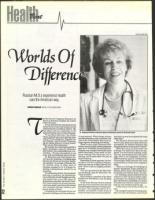
Dr. Eugeniya Khanukov underwent rigorous retraining to pursue her American dream.
al requirements. When foreign doctors,
including Russians, want to practice med-
icine in the United States, they must un-
dergo rigorous retraining and testing.
There is now a single, three-part certi-
fication test all foreign medical graduates
take: the U.S. Medical Licensing Exams.
Emigres must complete the first two parts
before they begin "house staff' or resi-
dency training. The third part, for li-
censing, can be taken after one year of
clinical training.
Depending on their specialty, the doc-
tors have to re-do a residency program,
which can take up to three years to com-
plete. There is also an English proficien-
cy exam.
"You can't get back into the field with-
out retraining," says Dr. Khanukov, 48.
"I had no choice."
Pola Friedman, president of the Sinai
Health Care Foundation, says the going
isn't easy.
"A lot of the Russian doctors trained
there don't have anywhere near the kind
of sophisticated training our doctors get,"
she says. "The language barrier is in-
credible. And there's a whole series of
hoops and tests that must be passed be-
fore they can even be considered for house
officership."
The Russian doctors know they will
have to play catch-up to their American
counterparts. Dr. Emerich Grinbaum calls
the post-graduate training here "superb."
"When you come, you don't know a lot
of things. You don't know about the ma-
chines. You don't know anything, really.
The care, the technical level, the knowl-
edge, there is no comparison. It's like a
different planet," says Dr. Grinbaum, 64,
a Farmington Hills internist who owns
and practices at a Flint area outpatient
clinic.
"There is a shortage of everything (in
Russia). Equipment, X-rays and film, an-
tibiotics, gloves, linens. The average Russ-
ian doctor can't read an X-ray," he says.
Dr. Grinbaum came to Detroit from the
Ukraine in 1979. At 50, he had to under-
go the rigors of a residency at Sinai Hos-
pital. He learned a completely new system
of health-care delivery while trying to
keep up with residents half his age.
"I didn't have a lot of time to lose," he
says.
He managed to pass his licensing exam
after one year of residency, then found