
Between The Wars
New home videos help portray the memory and legacy
of European Jewry before World War II.
MORRIE WARSHAWSKI
wo important new
home video releases
are now available
from the National Center
for Jewish Film — "Chil-
dren Must Laugh" and
"Chasing Shadows." Al-
though both tapes take
us back to eastern Euro-
pean Jewish communi-
ties before the war
(Poland and Carpathia),
the two works are dia-
metrically opposed in
their methods and in
their messages.
"Children Must Laugh" was
filmed in 1938 and portrays the
works of the Medem Sanitorium
outside Warsaw. As such, this
film is one of the few surviving
documentaries about pre-war
Jewish life in Poland. Medem
Sanitorium took young, ailing
Jewish children out of the War-
saw Ghetto and immersed them
in an idyllic country environment.
Funded by the organized Jew-
ish labor movement of Poland,
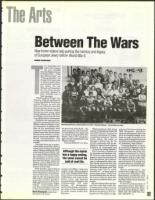
Medem allowed children to gov- Nourishing memories: Jewish children in the film "Chasing Shadows," now available on video.
ern themselves. In addition, chil-
dren at the sanitorium were the good work of the Bund — the
What emerges is a full, loving picture of the town during the
required to help tend the farm, same cannot be said of real life. portrait of Carpathian Jewish life 1938 Hungarian "liberation"
gather honey from the bee hives, In 1942 Medem was closed and just before the war. Gryn has an when his grandparents' farm had
attend science lessons, partici- its residents shipped off to Tre- uncanny storehouse of "happy, all of its animals brutally muti-
pate in sports and organize the- blinka. Only a few escaped to nourishing memories" that he lated one night. From then on, it
atrical entertainments. The fight with the underground in the fondly shares. He walks -us was a quick straight line toward
average stay lasted from 3 to 12 Warsaw Ghetto.
through a typical year for the the Nazi goal of making Bereho-
months.
"Chasing Shadows" is a docu- Jewish community with its em- vo "Judenrein" (free of Jews).
Although there are no profes-
phasis on seasonal and religious
"Chasing Shadows" is equal-
sional actors in the film, there is
holidays, all punctuated and ly a portrait of Berehovo and of
a great deal of acting and staged
"... lit up by the weekly Sabbath." Gryn himself. In Berehovo Gryn
scenes. Director Aleksander Ford,
Gryn's journey is fleshed out rediscovers the roots of his own
of the Jewish Labour Bund, opts
by memories and shadows only. religious convictions in a lesson
for a style of filmmaking that is
He visits the major Jewish syna- that he now conveys to the world
the antithesis of cinema verite.
gogues in town, but they have all through his work as a rabbi. "Bet-
He introduces us to two young
been demolished, left to deterio- ter understanding can only be
boys from the Ghetto, Lazar and
rate, or redesigned for other uses. safe and secure in a society that
Zalmen, and we follow their ex-
The Jewish community that once practices tolerance, cherishes har-
ploits as they learn about the san-
thrived in Berehovo is, except for mony and can celebrate differ-
itorium and its rules.
a handful of old people, gone. This ences."
Ford spends a great deal of mentary of a differe. It and more absence leads Gryn to notice
Gryn is worried that "... the
time showing the Medem chil- modern variety. After an absence around him "... so many gaps, so sands of time might cover the sto-
dren's theatrical presentations, of 45 years, English Rabbi Hugo many empty places." Gryn even ry of the Jews of Berehovo." His
each of which has a clear mes- Gryn returns to his hometown has the feeling that the old peo- documentary, and the fine work
sage. In one, the puppets break of Berehovo, now a part of the ple in town miss the Jews who of the National Center for Jew-
free of their master's strings to Soviet Union and formerly were once so central to their corn- ish Film, helps ensure that this
prove they can act on their own. bounced between Hungary and munity.
will not happen.
Although the movie has a happy Czechoslovakia. The work
His own history belies this feel-
To rent or purchase either of
ending — cured children with a includes old photographs, ing. Gryn notes that unlike oth- these tapes contact: The Nation-
new sense of purpose returning archival film footage, and exten- er communities, there is not one al Center for Jewish Film, Bran-
to their communities to carry on sive shots of Gryn narrating as documented case of anyone in deis University, Waltham, Mass.
he walks around modern day Berehovo harboring a Jew dur- 02254, Tele.: (617) 899-7044. Fax:
Morrie Warsliawski writes from
Berehovo.
ing the war. He paints an ugly (617) 736-2070. El
his home in St. Louis.
Although the movie
has a happy ending,
the same cannot be
said of real life.
Scanned image of the page. Keyboard directions: use + to zoom in, - to zoom out, arrow keys to pan inside the viewer.
July 15, 1994 - Image 117
- Resource type:
- Text
- Publication:
- The Detroit Jewish News, 1994-07-15
Disclaimer: Computer generated plain text may have errors. Read more about this.