

On A Pickle
RUTH LITTMANN STAFF WRITER
Bella Astrakhan and bra Bank
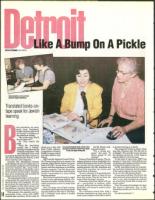
puzzle through translations.
Translated books-on-
tape speak for Jewish
learning.
uJ
Cr)
UJ
CC
LLJ
CD
LLJ
14
ella Astrakhan, an immi-
grant from Leningrad,
couldn't find the right word
for "kvetch" in Russian, so
she asked her mother.
"My mother said, 'What?
Do you mean me?' "
No. That wasn't the
point.
What Ms. Astrakhan
needed was a Jewish-
sounding translation for the
"ultimate complainer." She
was looking for some word
to properly describe the whiny matron in
The Tale Of Meshka The Kvetch, a chil-
dren's book by Carol Chapman.
Actually, Ms. Astrakhan's literary
undertaking was part of a higher goal: to
record books-on-tape for new Americans
and their families. She, along with a
multi-cultural team of volunteers, start-
ed the project last November. Together,
they have translated and recorded 53
Jewish stories for children.
"By preparing the tapes, we have given
young people the opportunity to listen to
stories in their native language. This also
gives them the opportunity to practice
their English as they follow along," said
Sue Stettner, executive director of Jew-
ish Experiences For Families (JEFF).
This summer, the cassettes and cor-
responding books, along with JEFF-
donated tape recorders, will be ready for
vy
For Ms. Hirsch, read-
check-out at the_Oak Tamara ChachashvIll reads a Purim story
Park Public Library, as project coordinator Gayle Hirsch waits ing had rewards.
to ring the page-turning bell.
"It's a giving pro-
Congregation Shaarey
gram," she says. "It
Zedek's nursery school
draws people in. It's
and Akiva Hebrew Day
sharing."
School.
Tamara Chachashvili agrees. The im-
JEFF and the National Council Of Jew-
ish Women joined forces to sponsor the migrant physician is busy studying for her
program. Gayle Hirsch, former vice pres- medical licensing exams, but for the past
ident of NCJW's "Jewish News On Tape" few months she has made time for the
project, used that experience to coordinate reading program. She, Ms. Astrakhan and
the story program. Last fall, she invited others help translate the stories and
members of the American and Russian record them in Russian.
"It was a pleasure to do something for
Jewish communities to a story-telling
new Americans. Many of them do not
training seminar.
More than 20 people showed up, eager know the stories. They do not know the
to lend a voice and acting abilities. Pro- roots of their heritage," she says.
Volunteers hope their efforts will pay
fessional storyteller Corinne Stavish pro-
vided instruction on how to make tales off — particularly at bedtime, when
parents, before kissing their children
come alive.
Soon, the tapes were off and running. goodnight, will choose to read (or play)
Volunteers spent hours and hours record- them a story.
The volunteers reason that, with a
ing such classics as The Carp In The Bath-
tub, a Passover yarn about a lovable Russian translation on tape, even the
most recent emigres will be able to share
fish-gone-gefilte.
in Jewish learning as a family.
The program's format is simple. Each
tape has a Russian side. The flip side is
in English. The recorded voices animate
the dialogue and prose. A bell rings to
signal readers to turn the page.
In the back of each book, JEFF has
inserted a "value card," which defines new
vocabulary and explains Jewish concepts
introduced throughout the story.
As Ms. Astrakhan found out, translat-
ing, much less explaining, Jewish concepts
in her native tongue is no easy task. Russ-
ian is not rife with Semitic diction.
At one point in Meshka The Kvetch, the
main character gripes about her lazy son
who "oy vey, does nothing but read. and
sit around the house like a bump on a
kosher pickle."
True, the puzzle of translation is a bona
fide literary nightmare. But, as Ms.
Astrakhan points out, it's all for a good
cause.
So who's kvetching?