

\WMAIN
:
KOMMMZUMMWS,,,,MMMWMIKM1,Vik
ISVPAM,A.VMAiMMM:
OKUMWMMWVMMMKM.M.IMMMk,M,60 E3AIVMMWM
"MWM:f£0`
*Mrafi.MWAIORVAMWASSOXAMIOSTOSY,Z, ZOW.e.::V/0.0Ac
RUTH LITTMANN
STAFF WRITER
I I)
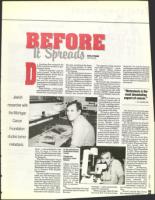
Jewish
researcher with
the Michigan
Cancer
Foundation
studies tumor
metastasis.
r. Avraham Raz compares the this year, according to the Amer-
The objective of his research
field of medical research to pro- ican Cancer Society. In 1994,
was to find "indicators"— chem-
fessional sports.
nearly 10,600 Americans will die ical signals telling doctors
"Life as a scientist," says the of the disease.
whether tumors have the poten-
native Israeli, "is like life as a
As with other types of cancer,
basketball player. You're only as the later a bladder malignancy tial for spreading. Exactly what
triggers metastasis is still a mys-
good as your last shot."
is diagnosed, the more likely it is
So it might be said that Dr. to kill — and the more costly it tery, but experts have found
Raz and his associates have is to treat. Millions and millions some clues.
Some years ago, researchers
scored game-winning points with of dollars are spent annually to
their progress in bladder-cancer battle intact tumors, much less at the Michigan Cancer Foun-
dation discovered a molecule
prognosis.
those that have spread.
called "Autocrine Motility Fac-
Their findings — which might
Dr. Raz, a researcher at the
save thousands of lives and spare Michigan Cancer Foundation in tor" in certain cancer cells. AMF
others from unnecessary treat- Detroit, has worked with col- secretes "AMFR," which stands
for Autocrine Motility Factor Re-
ceptor.
AMFR is located on the
surface of cancer cells. It
can be likened to chemical
"wheels," enabling cancer-
ous cells to dislodge from a
tumor mass and move to
other parts of the body.
Through a series of ex-
periments, Dr. Raz and his
German associates found
they could differentiate be-
tween high-risk and low-
er-risk bladder cancer
patients by determining
whether a sampling of cells
showed traces of AMFR.
The scientists further
noted that E-cadherin, a
protein which binds cells
to each other, disappears
when normal cells become
cancerous. As levels of E-
cadherin decline, AMFR
ment — were published in the
June 15 issue of Cancer Re-
search, the official journal of the
American Association for Can-
cer Research.
The title of the study is (say it
three times quickly): "Inverse Re-
lation of E-cadherin and Au-
tocrine Motility Factor Receptor
Expression As a Prognostic Fac-
tor In Patients With Bladder
Carcinomas."
The title might sound compli-
cated, but "the message is very
simple," Dr. Raz says. If physi-
cians use the discovery to screen
people for high-risk bladder can-
cers, they will be able to cure vic-
tims more quickly and cheaply.
The stakes are high. More
than 51,000 U.S. citizens will be
diagnosed with bladder cancer
Dr. Raz graduated from
the Weizmann Institute
in Israel.
The study was
published in Cancer
Research.
leagues at the Uni-
versity of Essen
Medical School in
Germany to find
that certain, dan-
gerous bladder
cancer cells exhib-
it traits enabling
them to spread
throughout the
body, or metasta-
size.
"Tumor metastasis is the most
devastating aspect of cancer," Dr.
Raz says.
increases — and so does the like-
lihood for metastasis.
Three years ago, when Dr. Raz
set out to find "a tool for better
diagnosis," he and his German
counterparts studied 2,000 blad-
der cancer patients in Europe.
Paralleling statistics for the pop-
ulation at large, 70 percent of the
patients involved in the study
had low-level tumors, easily re-
moved without consequence or
recurrence.
"Metastasis is the
most devastating
aspect of cancer."
— Dr. Avraham Raz
But 30 percent showed signs
of regrowth, even after their tu-
mors had been extracted. These
were the metastatic cases — the
same ones that showed high lev-
els of AMFR.
Dr. Raz believes the United
States could save money if physi-
cians began testing bladder can-
cer patients for AMFR right off
the bat. He says indications of
AMFR will be a clear-cut call for
aggressive treatment.
For Dr. Raz, the recent find-
ings have personal as well as
medical significance. The grad-
uate of Israel's Weizmann Insti-
tute moved with his
family from Rehovot, Is-
rael, to West Bloomfield
in 1987. When he began
working for the Michigan
Cancer Foundation, he re-
ceived grants from the
National Cancer Institute
and the Paul Zuckerman
Support Foundation for
Cancer Research.
Paul
Zuckerman,
founder of Velvet Peanut
Butter, was a Detroiter
who died of invasive blad-
der cancer in 1986. Since 0)
.,r.
his death, his wife, Helen, a,
other relatives and —
friends have raised more —
than $2 million to further
metastasis research at
the Michigan Cancer Founda-
tion.
"For me," said Dr. Raz, "it was
like reDavin2- the family." 17
33