

CD
O
O
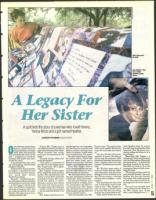
Patti Tapper with
her quilt.
Jane Walther. "She
was a bright,
sensitive, giving
person.
A Legacy
t
A quilt tel the story of a woman who loved history, .
Yellow Birds and a girl named Heather.
ELIZABETH APPLEBAUM ASSOCIATE EDITOR
At first, Mrs. Tapper says, it
ne of the first panels shows
Jane as a dark-haired lit- was difficult to feel anything but
tle girl beside her younger pain when thinking of her sister.
sister, Patti. The photo has 'When someone dies young,
that unmistakable sense of the you're just overwhelmed by the
past — a slight tint, a mother's death."
The quilt, though, offers a dif-
hairstyle that hasn't been fash-
ferent perspective.
ionable for years.
"This quilt is a statement of
A second panel has Jane, smil-
ing and laughing, with her baby how she was in the happy times,"
Mrs. Tapper says. "It's a legacy,
daughter, Heather.
A third shows Jane's parents: not just a sad story."
Mrs. Tapper, of Farmington
her father, a psychiatrist who
loved flowers, and her mother, Hills, began the quilt last Sep-
who would later become tember. She asked friends and
family to send their memories
Heather's guardian.
The quilt— which features pho- and photos of Jane. She trans-
tos and recipes, trinkets and poems, ferred the photos to fabric,
announcements and cartoon strips through a process that retains
— is Patti Tapper's tribute to her their color and remains perma-
sister, Jane Walther, who died five nent. Many of the other donations
years ago of leukemia. Mrs. Tap- — a letter, a birth announcement
per made the quilt for her niece, — she has attached directly to the
Heather. She plans to give it as a fabric.
Mrs. Tapper spent hours sort-
college graduation gift.
0
ing through her own keepsakes,
too. She found an envelope that
gives a scratchy rattling sound
when it's shaken. It still bears
Jane's handwriting: "Lily seeds."
She also came across a recipe
for a drink called a Yellow Bird
that her sister loved, and a
Blondie cartoon that had been
taped to Jane's refrigerator door.
Then Mrs. Tapper went to
work, piecing together the pho-
tos and other treasures into a
kind of garden ofTnemories.
"My husband took this photo,"
she says, pointing to a picture of
a fresh rose. "Jane loved roses."
The late Jane Walther was a
Toledo resident, "a bright, sensi-
tive, giving person who didn't ac-
cept compromise," Mrs. Tapper
says. She liked history books and
collecting glass, garage sales and
the Los Angeles Lakers.
"She loved animals, too," Mrs.
Tapper says. "We used to pray child, Heather, then 15, went to
that a stray wouldn't find her be- live with her grandmother Rita
cause she would take any animal Schechter. Now, Heather is com-
pleting college and plans to be a
in."
Jane was 38 when she was di- psychologist.
These days, Mrs. Tapper — a
agnosed. A nurse, she did not
need to ask the prognosis. With professional artist and instructor
this kind of leukemia, she told her with the Birmingham Bloomfield
sister, "nobody comes out of the Art Association — is putting the
hospital." She died seven months finishing touches on her quilt.
She likes to work on it in the
later.
Ms. Walther spent many of evening and does virtually every-
those last weeks with her sister, thing by hand.
"The sewing machine and I are
who frequently would drive from
Michigan to Ohio and back in one only partially friends," she says.
day. The two women — who had Besides, she likes the intimacy
not been close as children — drew that comes with working hands-
on with the material and the lit-
together.
"The day before she died, Jane tle fragments from her sister's
said, 'I really think I wasn't a good life.
The quilt has brought back
sister to you,' " Mrs. Tapper re-
calls. "I'm happy I had the chance many good memories of her sis-
to tell her that she was wrong, ter, Mrs. Tapper says. "It has
that she was a great sister to me." been a real healing for me." ❑
After Jane's death, her only