

Community Views
Editor's Notebook
Correctness And Compassion
Make For Acceptance
What Is This,
1954 Again?
THE REV JAMES LYONS SPEC A TO THE JEW SH NEWS
PHIL JACOBS EDITOR
I have been watch-
ing with absolute
dismay the grow-
ing pressures on
various segments
of society based on
a strange concept
called "political
correctness." I
have heard discus-
sion in universities stifled by a
refusal to examine ideas, partic-
ularly if they don't fit the "polit-
ically correct" point of view
current among some students.
I have seen students argue
scandals requires no additional
proof.
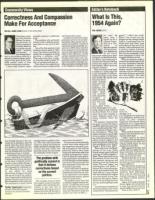
The problem with politically
correct is that it defines correct-
ness based on the current poli-
tics.
One of the first questions I ask
students when I teach is, "How
many of you believe anything you
read in the newspapers or accept
anything a politician says?"
There was a time when a major-
ity of hands would be raised. To-
day not a single hand goes up.
Even those who argue for po-
litical correctness recognize that
real chauvinistic issues.
I would not want to have been
politically correct in the antebel-
lum South when slavery was ac-
cepted and justified. I would not
want to have been politically cor-
rect in the 1930s when hatred of
Jews, Gypsies and homosexuals
was not only supported, but jus-
tified in Nazi Germany. I would
not have wanted to have been po-
litically correct when over a ma-
jor portion of our history women's
roles were strictly controlled, jus-
tified and stated, limiting females
to the traditional "barefoot, preg-
fa .............................
1,1 • •'• , I...
[IiIi -,!::• . -
I ,
,,...
: f•:,5
, 1
1 :4• 1'.1..! ' i•l !
s.,.
\\. \....:.
\,... .., -,,,,),,N<*,......:\
..
••••\\,\\ \ ,... - • -••••• ",s0;t:s• ' •
) )
‘ k ■ \
\\\\\„. . \`'..\)\
_ ,
- • ''',
. ■ - N \
• N\
,
\■
„...... NN
•••••;\ NN.N. N
\
N.' '
\ N. N\
, , . ...C . \\\ \ :\
\\.:\\ ■ •• 1 .
NN\
...\\N„ \\ \\\.\\
\
\ \ N
\\\\‘ •••..N,
0.■•■ \
\ s ' '.
\\\ ..... .
N\ , • • \
\ N'
ss•N`' ' \..\\.
, \‘‘ \\'' • - „,. .\••
\\ N , , \\N. .
\
\\ . • • \NN,
N \\ \ „\
\\\\ . \\\ . ' \\\
that though they go to the uni- changes based on politics will oc-
versity for an education, they will cur. The very real issues that
decide what they learn and how need to be openly discussed are
it is taught on the basis of a "po- hidden behind the benign smile
litically correct" point of view. I of those who don't really care
may be old-fashioned, but I think about the issues, but can mouth
the politically correct slogans.
something serious is missing.
I remember when correct was
correct, regardless of the politics.
It seems to me to be an oxymoron
to talk about "politically correct,"
because when politics change, it
means correctness has changed.
We witnessed the "politically cor-
rect" '60s with its war on pover-
ty and efforts for equal
opportunity change as the poli-
tics moved toward the celebra-
tion of a generation dedicated to
getting what they conceived to be
The number of men I know
theirs regardless of the social cost.
The abundance of stock market who support women's reproduc-
tive rights while remaining chau-
The Rev. James Lyons is executive vinistic to the very core is
astounding. Having one area of
director of the Ecumenical
support lets them off the hook in
Institute for Jewish-Christian
their
minds from dealing with the
Studies.
The problem with
politically correct is
that it defines
correctness based
on the current
politics.
s -
nant and in the kitchen."
I do not want to be politically
correct when white racism still
has supporters who seek to jus-
tify and support it. Nor will I be
politically correct when black
racism and separatism seek to be
justified and supported. Indeed,
I cannot think of a more patron-
izing, paternalistic attitude than
to smile benignly at those African
Americans who genuinely feel
that separatism is the only way
for people to get along.
If any of the above is political-
ly correct, count me out. My faith
commitment is that there is with-
in my experience a correctness
that transcends opinion, politics
and even social norms.
The problem occurs when that
con-ectness is applied without com-
passion. I would hope that I would
stand with those who, drawing
their strength from various tradi-
tions, have learned to accept one
another even when we differ. ❑
It's been 20
years since I
signed up for a
summer intern-
ship as a Uni-
versity of
Maryland School
of Journalism ju-
nior. Registering
for the intern-
ship meant working at a small
newspaper on Maryland's East-
ern Shore, then returning to
campus that fall and taking a
course that might have well
been labeled, "How I spent my
summer vacation."
First, the course work itself.
I worked as a sports editor for
a tiny newspaper of 4,500 cir-
culation serving a county of less
than 20,000. My sports beats
took me to home-
made baseball
diamonds with
chicken wire
backstops and
fishy smelling
tackle shops
with products
with names like
"hoogies" (a
plastic lure) for
sale. The area
was located
about three hours
from Washington, D.C., the
center of power and civility in
the Free World. Yet, it could
easily have been located in
some Alabama small town
where everyone "knew his
place."
For starters, I learned that
the paper I worked for had an
unofficial editorial policy that
went something like this: "Nev-
er run photos of blacks enjoy-
ing themselves." What that
meant was that it was all right
to have a photo of a black per-
son with the business end of a
police revolver poked in his
head. But pictures of black fam-
ilies picnicking on the beach?
Forget it. What is this, 1954?
There also were "unofficial"
policies of the town. Black
church buses weren't allowed
in for fear of "traffic congestion."
Right. There was even a bar on
the outskirts of town that still
had separate entrances and
drinking areas for blacks and
whites. The word "nigger" was
commonplace and public. I
learned this when taking pho-
tos of a girls baseball team. The
coach told two 11-year-old girls
who were sticking their tongues
out at the camera to stop "nig-
gering-up" the picture. After a
while, even the college boy from
the city started getting numb
to it.
Anti-Semitism? Outside of a
fisherman telling me he used a
certain tool to "circumcise your
people," I didn't feel much.
When I was invited into the
shingle-and-tar cottages blacks
lived in, I understood that the
words "poor" and "black" were
synonymous in this part of the
country. I also understood that
it wasn't a matter of getting
photos of blacks having a good
time into the newspaper, it was
more important to show the
struggle of black survival.
When the summer ended, I
returned to school ready to tell
the story of prejudice I had seen
in rural America. I read the
schedule for the upcoming se-
mester, checked it against my
calendar and saw that the sec-
ond week of classes was set for
erev Yom Kippur. The class
was a four-credit, one-day-a-
week
lecture,
starting at 4
p.m. The grade was based sole-
ly on attendance and the eval-
uation of one's summer
supervisor. My summer editor
graded me an A. I approached
the professor and told him that
the second class was on Yom
Kippur.
'Then you'll be losing your A
based on the attendance rule,"
was the stark reply.
I didn't need to be three
hours away from the big city to
run, firsthand, into some sort
of deep-seated anger. It was
staring me in the face.
After appeals to the dean and
a letter from my rabbi, the pro-
fessor relented. I did have to
write an additional paper to
make up for the lost class.
Yet from that day on, it was
never the same. As one of only
two Jews in a class of 30, I had
become different.
This fall, Jewish students at
Wayne, Oakland and OCC will
be faced with missing class to
celebrate Rosh Hashanah.
Even with the efforts of the
Jewish Community Council
and Hillel of Metro Detroit,
class will go on.
Again, we're made to feel dif-
ferent. Again, it's not our time
to enjoy, but instead to feel the
gun of indifference at our head.
What is this, 1974? ❑