

•
his way to the European The-
ater. "We didn't think we
would be hearing much," his
wife says.
But they did.
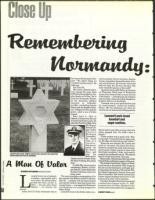
Mr. Lewis, a Detroit native,
was among the more than
9,000 Americans killed at Om-
aha Beach on D-Day. He is
buried in Normandy, France,
at the American military
cemetery at Colleville-
sur-Mer, overlooking Omaha
Beach and the English Chan-
nel. A Magen David is atop his
grave, amid a sea of white
crosses.
Born April 6, 1914 in
Detroit, Leonard was the son
of Jacob and Sarah Lewis. He
attended Northern High, then
Michigan
Normal Col-
lege (today
Eastern
Michigan
University).
He found
work as a
teacher,
then as a re-
porter for
the Detroit
News and
Leonard Lewis' grave. (Right) Leonard Lewis, pictured at the Jewish War
later the
Veterans Memorial Home In Southfield.
Kalamazoo
Gazette and the Pontiac Press.
He liked working the police
beat.
In 1939, Mr. Lewis met his
sweetheart, Esther, at Tem-
ple Beth El, where both their
ELIZABETH APPLEBAUM ASSOCIATE EDITOR
families had been active for
many years.
eonard Lewis was a husband,
The most prestigious congregation of its
a teacher, a journalist and a day and the only Reform temple in Detroit,
new father. He added soldier Beth El — complete with its huge columns
to that list when, on Dec. 8, and colorful windows depicting scenes from
1941 — the day after Pearl Jewish history — was located on Woodward
Harbor — he entered the and Gladstone in a building designed by
service.
Albert Kahn.
Later, the U.S. Navy lieutenant was on
Leonard's soon-to-be-bride, today mar-
it Wait Ob Moot
Ii
ried to another former Detroiter, Stanley
Lewin, remembers Leonard's sense of hu-
mor and kindness. He loved to travel and
take car trips, too. He was, she says, "the
most wonderful person in the world."
Leonard soon brought Esther to his home
on Worcester Place (east of Woodward
across from Palmer Park) to meet the rest
of his family — including his six brothers
and one sister. Some have died, though two
brothers still live in Southfield.
"Leonard was a very good student and
he loved baseball," recalls his brother,
Henry. "He was ambitious, too. Once, he
went to the zoo and started selling peanuts.
Leonard Lewis loved
baseball and
sugar cookies.
But he had to quit after one day when the
police stopped him. He didn't have a
permit."
"Their mother was a great cook," Mrs.
Lewin adds. "Leonard loved her sugar cook-
ies. We often sat and had tea and cookies."
When the war started, Mr. Lewis was
quick to volunteer. He joined the Navy,
where he reached the rank of lieutenant-
senior grade. Esther stayed at home with
their baby daughter, Linda, and eagerly
awaited her husband's return. "We prayed
that he would come back," she says.
Meanwhile, Detroit joined the rest of the
United States rallying in support of the war.
The Jewish Community Center on Wood-
ward served as the central USO lounge in
the city and hosted dances and bagel-and-
lox brunches for the boys. The Jewish Wel-
fare Board organized a Detroit Army and
Navy Committee. The Jewish Community
Center helped residents learn how to can
produce from their victory gardens.
President Franklin Roosevelt announced
a national day of prayer on Dec. 31, 1943.
A second came on D-Day. Members of the
Jewish community packed into synagogues
A MAN OF VALOR page 53
c_
)