

ea
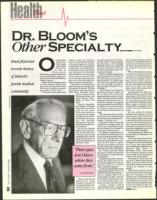
DR. BLOOM'S
Other SPECIALTY.
Sinai physician
records history
of Detroit's
Jewish medical
THE DE TR
T JE WI
community.
0
ne December
afternoon in
1944, inside
Sammy Sof-
ferin's Won-
der Bar on
Washington
Boulevard, a group of business-
men and physicians made a piv-
otal move toward establishing a
Jewish hospital.
When Detroit Jews proposed
the idea decades before, they
were met with opposition from
The Jewish American newspa-
per, which, in 1901, wrote:
"We must, in the name of the
business associates to the Won-
der Bar. There, with prompting
from Dr. Bloom, "I.D." pledged
$100,000 to the cause. Others did
likewise, following an example
set by the late Sam Osnos, a lo-
cal philanthropist.
"(Sam's son) Max disclosed the
fact that his father had died and
left $100,000 to be used for a
Jewish hospital," Dr. Bloom says.
`The other men agreed to match
the sum and that was the be-
ginning of Sinai Hospital. I'll nev-
er forget it."
And he doesn't want present-
day Jews to forget it, either. At
82, Dr. Bloom has written 100
pages detailing a century of chal-
lenges facing the Jewish medical
community. Focusing on the in-
dividuals, temples, synagogues
and aid societies that contributed
to health care in the early days,
Dr. Bloom couches his account
in the history of Detroit Jews at
large.
"My research took me back,
back, back, until I finally got back
to the first Jews who came here,"
he says. "I learned a lot."
Though Dr. Bloom originally
intended on writing a book, his
work is yet unpublished. Right
now, he keeps it in a binder, to
be used as a reference tool.
Dr. Bloom's commitment to
his archival undertaking comes,
in part, from personal experi-
ence. The Chicago-born Jew
moved to Detroit when he was 1
year old. He went to dental
school in Ann Arbor and later
earned a doctorate in pathology
from the University of Michigan.
Dr. Bloom married Betty
Davidson in 1935 and they had
three children: Linda, Michael
and Stephen.
Despite his academic achieve-
ments, Dr. Bloom says he en-
countered opposition when he
tried for a spot in a medical
school residency program.
"Jews like myself had trouble
getting appointments. There was
a definite anti-Semitic feeling —
– Dr. Herbert Bloom
even in colleges. There was a
quota system," he says. "(One ad-
That was the day his ministrator) stated openly that
father-in-law, Israel he wouldn't have Jewish resi-
Davidson, president of dents, no matter who they were."
Luckily, another medical
the popular Federal De-
partment Stores, sum- school administrator, impressed
moned his friends and with Dr. Bloom's work, offered
common good, set ourselves
down as unqualifiedly adverse
to the encouragement of (this)
undertaking. The great difficul-
ty with many of our modern phil-
anthropists is that each has his
own 'pet scheme' for the allevi-
ation of distress, and as a result,
institutions are created which
are in the first place unneces-
sary, and in the second place un-
ableto maintain themselves."
Ultimately, the press did not
quell attempts to create the Jew-
ish hospital in Detroit. The first
major fund-raiser took place in
1912 when Orthodox immi-
grants marched down
Hastings Street with
signs reading, "Buy A
Brick To Save The
Sick."
Shortly thereafter,
the Hebrew Hospital
Association formed to
carry on the cause.
Only a few months lat-
er, physicians created
the Maimonides Med-
ical Society "for the so-
cial and scientific
betterment of the Jew-
ish medical profession-
al in Detroit."
But, for Dr. Herbert
Bloom, a local surgeon,
one of the most mo-
mentous steps toward
establishing a Jewish
hospital took place on
that cold afternoon in
December 1944.
L 1TMANN A WR R
him a residency position and fel-
lowship in U-M's department of
oral and maxillofacial surgery.
Dr. Bloom became the first Jew-
ish surgeon of his kind in the
state.
"When I finished my training
and went into practice, however,
I received a lot of opposition from
the other oral surgeons in Michi-
gan," he says. "In fact, it was so
bad that a lot of them called peo-
ple who sold equipment and told
them not to sell to me. Every
place I went told me they didn't
have what I wanted."
Nevertheless, Dr. Bloom es-
tablished his own practice after
returning to Detroit in the mid-
1940s. He and his brother-in-law,
Dr. Jerry Hauser, built a clinic
near the Fisher Building, and Dr.
Bloom began working at Mt.
Cannel Mercy Hospital on Out-
er Drive (now part of Grace Hos-
pital.)
All the while, Dr. Bloom
served on the staff at U-M and
volunteered at the North End
Clinic, where indigent Jews went
to receive free or low-cost med-
ical care. The North End Clinic
was, in part, started by Harry
Saltzstein, a physician who also
played an important role in the
founding of Sinai Hospital.
In his archives, Dr. Bloom ex-
pounds upon Dr. Saltzstein's con-
tributions:
"Of all the physicians inter-
ested in and influencing the de-
velopment of a Jewish hospital,
few, if any, had more impact
upon bringing the ambition to re-
alization than Harry C.
Saltzstein, M.D., who, when
Sinai Hospital opened, served
concurrently as its first chief of
surgery and chief of staff."
Although Dr. Bloom was do-
ing well in Detroit during the
1940s and early 1950s, he felt
that Jewish doctors were not ad-
vancing as quickly as they
should.
"Before Sinai was built, I think
Jewish doctors had trouble get-
ting into hospitals," he said.
"There were a lot of capable Jew-
ish physicians who never really
had status in any hospital. A lot
of them had admitting privileges,
but for a lot of them, it was a con-
stant battle. No one felt com-
BLOOM page 40