

a s ses
unique
que s is
it s i challenging. We're cog-
nizant of what children are ready for at
what age."
In I Can Learn Torah, rather than
simply telling Torah stories to 5- and
6-year-olds, scaled-down language of
actual text is used.
The exercises in Betman's Book of He-
brew Letters, while not particularly
unique Mr. Wise admits, are not insult-
ing to the students' levels of intellect, ei-
ther.
Rather than teaching mem is for "mit-
ten," as some texts do, Betman says
"mem is for matzah." Hebrew letters and
vocabulary are taught together.
"I was once bored to death in a He-
brew school classroom and rm trying to
connect with that bored kid," Mr. Wise
said. "What's going to keep those chil-
dren interested? A kid their age dressed
in a cape and mask as Betman? Maybe.
"The student who already learned the
letter and is bored might go on to read
the cartoon and the pun. It's all con-
nected in the learning."
Mr. Wise recalls sitting in the
cramped Los Angeles offices with Mr.
Grishaver, thinking up the simple learn-
ing gags like "Last week I won a tri-
athalon in Hawaii. They gave me an
award saying that I was an AYIN man
(instead of Ironman)."
"The jokes were so bad, but we were
having so much fun. Joel and I knew if
we were having a good time writing for
kids, the learning would be fun, too. Ed-
ucators don't just adopt a book because
it's cute. They buy books when kids are
willing to learn from them," Mr. Wise
said.
Working with teachers and students
at Temple Emanu-El remains Mr. Wise's
primary concern. Most of his writing for
Torah Aura Productions takes place dur-
ing vacation. He does it for two reasons.
"There's a story of a man whose chil-
dren asked him each morning where he
was going. To save the Jewish world,'
he would say. In some small way, I guess
rm trying to help do that, too.
"On a more practical level, there's not
enough high-quality, challenging and in-
teresting material for our teachers to use.
As an educator, I have to do my part to
create some of it, then let the teachers
bring it to life," Mr. Wise said.
Harlene Winnick Appelman is also a
Torah Aura Productions contributor.
Dividing her time between the Agency
for Jewish Education and California's
Whizin Institute for Family Life, Ms.
Appelman is still able to call herself a
writer.
The Whizin Institute, a department
of the University of Judaism, focuses
specifically on family education. Ms. Ap-
LESLEY PEARL
STAFF WRITER
pelman's employment with Whizin takes
her to tiny communities around the coun-
try and major cities around the world.
Her latest publication by Torah Aura
Productions, Step by Step: The Building,
Blocks for Jewish Life, offers simple sug-
gestions to bring Judaism into the home,
exploring celebration of Shabbat and hol-
idays. Prayers are in Hebrew, English
and transliteration, along with expla-
nations of their significance. In writing,
Ms. Appelman assumed nothing as com-
mon knowledge on the part of parents.
She also edits Jewish Family, a glossy
newsletter put out by the Alef Design
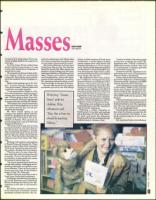
Watching "Sesame
Street" with her
children, Rita
Abramson said,
"Hey, this is how we
should be teaching
Hebrew."
Group, a sister company of Torah Aura
Productions. A recent edition tackled
issues ranging from child abuse and
chemical dependency to Purim recipes
and a "Psycho-Judaic Response to Beavis
and Butthead" (a controversial MTV car-
toon featuring two high-school youths
and chronicling fantasies and realities
of sex, drugs, rock and roll).
Ms. Appelman's first work, A Seder
for Tu B'Shevat, developed with Jane
Sherwin Shapiro and illustrator Chari
McLean, was printed nine years ago.
Maryland publishing house Kar-Ben
Copies put out the guide, which explains
the 16th-century kabbalistic tradition of
welcoming spring and its harvest with
fruit, nuts and wine (or grape juice, us-
ing both the white and purple varieties).
Spare moments are spent writing for
Moment, Hadassah Magazine and the
L'Chayim section of The Jewish News.
The energy and confidence to tackle
such projects grew out of Ms. Appelman's
work in secular classrooms.
Following a college education at
Northwestern University and teaching
jobs in Evanston, Ill.; New York; Berke-
ley, Calif.; and Israel, Ms. Appelman
found herself with the students of tough
neighborhoods in Oakland, Calif.
"I was on a mission, like many people
at that time, to change the world," Ms.
Appelman said. "I think I realized in
Oakland how good a teacher I was. And
if I was that good, I wanted to give that
to the Jewish community."
Classrooms led Ms. Appelman to di-
rectorships and a job at Congregation
Shaarey Zedek in Southfield.
A joint venture between Whizin and
the Jewish Federation of Metropolitan
Detroit bound Ms. Appelman and JEFF
(Jewish Experiences For Families).
A pilot program now being replicated
in New Jersey, JEFF carved a niche for
family time, projects and informal edu-
cation in Detroit. Ms. Appelman is writ-
ing a manual of the work she developed
with JEFF staff and its sponsor, Bill
Berman.
`The most important work you can do
is on the front line, but it's imperative to
further the field as well. Ms. Appelman
said. "For me, each project feeds off the
rest. It's an integrated whole.
"Jewish family education is not other
than what rm doing in everyday life. It's
all permutations. Inevitably, if you
speak, someone asks you to put it down
on paper."
Ms. Appelman believes the deficiency