
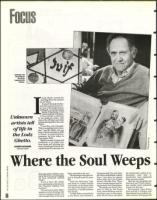

Isaiah Shoff'', with
his drawings and
other terrible
treasures from the
Holocaust.
ELIZABETH APPLEBAUM
ASSISTANT EDITOR
Photos by Glenn Trie
Unknown
artists tell
of life in
the Lodz
Ghetto.
saiah Shafir wanted the
drawings from the moment
he saw them.
It wasn't the kind of collec-
tion that most art lovers cov-
et:
t none of the bright beauty
of Chagall, or the demanding
figures of Kandinsky, or the
gentle sadness of Soutine.
It was, instead, a collection
by an unknown artist, with
most of the 109 black-and-white
pictures showing life in the Lodz
Ghetto.
"I saw this, and I thought:
'This is something that's price-
less,' " says Mr. Shafir, who was
born in Israel and came in 1950
to Detroit. A semiretired busi-
nessman, he lives today in
Farmington Hills.
Made on scraps of paper and
cardboard, or on pages torn
from books still showing the
heavy, formal print found in Eu-
ropean books 50 years ago, the
Where the Soul Weeps
drawings picture children weep-
ing in the street, people begging
for food, streetcars marked
"Jude."
"Look at this," Mr. Shafir
says, pointing to a drawing of a
boy. "Barefoot. Children, with
no shoes."
The name of an artist, "Meir,"
appears on a few drawings. But
most are unsigned, and the men
who brought them to life most
likely perished in the war.
The drawings' long story be-
gan in Poland some 45 years
ago.
Until the Holocaust, Lodz
was home to a major Jewish
community; at the start of the
war about one-third of Lodz's
population, or 23,000 persons,
was Jewish.
In 1939, Hitler annexed Lodz
to the Reich and renamed it
Litzmannstadt. One year later,
the Nazis established a ghetto
there. Less than two square
miles wide, the Lodz Ghetto
housed 164,000 Jews. There
was no sewage disposal and liv-
ing quarters were horrendous.
The ghetto was finally liber-
ated in 1945 by the Soviet
Army. About 800 Jews were liv-
ing there upon its liberation;
some 76,701 (those who didn't
die of starvation, typhus or tu-
berculosis were sent to
Auschwitz) were registered
there one year earlier.
After the war, the ghetto was
destroyed and Polish authori-
ties quickly built makeshift
homes over the area.
But recently, those homes
have started to collapse, and
their demise has revealed a ter-
rible treasure: belongings left