

D ETRO I T J E WIS H NE WS
LLJ
1 --
00
those who agree with their platforms.
"I would not want to speak for the
Jews,' " said Laurence 'merman, presi-
dent of the AJCommittee. "We're not a
homogeneous community. The days of a
rabbinic group speaking for the Jewish
community, for instance, have long since
passed."
The cacophony of political views ex-
tends to debates over public aid for
parochial schools. Groups like
the Jewish Community Coun-
cil, American Jewish Congress
and the Anti-Defamation
League hearken to the First ••
Amendment in their opposition to gov-
ernment support of private schools.
But Elimelech Silberberg — rabbi of
Bais Chabad of West Bloomfield who also
sits on the presidium of the Council of
Orthodox Rabbis — criticizes this view
as hardly all-inclusive. "For the most
part, the organizations that fight (gov-
ernment aid) have members who don't
send their children to parochial schools.
Their members don't shoulder that bur-
den," he said.
Rabbi Silberberg argues against the
claim that parochial schools are a luxu-
ry — that parents should foot the bill for
anything over and above the public
school system.
"It's not a luxury. We don't view Torah
education as a choice. We view it as an
obligation," he said. "Furthermore, we're
paying taxes to public schools, too. It's
double jeopardy."
Like Rabbi Goldberg, Rabbi Silberberg
believes organizations calling themselves
"Jewish" should define their stances ac-
cording to Halachah.
"Unfortunately, most Jews and Jew-
ish organizations today are unaware of
the laws and concepts of the Torah and
Judaism; therefore, many times their po-
sitions run contrary to it.
"The problem is that the
(gentile) world thinks these or-
ganizations are speaking in the
name of Judaism. It's de-
plorable," Rabbi Silberberg
said.
"If they want to espouse
views that are contrary to
Torah, let them do it as indi-
viduals. But when they include
the word 'Jewish' in the title of
their organization, it's very un-
fortunate."
Orthodox organizations,
however, have publicly pro-
pounded views unacceptable to
much of the nonobservant
community. For instance, the
Council of Orthodox Rabbis
openly denounces not only
abortion but also homosexual-
ity.
Rabbi Silberberg thinks this
is altogether appropriate. "If a
person disagrees with the
Torah viewpoint on these issues and oth-
ers, it's their right to do so — but as in-
dividuals, not as Jews."
Robert Brown, president of the Amer-
ican Jewish Congress chapter in Detroit,
disagrees.
"They (Orthodox rabbis) are speaking
for their interpretation of the Torah and
they have a right to do that. But they do
not have a right to say they speak for the
entire community," Mr. Brown said.
"Pm not sure that anyone has the right
to set themselves up as the ultimate
spokesman for the Jews on issues like
that. Reform, Conservative and obser-
vant Jews have different opinions."
T
he political rift within the
Jewish population doesn't
always manifest itself as an
, interdenominational split.
Individuals like Robert
. Kleiman, an associate professor of fi-
nance at Oakland University, believe
Jewish groups propound Democrat-
• is views — often to the exclusion of Re-
publican and Libertarian ideology.
Last month Rabbi Alexander
Schindler, president of the Reform Union
of American Hebrew Congregations,
came out in support of President Clin-
ton's agenda. In reference to the ongoing
Whitewater controversy, he said: "I was
just in eight different communities. From
the conversations I had, there is nothing
but good will in our community toward
this administration; we wish they could
get on with the job."
But Professor Kleiman, who serves on
the board of governors of the Heartland
Institute (a free-market think tank), ob-
jects to universal coverage. He also
thinks it is inappropriate for
Jewish groups to take stances on
such issues without represent-
ing minority views.
"I don't like the idea of one
group appearing to speak for all
of its members. To take a specific
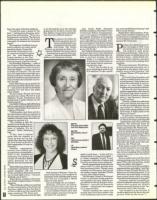
Upper left:
Selma Goode, director of Work-
men's Circle, Michigan District.
Upper right:
Richard Lobenthal, director of
ADL.
Right:
Laurence !merman, president of
AJCommittee.
Left
Jeannie Weiner, president of
JCCouncil.
Said Professor Kleiman: "Jews, be-
cause of their history, have tended to be
champions of the underdog and in some
ways that has encouraged a liberal
stance on many issues."
Universal health care, for instance.
Hadassah, JCCouncil, the AJCom-
mittee and others have come out in fa-
vor of some type of universal health care
— if not President Clinton's plan, then
another program ensuring coverage for
the entire U.S. population.
stand on each issue — in line with tra-
ditional liberal or conservative beliefs —
is, I think, misguided," he said. "It real-
ly suggests a uniformity of opinion and
I'm not so sure there is any uniformity."
Jewish organizations stress their tax
status is 501-C3, which excludes them
from partisan politics. Though many
members are Democrats, their groups
can neither support President Clinton
nor any other political figure.
The Michigan District of Workmen's
Circle is a secularist Jewish organiza-
tion founded in the early 1900s by peo-
ple affiliated with the Socialist Party.
Members — some still call themselves
socialists — always been have support-
ers of organized labor.
"Almost anything the unions feel
strongly about we're apt to endorse. Part
of our constitution says if you're a scab,
you can be expelled from the group," said
Selma Goode, director.
Despite their radical platform, Work-
men's Circle members (numbering 300
in Detroit) try to represent a variety of
views at debates and other forums they
sponsor, Ms. Goode says.
erhaps the organized quest for
one voice began in 1937, when
the Jewish Community Council
was created to unify groups
countering anti-Semitism. Today it con-
centrates, in part, on political issues that
hit close to home — black-Jewish rela-
tions, gun control, abortion, education
and other controversies making daily
headlines.
"We act as a local voice. The JCCoun-
cil, by its nature and community role, is
designated as the agency that is sup-
posed to come to a local consensus," said
Jeannie Weiner, JCCouncil presi-
dent.
JCCouncil board members and
staff say a unified Jewish voice is im-
portant because it helps leaders rep-
resent the community in such en-
deavors as inter-ethnic bridge
building and government relations.
"It's very rare that I hear of an in-
dividual organization, other than the
JCCouncil, that claims to speak on
behalf of all of Detroit or American
Jewry," said Executive Director
David Gad-Harf.
"However, I think the problem lies
with public officials and other lead-
ers who are confused when they are
approached by different Jewish
groups with varying positions on the
same issues. It really points to why
there is a Council."
To arrive at a consensus, the JG
Council includes a broad spectrum
of Detroit Jews from more than 250
organizations with often conflicting
platforms. The JCCouncil forms its
stances democratically, after much dis-
cussion and debate, Ms. Weiner said.
The JCCouncil is pm-choice and it sup-
ported the Brady Bill (requiring back-
ground checks for gun purchases). When
the JCCouncil's position is reflective of
the majority — but not a consensus —
spokesmen are careful to represent the
other side to the media and in other pub-
lic forums., Ms. Weiner said.
If the media consults the Council for
the "Jewish" perspective on a local affair,
"we have to feel very, very comfortable
that we're not speaking with an isolated
voice and we make it clear that there's
another side."
But is a unified voice worth the risk of
misrepresenting some Jews who do not
agree? When all's said and done, should
Jews mix politics and religion?
"For me, it has never been possible to
separate politics and religion," said Rab-
bi Ernst Conrad of Temple Kol Ami. "Ju-
daism is an all-embracing system. To be
relevant to our people today it must ad-
dress current issues, which are simply
old (ethical) issues dressed in new garb."
Unanimity might be impossible, but
Richard Lobenthal, director of the ADL,
believes that's no great loss. Detroit's
Jewish community thrives on the "two-
Jews-three-views" cliche, he said:
"Our strength is in our diversity. It
would be destructive for there to be a sin-
gle voice. That's not who we are." ❑
p