

Antibody might flag candidates
for colon cancer.
RUTH LITTMAN STAFF WRITER
r. Martin Tobi was corn-
, pleting his medical resi-
dency in the early 1980s
when he met a couple
whose raffle victory brought
them an unlikely prize: free
cancer screenings.
The couple — avid sup-
porters of cancer research
— were delighted with
their good fortune. The wife
underwent tests for differ-
ent types of cancer. So did
the man.
Doctors detected no malig-
nancies at the time. "But two
years later, the man came back
with a cancer that had been
missed," Dr. Tobi said. By that
time, however, it was too late to
save his life, even with the most
heroic treatments.
"We can't go and
scope the whole
nation."
Dr. Martin Tobi
This incident in part moti-
vated Dr. Tobi's current re-
search at Wayne State
University School of Medicine.
In his quest to reduce colon can-
cer deaths, the South African
native has spent years engi-
neering a test to determine if
certain individuals are predis-
posed to developing colonic ma-
lignancies.
The test aims to detect colon
cancer before it starts. If proven
effective, it likely will save mon-
ey on typical diagnostic proce-
dures, including colonoscopies,
which cost in the vicinity of
sociated with the benign polyp,
$1,000. (Colonoscopies are ex-
not with the cancer itself.
aminations that use a lighted
"The reasoning behind my
flexible tube, or "colonoscope,"
test is that this type of sub-
to detect irregularities in the
stance, if found in the normal
lining of the colon.)
lining of the colon, can indicate
"There's an urgency in this
the patient's future risk of colon
area," Dr. Tobi said. "The best
cancer," he said.
test we have is the colonoscopy.
Through a series of compli-
But we can't go and scope the
cated experiments, Dr. Tobi de-
whole population. We need a di-
veloped an antibody called
agnostic test to see who is at
Adnab-9, produced in mice. He
risk. I'm trying to find the peo-
designed Adnab-9 to latch onto
ple who, somewhere down the
extracts from benign human
line, are going to have colon can-
polyps.
cer."
To screen for pre-cancerous
When colon cancer is dec-
cells, Dr. Tobi exposes Adnab-
tected and treated early, the av-
9 to human feces or washings
erage five-year survival rate is
from the colon. If the pre-can-
better than 80 percent. Still, the
cerous substance is present,
death toll is high. According to
Adnab-9 will bind to it. Doctors
the American Cancer Society,
could use standard medical
colon cancer kills
nearly 50,000 U.S.
citizens annually.
The colon is part
of the large intestine
and aids in diges-
tion. Dr. Tobi, a gas-
troenterologist and
assistant professor
at Wayne State Uni-
versity, says his
colon cancer test dif-
fers from others be-
cause it does not look
for malignancies,
but rather identifies
cells associated with
a pre-cancerous
stage.
"Most tumors go
through an interme-
diate stage called the
`benign polyp.' The
substance that my
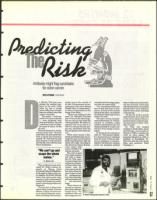
test recognizes is as- Dr. Martin Tobi patented Adnab-9 in 1993.
tests to determine if this bind-
ing has occurred. If the tests
come back positive, the patient
should receive more extensive
tests for colon cancer, including
a colonoscopy. –
"So far, the work is purely
experimental, but I hope that
in the not too distant future, a
practical test to screen the gen-
eral population will be avail-
able," he said.
Dr. Tobi, who studied
medicine in South Africa, Israel
and Chicago, was brought to
Detroit in 1989 to continue his
work on colon cancer. He
patented Adnab-9 in 1993. A
resident of Southfield, Dr.
Tobi lives with his wife, Susan
Katz, and newborn, Yosef
Yitzchak.
❑