

From the Tap
D.J. BRADLEY
SPECIAL TO THE JEWISH NEWS
Bartenders
play friend,
therapist and
entertainer
while serving
the suds.
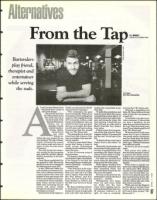
E.D. Baum:
More than mixing drinks.
1 and Lorraine Rimar have
witnessed their corner of
the world change.
The private eyes from
the 10th precinct across
the street who sat at
, the back table of the
Rimars' Detroit bar,
Oscar's, are re-
placed by a lonely
pinball machine.
Frank Kelley,
Gates Brown
and other
Detroit no-
tables who once stopped by are
now shadows. The sale of lottery
tickets, cluttering the counter
with various sizes and colors of
paper, is today the main source
of business.
But even though the commu-
nity outside the bar has gotten
ugly, inside Mr. and Mrs. Rimars'
familiar hospitality is still alive
and well.
Oscar Rimar established the
bar and grill in 1932. His son and
daughter-in-law have maintained
the watering hole since 1975.
In the 1950s and 1960s, Os-
car's, located on Livernois in De-
troit, was a vibrant community
outpost packed with voices and
laughter of men and women who
lived in the neighborhood hous-
es behind the corner establish-
ment. Today, only the sound of
EMS units screeching around
corners and sirens slicing
through the cold silence like shat-
tered glass are heard.
Second-hand smoke lingers as
thickly as memories for the Ri-
mars and their customers.
"The community has gone
down economically. There are no
businesses; there's nothing here
anymore. The neighborhood has
ADC recipients, welfare, crack
houses and oldtimers who are
afraid for their lives and don't
dare go out at night. But there
are still some real hard-working
homeowners that live around
here, too," Mr. Rimar said.
The atmosphere is much dif-
ferent from that of many of the
bars and singles clubs populat-
ing the suburbs.
At Oscar's, music doesn't blare;
people don't dance or come in
rowdy groups. Entertaining
sideshows and collections of tips
aren't the focus.
In fact, it's not even a way of
doing business.
But despite a dwindling clien-
tele and lack of glitz, the attitude
of the Rimars is one that has
been passed along to another gen-
eration of barkeeps — at least the
successful ones.
"Your first job is to be a gra-
cious host, to look after people.
Then your next job is to make
them a regular, make them feel
like they belong," said E.D.
Baum, who has worked at the
Soup Kitchen in Detroit and
the Red Coat Tavern in Royal
Oak.
Mr. Baum said being a friend-
ly drinkmaker is not only ex-
pected, it's a must to make ends
meet. Like other wait staff, bar-
tenders rely on gratuities to pay
their bills.
To build client satisfaction and
keep the tip jar filled often means
remembering at least eight to 10
alcoholic potions that make heads
spin and stomachs churn the
next morning. A hawk-like eye
that will spot an order amid a
Mardi Gras-like fury doesn't
hurt, either.
If these traits don't impress,
and all else fails, then Mr. Baum
suggests writing "15 percent will
pay the rent" on the back of the
bill.
"It doesn't always work, but it
doesn't hurt to ask either," he
said.
Historically, the bartender was
the inventor of witty quips or oth-
er forms of entertainment. But
according to Mr. Baum, the pop-
ularity of dance clubs is chang-
ing this aspect of barkeeping.
Yet there are moments and
places when the bartender re-
turns as the life of the party.
While taking a breather from
the dance floor, customers turn
their perspiring brows and
parched throats toward the one
who pours the drinks.
For some, at this point the role
of bartender is fused with that of
showman — carefully.
"Management isn't happy
when you spill booze doing
bar tricks, but the time
comes when juggling lemons,
making flaming drinks that bum
off customer eyebrows is all
right. As long as everybody
is having fun," Mr. Baum said.
Although a magnificent act
helps, Mr. Baum believes the best
asset a bartender can possess is
a quick wit.
"A bartender can tease or pro-
voke a customer. It shows that
you have a backbone. At the
same time, you have to know how
far to go. There have been many
times I have talked myself out of
a tip," Mr. Baum said.
He has learned through expe-
rience how to spot a customer
who merely wants a chardonnay
and the check from the three-
martini socialite looking to be lav-
ished upon. Different customers
have different needs.
At Oscar's, it's not so compli-
cated.
Each person who walks in
from the back entrance is warm-
ly greeted like family and in-
cluded in any conversation Mr.
and Mrs. Rimar might be having
between themselves or with their
"guests."
Willie Dale is a regular cus-
tomer and a friend of the Rimars.
He appreciates Mrs. Rimar's
memory of every number combi-
nation that he and other cus-
tomers have played since they
first started buying tickets. Mr.
Dale also appreciates how Mr.
and Mrs. Rimar take care of his
daily lottery purchase.
"Willie once won the thing but
lost the ticket, so we keep it here
for him. Besides, when he wins
he'll cash it here anyway," Mr.
Rimar said. ❑