

Community Views
Editor's Notebook
Does Popular Education
Mean Real Learning?
Credit For Reason,
Not Extremism
SIDNEY BOLKOSKY SPECIAL TO THE JEWISH NEWS
PHIL JACOBS EDITOR
As he cut the
hair of an imag-
inary customer,
Abraham Bom-
ba, a barber,
spoke, respond-
ing to questions
from Calude
Lanzmann who
s' had asked him to
demonstrate the hair cutting
technique used in the gas cham-
ber at Treblinka. The scene be-
came the icon for the marathon
film Shoah.
Mr. Bomba wept, telling of
the heart-rending, ruacabre
parting of friend from his fami-
ly inside that gas chamber. Mr.
a special solicitude. Such solic-
itude has become increasingly
problematic as Holocaust his-
tory and education seem des-
tined to be conveyed not
through scholarly works but
through the arts and mass me-
dia: film, museums, literature,
theater, television.
The two most recent and ob-
vious examples of this phenom-
enon are the U.S. Holocaust
Memorial Museum and Steven
Spielberg's intensely moving
film Schindler's List. Given my
premise about exploitation,
what do we do with such mas-
sive and popular appearances
as these?
taneity with camera techniques,
the portrayal of graphic vio-
lence, etc.
The film omits the stories of
those who spent brief times in
the factory and who were not
among those fortunate enough
to be chosen for the factory at
Brinnlitz. Many of them did not
survive; they were sent to var-
ious labor or death camps. Some
have come forth still praising
Mr. Schindler for having pro-
tected them for a few months, a
year, gaining them strength to
endure what followed. Their his-
tories, however, will remain if
not unknown, then surely not
as dramatized or popular as the
It's difficult in De-
troit to under-
stand the pain
felt on all sides in
1 the Middle East.
Nobody wants
anyone to die or
, Ali
-
get wounded, es-
es-
pecially
'all child
children.
'
Isn't it sad that a
Lebanese child had to die re-
cently? But isn't it also sad that
two Israeli soldiers' lives were
snuffed out in a roadside bomb
explosion? Isn't it horrible that
Palestinian terrorists attacked
a busload of civilian settlers?
It always is maddening when
this guerrilla group or that ter-
rorist organization claims "re-
sponsibility" for killing an Israeli
civilian or soldier. Wouldn't we
all be better off if these groups
also took their share of the "re-
sponsibility" for the tragic death
of the South Lebanese school-
child?
Once again we seem to be
dealing with different standards.
By now, almost the entire Jew-
!
I
Photo By FINS/Reuters
Reason must
be our strength.
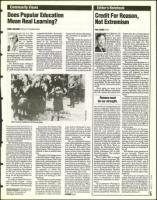
Nazis round up inhabitants of the Warsaw ghetto.
Lanzmann had forced him to
reveal long-buried emotions, to
retell the story of the most dev-
astating moments of his life.
Audiences watched and listened
horrified and wept with the bar-
ber who incidentally became a
Holocaust celebrity.
Mr. Bomba's story riveted au-
diences and bore deep into the
essential meanings of loss that
the Holocaust must convey. Few
scenes in documentary history
match the power of that one. Yet
Mr. Lanzmann had forced him
to open his innermost sensibil-
ities, to bare to the world what
he had refused to speak to that
point. He spoke to the camera,
pantomiming cutting hair, a
staged scenario as a backdrop
for true narrative; the witness
as film star and the director —
for all his commendable mo-
tives, for all the successful re-
sults — as exploiter.
In order to maintain the in-
tegrity of the victims — those
who survived and those who did
not— Holocaust work demands
Sidney Bolkosky is professor of
history at University of
Michigan-Dearborn.
In one year, the history of the
Holocaust has been handed over
to Hollywood and to Washing-
ton. Despite my admiration for
and support of both the muse-
um and the film, it strikes me
as somewhat worrisome that
two cities which should evoke a
natural suspicion and skepti-
cism have now become the cen-
ters of leadership in Holocaust
related issues. This must be con-
sidered at best a mixed bless-
ing.
Schindler's List raises sever-
al considerations which span a
wide range of issues. First of all,
this is not a documentary. Mr.
Spielberg's feature film is part
historical docudrama and part
fiction. The penultimate scene,
for example, in which Mr.
Schindler weeps over those he
did not save, does not appear in
the book and belongs to Mr.
Spielberg.
So the movie must be judged
as a movie: We are obliged to ap-
ply aesthetic criticism, raise
questions about composition,
the decision to use black and
white with selectively dramat-
ic insertions of color, the attempt
to capture a sense of simul-
ones told in Schindler's List.
Part of the criticism leveled
against the movie has to do with
such omissions and the corre-
sponding focus on a non-Jewish
hero, especially of Mr.
Schindler's character.
Yet, as a historical movie,
a film which attempts to portray
what life in Krakow and Plas-
zow was like, Schindler's List
goes beyond what other Holo-
caust movies have achieved.
Not only is the violence graph-
ic, Mr. Spielberg was relentless
and uncompromising in his pur-
suit of the consequences that fol-
lowed the acts of violence. And
the violence is terrifying — no
antiseptic shooting and killing;
people are blown apart, blood
spurts forth, flows, as survivors
have described, like rivers.
More terrifying, however, is
the apparently utter random-
ness of the violence. Perhaps
this is best embodied in Goeth's
nonchalant shooting of prison-
ers from his villa balcony. What
Mr. Spielberg does with such
scenes, it seems to me, is estab-
lish both the horrifying speci-
ficity and the indiscriminate
LEARNING page 8
ish world has apologized for the
Hebron massacre. Israeli Prime
Minister Yitzhak Rabin even
telephoned PLO Chairman Yas-
sir Arafat. Yet, reciprocal phone
calls were never made for any of
the nearly 40 Israelis killed since
the signing of the peace treaty.
In the meantime, hundreds of
Palestinian political prisoners
have been released, Israeli set-
tlers have all but been con-
demned, and soldiers, more
appropriately citizen-soldiers
(since almost everyone in Israel
serves), are targets for unbridled
savagery. Still, we wait for the
release of at least four Israeli ser-
vicemen missing in action and
hopefully still alive. Most re-
cently, six Palestinians were
killed by Israeli soldiers. Pales-
tinian witnesses call it cold-
blooded murder. The soldiers
claim self-defense.
Who is right? Who is wrong?
Where is reason anymore? Ex-
tremists have brought the Mid-
dle East strife into the lives and
the homes of seemingly every-
one, both Israeli and Arab. And
when Shiite-backed Muslim
guerrillas kill Israeli sons and
daughters, then nobody is inno-
cent anymore. Their outrage
when a schoolchild is killed
should be redirected at them-
selves.
Yes, it's tiresome. We'd like to
think that in the so-called "real
world" Israel and its Arab neigh-
bors could settle all of their dif-
ferences peacefully. We'd like to
believe that the overall regional
opinion is one of hope for peace.
But it's the extremists who have
run out of reason, who are win-
ning this war right now. The
price for their statements, for
their cause: children, be they Is-
raeli, Palestinian, Lebanese.
For the extremists who don't
want to see a peace happen, the
death of a child, the maming of
a pregnant woman are all small
prices. If there's reason, it's got
to be reciprocated.
The peace process goes on. A
Palestinian police force is even
in the works for Hebron. But
somewhere along the way, it just
feels as if something even more
tragic will happen to derail
something that could be so fa-
vorable for this region.
During the intifada, the Pales-
tinians were often accused of
shooting themselves in the figu-
rative foot because of the con-
stant infighting and deadly
divisiveness they showed the
world. Hopefully, they won't be
shooting the peace process in the
heart.
Despite the best of intentions
for peace, it seems the trend is
to more violence, more sadness.
Indeed, the stress of violence in
Israel is being felt even at home,
here in Detroit. Ask your Jewish
friends the next time you are to-
gether for a Shabbat dinner, a
Temple function or even a night
at the movies if they worry about
security here. The answer is
more and more "yes." Next, ask
your Jewish friends if they have
a gun in the house. You might or
might not be floored by the an-
swer you get.
On September 13, the com-
munity here was by and large
vocal and joyful over the peace
process. Now, the process is los-
ing steam, and with it goes the
hope. There are plenty of those
among us who are ready with
their "we told you so's." The tide
of opinion seems to be changing
in favor of peace not working af-
ter all.
But reason must continue to
be our strength. There's too
much to consider not to give
more talks, more discussion with
our enemies top priority. If we
don't stay at the table, and if
they don't, this chance will be
hard pressed to ever come again.
This would be an act of terror-
ism that we must not allow
Hezbollah or anyone else to take
credit for.
Terrorists can be beaten by
bullets. But they can also lose to
words, to overtures to honest de-
sires and dreams of differing peo-
ples who work to come together.
The biggest dream is that the
children will benefit from these
dreams and goals, instead of be-
coming the victims. ❑