

Washington Conference Draws 90 From Detroit
RUTH UTTMANN STAFF WRITER
A
mid the frenzy of White-
water investigations and
health care reform legis-
lation, 2,600 Jewish
young adults converged on
Capitol Hill last week for the
ninth Young Leadership Con-
ference.
The three-day event, which
drew 90 Detroiters between the
ages of 22 and 45, introduced
participants to senators and
representatives in Washington,
D.C.
"The conference is a multi-
purpose event," said Kathy
Wilson-Fink, who co-chaired
the Detroit delegation with
Robert Orley. "People were
made to feel as though they
were intimately connected to
their legislators. They were em-
powered to make a difference
when they returned to their
local communities."
The Young Leadership Cab-
inet — a branch of the United
Jewish Appeal — sponsors the
event biennially. This year,
Jewish leaders from 38 states,
Israel, Canada and South
America coordinated seminars,
social events and meetings with
government officials.
locally, where
On Sunday, March 20, after
they learned
a Saturday night tour of the
advocacy and
new Holocaust Museum, par-
lobbying skills.
ticipants attended a series of
Before meet-
speeches dealing with contro-
ing with mem-
versial topics, including the
bers of
Middle East peace process and
Congress, par-
foreign aid to Israel.
ticipants re-
Lisa Leib, 24, of Birming-
ceived their
ham, said the conference was a
legislators' vot-
motivating experience. Ms.
Leib's delegation met with Rep.
Fred Upton, R-Mich., whom
they encouraged to support con-
tinued funding of resettlement
programs for refugees.
"I have not been active in the
Jewish community up until last
summer when I attended the
(UJA) Singles Mission to Israel.
It was the most incredible ex-
perience of my life," she said.
"Going to D.C. added to that
and made me want to be more
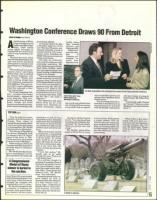
Ron Klein, Kathy Wilson Fink and Stacey Crane prepare for the Young Leadership Conference.
involved than I am now. Going
to functions like these make
pity to voice their opinions and
who has a history of voting for
me feel like I can make a Robert Orley and S. Evan
educate their legislators about
Weiner discuss the
Jewish issues," Ms. Wilson-Fink
difference."
Jewish issues.
Washington conference.
said.
The conference took place
"For us to bring them the in-
"I came back really charged
March 20-22, but for a few
ing records and political histo-
formation is sometimes just as
up," she said. "I think our whole
months prior, Detroiters at-
ries. During half-hour sessions,
important as it is for us to meet
delegation from Detroit felt the
tended preparation classes
young adults had an opportu-
with the friendly congressman
same."
-
❑
TOP GUN page 1
A Congressional
Medal of Honor
winner is buried in
the section.
guns. Some of the more bruised
and battered equipment is cut
up for scrap. Pieces that can be
salvaged are overseen and
maintained by the U.S. Army.
Mr. Saville managed to fmd
a company to transport the
howitzer, which came to Michi-
gan aboard a 48-foot trailer
attached to a truck. It was a
memorable journey. Among the
traffic jams that accompanied
the cannon on its trip was the
one outside Ann Arbor, as the
artillery piece neared its new
home.
When the howitzer arrived
at Machpelah, it was greeted
by a 35-ton crane ready to pull
it off the trailer. Its resting
place would be on an open
space, left empty for years for
just such a monument, adja-
cent to the more than 450
known veterans' graves at the
cemetery.
"I love this section," Mr.
Saville says as he walks
through the area. "There's so
much history here."
It's a cold day, though it's
supposed to be spring. Some of
the tombs are gently covered
with "grave blankets," a layer-
ing of pine cones topped with a
blue ribbon. "Some people feel
better if, well..." Mr. Saville
stops. "You understand."
Among the graves in the vet-
erans section are those of
Raymond Block (the namesake
of a local veterans post), a
Flying Tiger, Congressional
Medal of Honor winner Ray-
mond Zussman, and Arthur
Becker, a four-star colonel from
World War II.
During Col. Becker's funeral
service, "two men played taps
and planes from Selfridge flew
overhead," Mr. Saville recalls.
"Even my ground crew was
crying."
Mr. Saville, whose father
fought in World War II, turns
Photo By Glenn Triest
Then he spoke to a repre-
sentative from the Veterans of
Foreign Wars, where he
learned the government will do-
nate former tanks and cannons
to municipalities. Mr. Saville
liked the idea for Machpelah.
With the city of Ferndale as
its sponsor, Machpelah made
its request to the U.S. Depart-
ment of the Army in 1991.
Three years later, the howitzer
was on its way to Michigan.
Before coming to Detroit, the
howitzer had been housed in a
military depot in Chambers-
burg, Pa.
Mr. Saville describes the de-
pot as something of a car lot,
but populated with tanks and
A tribute to veterans.
to the howitzer. Still painted
a jungle pattern from its
Vietnam days, the cannon has
been rendered harmless: Its
firing pin has been pulled and
its breech sealed. But its pres-
ence, Mr. Saville says, remains
commanding.
"What I like is that when
people walk past here now,
even those who aren't going to
visit the veterans, they will
stop," Mr. Saville says. "People
need to know about these
men.", El