

RUTH LERVIANN STAFF WRITER
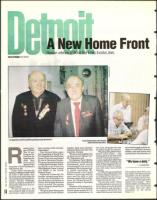
Lev Kuperstein and Pavel Chitrlk fought Nazis during World War II.
ussian veter-
ans of World
War II now
living in De-
troit have not
forgotten the
Jews they
defended
against Nazi
invasions of their homeland a
half century ago.
Today, these veterans are
fighting a different battle. With
an army of 266 people, they
have set out to raise money for
the United Jewish Appeal's Op-
eration Exodus campaign,
which has helped hundreds of
thousands of Russian Jews re-
locate to Israel.
"We feel we must do it. We
have a duty to help our people
and Israel," said Lev Kuper-
stein, secretary of the veterans'
organization.
Over the past three years,
the Committee of World War
Two Veterans From the Former
Soviet Union has contributed
$1,444 to Operation Exodus.
The group has made donations
to other Jewish causes, includ-
ing $3,000 to the B'nai Zion
Haifa Medical Center in Israel
and $6,800 to the Jewish
National Fund.
Organized 13 years ago, the
Russian veterans group start-
ed with only 39 members. As
more Russians immigrated to
Detroit, that number increased
nearly sevenfold. The average
age of a Russian World War II
veteran is 70.
The group plans fishing trips
and celebrates Jewish holidays
Pavel Chitrik watches other Russian
Jewish veterans play chess.
together. Each year, members
celebrate Memorial Day with
American veterans.
"We try to work together, but
we have our own duties, too,"
Mr. Kuperstein said.
For instance, Pavel Chitrik,
an Orthodox Jew whose life was
miraculously saved several
times during the war, serves as
president of the veterans group.
A retired accountant, Mr.
Chitrik moved to the United
States 14 years ago and has
since used his skills to help
Russian emigres fill out their
taxes. He charges $5 and do-
nates the money to Operation
Exodus.
Members of the veterans or-
ganization also help Russian
Jewish emigres prepare for U.S.
citizenship examinations. In
two years, 48 people have tak-
en classes taught by veterans.
The group also gathers for in-
formal social events — like
chess games at the Oak Park
Jewish Community Center —
or more resplendent affairs like
collective Jewish weddings. For
some of these programs, the vet-
erans group works in conjunc-
tion with other local Jewish
agencies.
In 1989, the group published
Veterans About Themselves: On
the Defeat Of Nazi Germany, a
book profiling members' expe-
riences during the war.
The forward reads: "While
justified attention was given to
the 6 million Jews who perished
in the ghettos and concentra-
tion camps in World War Two
under Nazi tyranny, facts about
the armed struggle and the sac-
rifices of a half million Russian
soldiers, men and women who
contributed to the liberation of
"We have a duty."
— Lev Kuperstein
Jews and non-Jews from a cer-
tain death, had been partially
ignored for over four decades.
"On the Defeat of Nazi Ger-
many opens a fresh page in the
history of our people ... More
Jewish soldiers, including many
volunteers, were represented
per capita than any other
nationality in the Soviet
Union."
❑