

Stretching
For Seder
s the doors are opened for Elijah and the story of oppression is
retold, Jews celebrate their freedom and proclaim, "Next year
in Jerusalem."
Cranky children squirm through hours-long seders while the
homemakers lament about the work in changing dishes and cleaning for
Pesach. By the end of the holiday, most are all too happy to return to a diet
which includes yeast.
Passover, with its bittersweet memories and preparation, remains one of
the holidays most Jews celebrate, regardless of affiliation or level of ob-
servance.
In America, the thoughts of freedom usually turn to our forefathers and
foremothers and brethren in foreign countries. But for some, the ideal is
one considered and prayed for each day.
And for these Jews, with their many and varied reasons, telling the sto-
ry and eating the bread of affliction are perhaps even more significant —
even when freedom seems impossible.
LESLEY PEARL STAFF WRITER
B
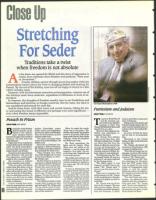
Tom Tannis: Missed seder as a POW.
Patriotism and Judaism
LESLEY PEARL STAFF WRITER
T tu
Pesach In Prison
eyond the metal detector
and the guards, up the
stairs to the "mezza-
nine," Jackson Prison's
Central Complex, the sounds of
"Dayenu" will echo down the
tiled hallways.
Rabbi Alan Ponn of Jackson's
Temple Beth Israel will lead the
seder. The Beth Israel Sister-
hood provides the meal for in-
mates, family and friends.
Dressed in state-issued blues,
John Sherbine will read the
Four Questions, traditionally
asked by the youngest child.
His conversion to Judaism
will be complete next month.
They use paper and plastic
rather than fine china; wine is
replaced with grape juice. The
seder will be held on April 3 this
year, the last day of the holiday,
due to scheduling conflicts. In
prison, you don't get to make
many decisions as to how and
when to celebrate.
A fund, created from dona-
tions by congregations, inmates
and families, assures the men
packages filled with matzah,
macaroons and other Passover
Photo by Marsha Sundq u ist
Traditions take a twist
when freedom is not absolute
staples. Yarmulkes, prayer
books, tallitot and Haggadahs
are frayed, often mismatched.
They are all donations, and the
inmates need more.
"I'm used to not being where
I want to be on the holidays," Ed
Holden said.
Born into an Orthodox Jew-
ish family in 1930 in Germany,
Mr. Holden remembers sedarim
that included the whole town.
"That changed. Our whole
way of life changed. So we came
to the United States in 1941,"
Mr. Holden said.
His first Passover in America
was spent on Liberty Island, not
yet released from quarantine.
Twenty-four years in the mili-
tary almost guaranteed Mr.
Holden wouldn't speak with his
loved ones of bitter herbs or
plagues. The last 23 years, Mr.
Holden has celebrated Passover
behind bars.
"I'm still free to think, to feel,
to enjoy faith. It keeps me alive
and motivated," Mr. Holden said.
"For me, this is a time of renew-
al, it helps me continue another
year of this existence."
When he reads the words,
"Next year in Jerusalem," Mr.
Holden will ponder his possible
parole in 21 months. With those
same words Harvey Hollo thinks
of Miami, where his daughter
and father are living.
Mr. Hollo remembers the
fights and the family. Often
there were two tables at his
sedarim — one for those who
wanted to "do it right," the oth-
er for those who "wanted to get
it over with and eat."
The buffet-style sederim are
all Bill Lovett knows. He con-
verted to Judaism in Jackson a
few years ago. He will never
leave there.
"I have to disassociate the
meaning of Pesach with being in
prison — one is secular, the oth-
er is spiritual," Mr. Lovett said.
"I relish the freedom to exercise
my religion under the circum-
stances. I gain inner strength
from sharing the seder with my
congregation, with my family.
Being able to participate in a
seder is a great achievement for
someone incarcerated."
o survive World War II
and the German cap-
re of his Army infantry
company in 1944, Tom
Tennis left behind all that could
identify him as a Jew.
However, that religious sen-
sibility and upbringing re-
mained in his heart.
Mr. Tannis' first military
seder was in Uma, Ariz., with
400 other enlisted men. ("I think
our blood was thin from the
desert, so after four cups of wine
we were all feeling good".) In
1943 Mr. Tannis found himself
breaking matzah in Belfast, Ire-
land, where he was stationed.
The following year, Mr. Tan-
nis missed Pesach. He was in a
prisoner of war camp, captured
by the German Army.
"We didn't know it was
Passover; we didn't have a cal-
endar," Mr. Tannis said. "I
knew it was that time of year,
though."
There was no matzah in the
field kitchens, but Mr. Tannis
recalls sneaking into a Russian
compound to gather any food he
could find.
Mr. Tannis was one of two
Jews in his company. The men
didn't discuss religion. The oth-
er soldiers protected identities
from the Germans. It didn't
seem a good idea to announce
one's Jewishness.
Being away from family and
friends during holidays like Pe-
sach was the hardest piece of
military life for the drafted Mr.
Tannis.
As a Jew, he feels the Army
did its best to accommodate
him.
Returning to the United
States, he discovered otherwise
of civilian life.
Mr. Tannis shortened his
name from Tikochinski in 1950
to assist in finding work.
"That, like throwing away my
dog tags, saved my life and my
livelihood. People were not hir-
ing Jews," Mr. Tannis said.
Around Passover, Mr. Tan-
nis celebrates his liberation
from the POW camps. Each
year, he makes his way to the
pulpit of Congregation Beth
Achim to read the weekly
Haftorah portion. In addition,
Mr. Tannis is involved with the
Jewish War Veterans.
"You can't forget your expe-
riences, you appreciate your
freedom and you remember a
little each year," Mr. Tannis
said. "At our war memorial, I
look at the pictures of the Jew-
ish veterans now gone. I work
all the harder for-them."