

Keep Informe
Breast cancer
RUTH UTTMANN STAFF WRITER
symposium targets women with questions.
f the topic hadn't been so se-
rious, the scene might have
seemed awkward: Fingers
poking at gelatinous breasts
on table tops in Adat
Shalom Synagogue.
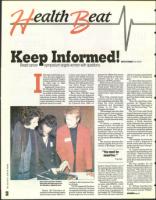
Registered nurses from
the Oncology Nursing Soci-
ety used the synthetic busts
as models to demonstrate
how to detect lumps, possible
indications of cancer. Regular
self-examinations save lives, the
nurses stressed to women who
gathered around to watch.
to learn more about a disease
likely to kill 46,000 American
women this year. Organized by
the National Council of Jewish
Women, the "Informative Sem-
inar About Breast Cancer"
aimed to update the communi-
ty on cancer research, treat-
ment and prevention.
More than 200,000 cases
of breast cancer are diagnosed
annually in the United States.
The number of cases diagnosed
each year has been increasing
by 2 percent since 1980, ac-
going to be affected by breast
cancer personally or will know
someone who is," said Ann
Zousmer, NCJW president.
Some women at the seminar,
had firsthand experience with
breast cancer. Others said they
attended because breast cancer
runs in their families and they
want to know ways of prevent-
ing it.
Fran Cook, a breast-cancer
survivor, served on the semi-
nar's organizing committee. She
hopes the event promoted
awareness and encouraged
women to be their own
strongest advocates.
`The message was clear that
women need to take responsi-
bility," Ms. Cook said. "When
you are diagnosed with breast
cancer, you get educated really
quickly.
"If there's a message to
women it's this: You must be
assertive. You must ask your
doctor questions. Don't get in-
timidated. This is your body.
Don't take `no' for an answer. A
women has a right to say, 'Doc-
tor, let me see that medical re-
port."
The seminar featured five
medical experts from the Uni-
versity of Michigan Compre-
"You must be
assertive."
Fran Cook
C/3
LLJ
(1)
LLI
w
LLJ
38
Nancy Glass and Karen Jacobson
learn about self breast exams from
Ann Dennehy, a registered nurse.
Nearly 180 Detroiters at-
tended an informational session
about breast cancer March 11
cording to the American Can-
cer Society.
"NCJW organized Sunday's
seminar in large part because
our agenda has always revolved
around women and families.
Every single one of us is either
hensive Cancer Center, one of
the cosponsoring organizations.
Dr. Max Wicha presented an
overview on the issue: "The in-
cidence of breast cancer is in-
creasing, but the good news is
that most women who are di-
agnosed will be cured."
Scientists have located a can-
cer gene, called BRCAI, which
is thought to increase a
woman's chance of developing
a certain type of malignancy in
her breasts. Dr. Wicha believes
that within this year scientists
will have created a special blood
test to detect the dangerous
gene.
Dr. Cheryl Rock discussed di-
etary factors that contribute to
good health and seem to lessen
chances of developing cancer. A
total of five servings of fruits
and vegetables is optimal, she
said. These days, nutritionists
place more emphasis on eating
good food than totally steering
clear of fat.
"Have the salad first, then
consider the Haagen-Daaz.
Now experts say 'Have more of
this,' not 'Don't eat that,' " Dr.
Rock said.
Drs. Lori Pierce and David
August discussed surgical and
radiation therapies for breast
cancer patients. Although taint-
ed with news of falsified infor-
mation, a North American
study indicates that patients
who had mastectomies (re-
moval of the entire breast) fared
no better or worse than patients
who received radiation therapy
and lumpectomies (removal of
the cancerous part of the
breast).
"The message we need to get
across is that a diagnosis of
breast cancer does not neces-
sarily mean the loss of a breast,"
Dr. Pierce said.
Dr. August emphasized the
importance of researching one's
own illness. "Take time to hear
about the options and then
make some very informed deci-
sions about what must be done,"
he said.
The last speaker, Dr. Ed
Wilkins, offered information on
breast reconstruction after mas-
tectomies. "We used to worry
about reconstruction interfer-
ing with the treatment of the
disease or a later diagnosis.
We've now determined that
breast reconstruction does not
confuse either of these issues,"
he said.
Dr. Wilkins described two
types of breast reconstruction:
the implant and the "TRAM."
INFORMED page 40