

M
."
! 1%...:WWftifitilNSIMIEtataIESIWAIMti.MttERIIIIPSFMNWAIS:e,3NLTMZfgr:=L..IJSSPJBEZZIMr"Sttiflk inIESSINEREI
7VANOIN
Mitzvah
Visits
Do-gooders help
the sick and
elderly feel better.
PHYWS MEER SPECIAL TO THE JEWISH NEWS
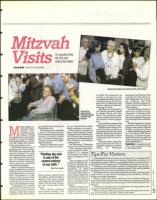
Borman Hall residents enjoy visits from Beth Jacob students.
Sylvia Ascher
enjoys a private
musical presentation
from Beth Jacob
students.
M
iriam Seagle, a lo-
cal social worker,
recently recov-
ered from major
surgery. During
her hospital stay, close family
members were at her bedside.
Friends dropped by to wish her
well. Ms. Seagle felt wonder-
ful knowing people cared.
Visiting the sick is an act of
kindness, the Torah teaches.
The Torah first mentions this
mitzvah in Genesis 18:1, when
God visited Abraham while he
was recovering from circumci-
sion. The Talmud states that
there is no limit to visiting the
sick, so long as the visitor does
not burden the patient.
Rabbi Leonard Perlstein, di-
rector of pastoral care at Sinai
Hospital, says good visitors ex-
press total concern for the pa-
tient. Compassion is a key
element of the mitzvah. Well-
wishers should attend to the pa-
tient's physical, as well as emo-
tional and psychological needs.
"(Compassion) is a complete
empathy that comes from un-
derstanding people and their
feelings, not just their medical
problems," write Chana Shof-
nas and Bat Tova Zwebner in
The Healing Visit.
The book goes on to state that
a show of compassion for pa-
tients becomes a prayer for their
recovery. In the metro Detroit
area, Jews have formed sever-
al groups aimed at accomplish-
ing this mitzvah.
Nearly 50 Orthodox women
are active in Ahavas Chesed-
"Visiting the sick
is one of the
central mitzvot
of our faith."
Rabbi Paul Yedwab
Bikur Cholim, a group led by
Pearl Biber and Sonia Ribiat.
Members take turns visiting
area hospitals and nursing fa-
cilities. They also drop in on peo-
ple who cannot leave their
homes.
Bikur Cholim volunteers
keep patients company, read
their mail aloud and keep an
our faith." As a clergyman, he
extends a listening ear and
sympathetic shoulder to the ail-
ing and bereaved. During hos-
pital visits, he kibbutzes with
patients, discusses philosophy
and prays for them.
His efforts are reinforced by
the "Hands" committee, chaired
by Russel Barett and June
Kamil. The committee makes
trips to comfort, cheer and as-
sist members of the congrega-
tion.
Local Jewish youngsters also
participate in "mitzvah visits."
Students often choose to en-
tertain the sick and elderly as
preparation for their bar or bat
mitzvah. Hebrew day schools in
the area include bikur cholim
(visiting the sick) in their cir-
ricula.
The Sally Allan Alexander
Beth Jacob School for Girls co-
ordinates a program to visit res-
idents of Federation
Apartments and Borman Hall
nursing home. The senior stu-
dent leaders this year are Ser-
ena Friedman and Ettie
Nachlas. The girls schedule vol-
unteer drivers and visitors to
these facilities.
Carol Rosenberg, director of
community relations and de-
velopment at Borman Hall,
trains the young volunteers,
who shine residents' shoes, pol-
ish their fingernails, comb their
hair.
"Besides helping our elderly
population with nice deeds, the
young women share religious
holidays, rituals and customs
— things that both generations
have in common," Ms. Rosen-
berg says. "It makes the resi-
dents feel that they are still part
of the community, that they are
still remembered." LI
Phyllis Meer is a registered pedi-
atric nurse practitioner living
in West Bloomfield.
eye on sick individuals while
family members run errands.
Most recently, members of
Bikur Cholim started a kosher
food pantry at Providence Hos-
pital. Kosher food is available
to patients and their families in
the emergency and surgical
waiting rooms.
Ms. Ribiat says, "Volunteers
get more out of it than they give.
"One volunteer was pleas-
antly surprised to find a
resident of a nursing
home speak in her native
tongue, Hungarian," she
* Although the Torah tells Jews to visit the sick, it is important that
says.
Area synagogues and well-wishers do not overstay their welcome. People who are ailing or re-
temples coordinate sim- cuperating tire easily. Deliver your greetings warmly and sincerely, but
ilar groups. Recently, Ali- don't linger in the hospital room. This defeats the purpose of your visit.
* Unless you are a close family member, it is best not to visit a sick per-
cia Nelson, adviser to the
sisterhood of Beth son immediately after he or she undergoes surgery. Wait until the patient
Shalom, founded Yadanu feels better and is more apt to appreciate your company.
* Sending flowers is a nice get-well gesture, but many patients are al-
(our hands). This organi-
zation assists clergy and lergic to them. You'd be better off sending cards and balloons. Healthy
helps family members of snacks are another alternative.
* Help can take many forms. Adults can lend a hand by cutting pa-
the sick during stressful
tients' fingernails, making phone calls, shopping, accompanying patients
times. Local sisterhoods
also provide help to new to the doctor, cleaning house, babysitting, as well as delivering and read-
ing mail.
mothers.
* Children can help the sick by sending cards, drawing pictures, mak-
Rabbi Paul Yedwab of
ing tapes and performing puppet shows.
Temple Israel describes
* There are many other ways to perform acts of lovingkindness for the
visiting the sick as "one
of the central mitzvot of sick. For information, call Bikur Cholim at 967-3606.
Tips For Visitors