

•
.0,0;•!>.•
, R•••
Visi!Wkw
• " '
M^:"
0).›.).:;,ig. 7 . .*.;,,,•• • •
040M.
:`.•;:•• ••••••
• • ••
.
•
• •
•
01111211Ntx
Th
":4VAPV:AMP
4.‘,0,40,'
04
43:':W.0R:ON*1044M%.
other spokesmen to disassoci-
ate the settlement movement
from the fanatic fringe are be-
ing read as too little, too late.
Part of their problem is that
fanatics from Kiryat Arba were
the first to reach the media and
tell the world that "What Dr.
Goldstein did was a great mitz-
vah," as Nahum Gous put it,
and that "he gave us a wonder-
ful gift for Purim," in the words
of Arye Bar-Yosef.
Still, even those who see
themselves as "moderate" and
"normal" have conveyed a less-
than-convincing message about
their plight, rights, and view.
r
• ....k.':::•••••
Mi20.0:WAvat
•, •
, •
\
•
••
•
•
"‘N
,
"
Naiaa;',44”1 ,
"
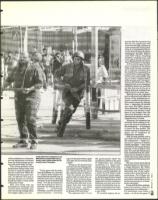
Jewish settlers fire at Palestinians on me
West Bank as an Israeli soldier runs by.
Sunday, Israel's Cabinet ordered the dis-
arming of some of the settlers.
"I don't agree with the defin-
ition of Goldstein as a murder-
er," a Kiryat Arba resident who
would identify herself only as
Yehudit came out in a freezing
downpour to tell journalists this
week. "It's the government's
fault for making our lives in-
tolerable, for choking this set-
tlement — economically,
culturally, and from the stand-
point of security — and bring-
ing us to the point where a good
man goes out and commits such
a deed."
"People in the government
and the Left are making polit-
ical capital out of Dr. Goldstein's
act," echoed Orit Stock, one of
the original settlers in Hebron.
"One can almost say they're
glad he did it so that they can
achieve their political goals.
They're exploiting the fact that
blood has been shed and, to my
regret, they may want more
blood to be shed — my blood
and the blood of my children —
by freeing 1,000 terrorists."
The argument that "it's all
the government's fault" for
pushing the settlers to the point
of desperation has become
something of a "party line"
among spokesmen of the Coun-
cil of Jewish Settlements, Gush
Emunim, and the opposition as
a whole. But if it doesn't wash
well among the Israeli majori-
ty, that's because it's been heard
before, from Palestinians, as the
explanation for the murderous
stabbings and other acts of ter-
rorism committed by lone as-
sailants (especially from Gaza,
where desperation has become
a way of life).
To a similar degree, the ar-
gument that the massacre was
the act of a single man who
went over the edge, whereas an
entire community is being taint-
ed by it, is countered by the re-
cently shown footage of settlers
rampaging through Hebron
(and other cities), smashing
windows, trashing cars, and
even calmly aiming and shoot-
ing at Palestinians in the street.
A few months ago, Zvi Kat-
zover, chairman of the Kiryat
Arba Local Council, comment-
ed on national television that
he wouldn't be surprised if, as
a result of the continuing Pales-
tinian terror, some settler who
can no longer "contain himself'
picks up a gun and "cuts down"
dozens of Palestinians. What
appeared then as an outrageous
prediction seems now more like
an idea that was in the air in
Kiryat Arba just waiting for an
opportunity to be acted upon.
Exactly how the massacre
and its aftermath will affect the
future of the settlements re-
mains a matter of speculation.
But certain trends are already
clear — beginning 19 months
ago when the Rabin govern-
ment declared a "new order of
priorities" and decided to shift
most of the budget that the
Likud had allocated to the set-
tlements into education and the
infrastructure in Israel.
Moreover, the massacre has
certainly done nothing to im-
prove the security situation for
the settlements — or anywhere
in Israel, for that matter. The
entire country is braced for a
major act of vengeance by
Palestinian extremists.
Still, the real question now is
less what will be the future of
the settlements — which con-
tain just 2-3 percent of Israel's
Jewish population — than what
will become of the peace process
because of the problem they
pose. For years the Palestinians
have contended that the settle-
ments are an obstacle to peace,
while Israel has either denied
or postponed addressing that
claim.
But now events have placed
the government on the horns of
a tough dilemma. Mr. Rabin
has reiterated his resolve not to
dismantle any of the settle-
ments and to move forward to-
ward peace. Yet if those two a,
aims prove incompatible, the
course that will be taken by the
present government, at least,
seems inevitable.
It may stall for time, perhaps, cc
.<
jockey for position, strive for
compromise, but ultimately —
if it absolutely must make a r5
choice — it will opt tbr peace. El
a